
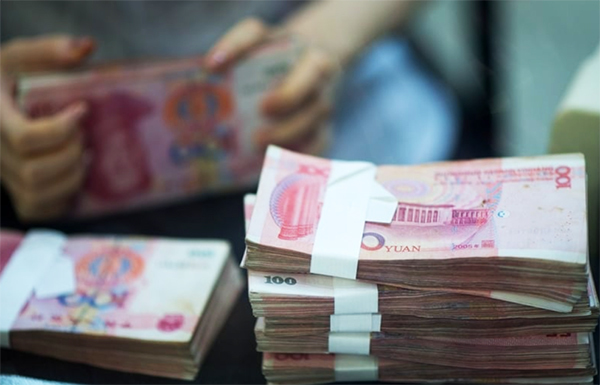
Photo Caption: As the CCP's local government finances grow increasingly strained, governments across China are finding new ways to extract money from the public. (Getty Images)
[People News] On June 19, 2026, Xinhua News Agency published an article titled "Three Major Transformations: An Unprecedented and Profound Social Change," which strongly endorses the socialist transformation movement of the Chinese Communist Party (CCP) in the 1950s, particularly the "public-private partnership" in capitalist industry and commerce, calling for its revival.
The article directly quotes a statement from Xi Jinping, defining this historical process as the establishment of the fundamental socialist system and a significant transition from revolution to construction, while stressing that it provides "solid institutional support and valuable experience" for today's "Chinese-style modernization." By utilizing the narrative of party history, the article conveys a powerful political message. Amid the current economic downturn, the CCP seeks to reinforce the legitimacy of state control over production resources and the economy by framing the socialist transformation movement of the 1950s, thus providing historical justification for the already initiated and forthcoming intensified "Legalized Robbery 2.0."
While the Xinhua article may seem like a casual reflection on history and policy, it is essentially a public opinion test by the CCP to lay the groundwork for a new wave of public-private partnerships. In the context of fiscal constraints, soaring debt, and a collapsing real estate market, private entrepreneurs are facing systematic political repression and economic deprivation. However, unlike the overt and harsh transformations of the 1950s, the current tactics employed by the CCP are more subtle, more "law-based," more systematic, and more penetrating, yet the objective remains unchanged: to seize private wealth, dismantle private assets, and extract wealth through economic monopolization, thereby achieving social control and political security.
Between 1953 and 1956, Mao Zedong carried out what was termed 'peaceful redemption' for national capitalists during the three major transformations. Initially, the assets of capitalists were assessed and converted, leading to a drastic depreciation of their capital. Subsequently, a promise was made to pay dividends to these capitalists for 20 years, but in reality, only three to four years of dividends were actually disbursed. Many capitalists faced the destruction of their families and lives after their assets were seized by the Communist Party of China. In Shanghai, it was not uncommon for several to ten capitalists to jump to their deaths each day.
A recent article from Xinhua News Agency extols the socialist transformation movement of the Mao era as an 'unprecedentedly profound social change' and celebrates the Xi Jinping era, noting that old factories that once underwent public-private partnerships have now successfully transformed in accordance with the times. This historical linkage, which transcends time and space and is intertwined with ulterior political motives, appears to serve as a political filter for the bloody public-private partnership movement of the Mao Zedong era, while also acting as a rallying call for the common prosperity initiative of the current Xi Jinping era.
By the end of 2025, China's government debt is projected to reach approximately 96 trillion yuan, with national debt comprising 41.23 trillion yuan and local government debt totaling 54.82 trillion yuan. In 2026, the national government debt ceiling is expected to approach 111.74 trillion yuan, reflecting an increase of about 11.89 trillion yuan. The burden of local government hidden debt is substantial, exacerbated by a sharp decline in revenue from land sales due to the real estate market's downturn. Once a cornerstone of the economy, the real estate sector has now transformed into a significant negative asset within China's economic framework. In the first quarter of 2026, the area of newly constructed commercial housing sold dropped by 10.4% compared to the previous year, while sales revenue plummeted by 16.7%. The inventory of unsold commercial properties remains high nationwide, with both stock levels and consumer confidence at a low ebb, resulting in a reduction in household wealth and a dramatic collapse of local 'land finance.'
In recent years, local finances of the Chinese Communist Party (CCP) have been compelled to implement a new round of salary cuts and layoffs due to debt issues. Concurrently, various regions have resorted to every conceivable method to generate revenue, with some even selling off assets, such as a pair of dilapidated mud bricks in Qiqihar that astonishingly sold for 800 million yuan at auction. Others have resorted to imposing harsh fines, such as a 20 yuan penalty for riding a bike after drinking. Local public security forces have been dispatched for distant fishing operations, and private entrepreneurs have found themselves caught in the crossfire. The CCP government's methods of extracting wealth from the populace are strikingly crude, brutal, and unsightly. In 2024, non-tax revenue nationwide surged by 25.4% year-on-year, while tax revenue saw a decline of 3.4%, making confiscated income a crucial lifeline for local finances. Private entrepreneurs are facing intense pressure, navigating a precarious situation. Between April and July 2025, Bi Guangjun, the founder of Shaoxing Jindianzi Textile Company, Liu Wenchao, the chairman of Hangzhou Xizi Elevator, Zeng Yuzhou, the founder of Guangdong Liangjiajv, and Wang Linpeng, the founder of Juran Home, all tragically fell to their deaths under the unbearable strain, echoing the tragic fate of capitalists during the public-private partnership era in 1950s Shanghai.
Over the past 40 years of reform and opening up, the private economy has played a crucial role in propelling the Chinese economy forward, contributing over 50% of tax revenue, over 60% of GDP, over 70% of technological innovation, over 80% of urban employment, and over 90% of the total number of enterprises. However, since Xi Jinping assumed power, there has been a political shift to the left, characterized by a closed-door policy and a return to planned economic practices, promoting public-private partnerships, which has turned the private economy into a target for exploitation. Under the banner of common prosperity, the revival of supply and marketing cooperatives and people's canteens, the reinforcement of resource monopolies, and the intensification of capital extraction have led to the continuous evolution of Xi Jinping's toolbox for legalized robbery 2.0.
Recently, the 'siphoning law enforcement' incident in Biyang, Henan, has gained significant attention online. This incident exemplifies the profit-driven chaos in grassroots law enforcement by local governments, closely resembling the 'distant ocean fishing' phenomenon, and can be considered its sister version. Between July 2025 and January 2026, 21 refrigerated trucks carrying pig feet and chicken feet were intentionally diverted from their southern destinations to the highway exit in Biyang, Henan, where they were seized. The drivers accepted low-priced orders through freight platforms and then deliberately altered their routes to siphon into the local law enforcement jurisdiction, where the relevant local authorities promptly responded to the seizure as per their agreement. Even when cargo owners had all the necessary documentation, they still faced significant economic losses due to delays in inspections and the auctioning of unclaimed goods. The entire incident is underpinned by an illegal industrial chain orchestrated by local government law enforcement agencies, which has become an unspoken method for these governments to enhance their fiscal self-sufficiency, reduce budgetary shortfalls, and achieve a balance between fiscal revenues and expenditures.
The Biyang incident has been described as an industrial chain formed by 'driver cooperation + precise reporting + rapid response', and has drawn criticism as an upgraded version of 'deep-sea fishing'. This incident represents a low-level version of the 'siphon' phenomenon, where the more advanced iteration involves state-owned capital absorbing high-quality assets, cash flow, and control rights from private enterprises into the state-owned system through methods such as mixed ownership reform, debt restructuring, and low-cost equity participation. While it is nominally framed as 'complementary advantages', 'risk resolution', and 'joint development', the reality is that it facilitates the transfer of capital control rights, thereby reinforcing the institutional preference for 'public ownership as the mainstay'. In recent years, several publicly listed private enterprises under debt pressure have been 'rescued' and taken over by state capital, resulting in the dilution of founders' equity and their exit or marginalization. A broader interpretation of siphoning also encompasses the Chinese Communist Party's policies, subsidies, and project allocations favoring state-owned enterprises, while private enterprises consistently face disadvantages in financing, market access, and regulatory environments. Furthermore, the coordinated actions of various local government departments, coupled with selective high-pressure inspections related to environmental protection, safety, and labor, have further escalated compliance costs for private enterprises, compelling them to either transfer equity or reduce capital. Consequently, the influence of private capital has diminished, innovative vitality has been stifled, and the private economy is increasingly diverging from the macroeconomic foundation, leading to a complete decoupling.
An article from Xinhua News Agency describes the public-private partnerships of the Mao era as 'providing solid institutional support and valuable experience for today's Chinese-style modernization efforts.' It claims that this approach 'motivates China to ground itself in its national conditions and move forward.' Reading this evokes a sense of dread and horror; those familiar with that historical period are well aware of the devastation and turmoil that ensued.
In the current era of Xi Jinping, the authorities remain committed to their fundamentalist communist agenda of violence and theft. The party media seeks to glorify the historical wrongs associated with public-private partnerships, framing them as a 'great journey' and 'historic leap,' while neglecting the fate of the nation and the livelihoods of ordinary citizens. In their efforts to deliberately obscure and erase the distinctions of private property rights, they unabashedly promote the supremacy of power, quoting Xi Jinping to align with the leader's personal ambitions and thereby pledging political allegiance. This trajectory is bound to culminate in a new wave of historic disaster for the entire country and its people.
(Originally published by the People News)△






News magazine bootstrap themes!
I like this themes, fast loading and look profesional
Thank you Carlos!
You're welcome!
Please support me with give positive rating!
Yes Sure!