
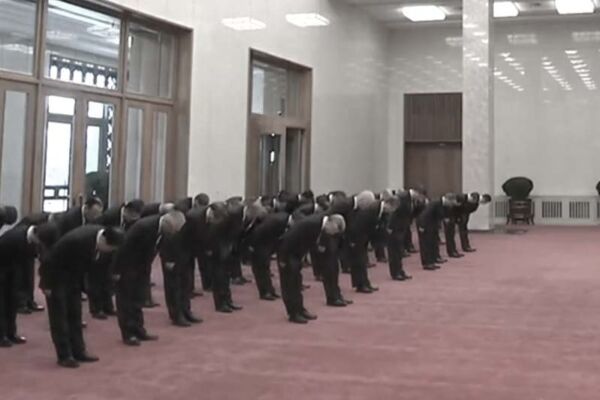
"Paying Respects" Is Actually a Tactic for "Drawing Vital Energy" (Photo: On December 26, 2023, members of the CCP Politburo Standing Committee and senior officials in Beijing bowing to the statue of Mao Zedong. Screenshot from a video.)
[People News] The phrase "borrowing a corpse to resurrect the soul" describes one of the survival tactics the CCP resorts to when facing potential annihilation. Historically, the party has managed to escape disaster multiple times using this method. On August 17, the CCP plans to employ this old tactic again in an attempt to evade its current life-and-death crisis. However, analysts indicate that this time, the CCP is not only unlikely to escape but may very well be at the onset of a significant misfortune.
According to reports from the Central News Agency, Hong Kong media, and various informants, on August 17, the CCP will hold a "Centenary Commemoration of Jiang Zemin's Birth" at the Great Hall of the People in Beijing, mirroring the scale of the centenary commemoration for Deng Xiaoping. Xi Jinping is expected to deliver a speech. All current and former members of the Politburo Standing Committee will be in attendance, along with vice-ministerial and senior military leaders, descendants of veterans, officials from various party, government, and military departments in Beijing, as well as leaders from various democratic parties and representatives of non-party individuals, totaling over 6,000 attendees. The level of extravagance and the high standards of this event are truly astonishing.
The political challenges currently faced by Xi and the CCP are largely a continuation of the issues that began during the Jiang Zemin era. These include rampant corruption within the party, the degradation of national morality and culture, and the subsequent weakening of the economy, political stability, social order, and public sentiment. All of these factors undermine the foundation of the CCP's regime. Consequently, it is likely that Xi Jinping's political anxiety and distress are significantly inherited from Jiang Zemin, and he certainly does not hold a favorable view of Jiang. So why commemorate Jiang with such high standards?
Jiang Zemin came to power by participating in the massacre and suppression of the 'June Fourth' student movement. Once in power, he ruled through corruption, bribing officials, indulging in personal desires, and manipulating elites across various sectors. He formed factions to undermine the Hu-Wen administration and the early Xi central government, while persecuting the principles of Truth, Compassion, and Tolerance, positioning them as adversaries of modern civilization, universal values, and the people's sentiments. It can be said that Jiang's only contribution to China is his death. Commemorating Jiang Zemin is undoubtedly against the wishes of the world and lacks public support.
Analysts suggest that the Xi-led Communist Party seeks to invoke the 'ghost of Jiang' as a means to prolong its survival. Firstly, this may signify an inheritance of the evils of the communist system, aimed at alleviating the anxiety of party officials caused by sixteen years of anti-corruption campaigns. Secondly, it may indicate a continuation of reform and opening up, suggesting that as long as party officials remain loyal, they can continue to quietly accumulate wealth. After all, during Jiang Zemin's decade in power, developed Western nations hoped for reform within the Communist Party, investing heavily in China, which integrated the country into the global economic and technological landscape, providing it with substantial material benefits.
However, the current situation is different. Civilizations around the world and developed countries are increasingly recognizing the Communist Party as a harmful anomaly, and a consensus is forming to contain its hegemonic ambitions: foreign capital is withdrawing, technology decoupling and blockades are being implemented, tariffs are being raised, and military constraints are being enforced... Domestically, the number of citizens who have renounced the Communist Party (the 'Three Withdrawals') has reached 460 million. The anti-corruption campaigns and the eradication of the remnants of 'non-organizational political activities' have left no room for reversal. It is clear to everyone that commemorating Jiang Zemin stands in stark contrast to the strict governance of the party, the elimination of political dissent, and Xi Jinping's new era of thought, which is quite off-putting.
Historically, before the collapse of a dynasty, certain signs are always evident: frequent natural disasters and man-made disasters, rampant corruption, economic collapse, a decline in people's livelihoods, loss of public support, a surge in displaced persons, ongoing domestic and international conflicts (including domestic protests and international economic or cultural wars), continuous power struggles among officials, and brutal officials committing atrocities against the populace. These events and phenomena are currently manifesting in the People's Republic of China.
So why hasn't the Chinese Communist Party (CCP) collapsed yet? One of the reasons lies in an insidious tactic hidden behind its rule of dictatorship, brutality, and deception: the misleading concept of 'governing the people by the people.' This strategy exploits the public's utilitarian desires and employs brainwashing techniques to control the masses through the masses.
For instance, the CCP engages members of the Chinese People's Political Consultative Conference, journalists, community grid workers, internet trolls, and tech company personnel to collect social sentiments and public opinions, provide suggestions, and extend the party's longevity. Additionally, they have set up various community defense and governance organizations across provinces and cities, such as Chaoyang Aunty, Xicheng Uncle, Shanghai Aunty, Wulin Aunty, Old Yang's Community Workers, and Guangzhou Neighborhood Groups. Most of these individuals are not part of the official system and do not enjoy the privileges of party officials. However, feeling a sense of superiority and backed by the party, they can exert influence over others. As a result, even as volunteers, they are willing to serve the party without compensation.
However, the situation has changed. After enduring the COVID-19 pandemic, floods, storms, earthquakes, landslides, and other natural and man-made disasters, as well as experiencing economic collapse and insecurity in their lives, many individuals have faced life-and-death decisions. They now recognize the risks associated with being connected to the Chinese Communist Party (CCP). When those who have devoted themselves to the CCP announce their withdrawal from the party on the 'Three Withdrawals' website, they state: 'I previously did not realize that all disasters were brought about by the CCP's evil cult; now I have awakened...'
Who is Jiang Zemin? He is the infamous figure whose body was transported from Shanghai to Beijing by Xi Jinping's central government to be displayed in sunlight after his death. According to traditional Chinese culture and folklore, at the moment his soul was exposed to sunlight in the transparent coffin, it vanished completely. As his body was cremated, both his spirit and form were entirely destroyed, leaving no remnants of his existence in the world. Regardless of Mao Zedong's flaws, after his body was disemboweled, a half-corpse remained in the tomb in Tiananmen Square for the living to disturb. Thus, during times of crisis, the CCP often seeks to rally party members and officials around Mao's lingering spirit. Jiang Zemin is different, as his ghost has been completely eradicated. Now, if the CCP attempts to summon his spirit, it would be a futile endeavor; without a ghost to invoke, isn't the CCP facing imminent disaster and misfortune?
(First published by People News) △





News magazine bootstrap themes!
I like this themes, fast loading and look profesional
Thank you Carlos!
You're welcome!
Please support me with give positive rating!
Yes Sure!