
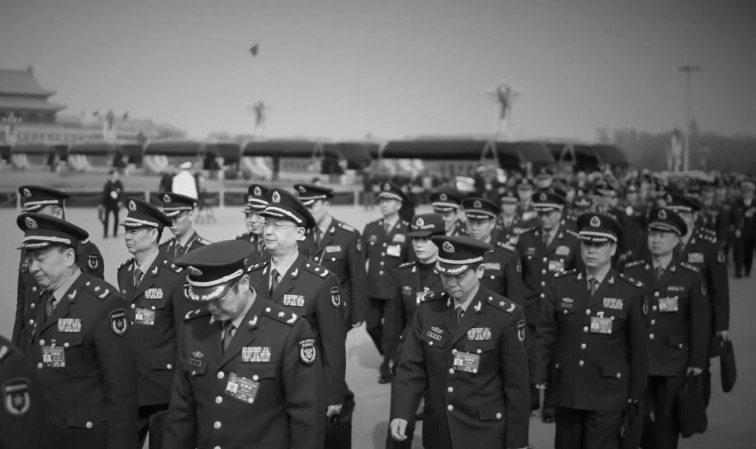
The new prophecy mentions that Xi will face a rebellion from the military and local warlords. The image shows the representatives of the Chinese military attending the Two Sessions in Beijing. (Video screenshot)
[People News] Over the past few days, an unusual development has appeared on the Chinese military website: the name of former Chinese Communist Party leader Mao Zedong has twice shown up in headline news on the homepage. One was a June 10 report titled “Revisiting Comrade Mao Zedong’s ‘Persist in Hard Struggle and Maintain Close Ties with the Masses’,” and the other was a June 12 report titled “The Seventh Party Congress: Inscribing Mao Zedong Thought on the Party’s Banner.”
The first article was written by a military journalist and published the following day on page 12 of the PLA Daily, where its main headline was changed to “Persistently Carry Forward the Party’s Glorious Traditions and Fine Work Style,” while “Revisiting…” became a subtitle. The second article was written by a Xinhua News Agency reporter and appeared on page 3 of the June 13 PLA Daily under the main news section. However, unlike the military website, which placed the article prominently on its homepage, Xinhua handled it more discreetly—it was not featured on the homepage but instead placed under the “Remain True to the Original Aspiration and Keep the Mission Firmly in Mind” section, accessible only after clicking into it.
This is where the first peculiarity lies. Observers of the CCP political scene will know that since the 19th Party Congress, when Xi Jinping began ascending to the peak of power and worked hard to establish his “supreme leader” status—especially after the 20th Party Congress in 2022—the central figure highlighted by Party and military media has been Xi alone. As for his predecessors—Mao, Deng, Jiang, and Hu—their appearances in the media have been rare except under special circumstances. Even when they do appear, having their names in news headlines is exceedingly uncommon, as Xi is pursuing ambitions of surpassing them.
In July 2024, following Xi Jinping's stroke during the Third Plenary Session of the Communist Party of China, numerous signs over the next year suggested a weakening of Xi's authority within both the party and the military, with his media presence fluctuating significantly. It was not until January of this year, when Xi removed Zhang Youxia, the Vice Chairman of the Central Military Commission who was believed to have actual military control, and Liu Zhenli, the Chief of Joint Staff, that coverage of Xi returned to its pre-stroke state.
Nevertheless, the military's passive response to the statements made by Zhang and Liu, the superficial nature of certain key indoctrination campaigns, and the omission of the term 'Chairman Xi' all indicate that Xi does not genuinely command the military. Zhang Shengmin, the Vice Chairman of the Military Commission promoted by Xi and with a political background, struggles to earn the military's respect.
In this context, the military media has twice emphasised Mao Zedong's name in their homepage headlines. What could be the purpose of this?
Additionally, let’s examine the second oddity. The article titled 'Revisiting Mao...' starts by distorting the truth, stating that 'Comrade Mao Zedong has consistently upheld the good tradition and style of hard work and close ties with the masses.' It then references an article written by Mao and explains his motivations. The rationale is that after the Communist Party took power, social tensions remained acute, leading Mao to decisively initiate a rectification movement throughout the party. The article highlights Mao's two 'imperatives' and notes that the spirit of 'serving the people wholeheartedly' is currently lacking within the party, stressing that the military must continue to 'connect with the masses.'
The author notes that although the article was written several decades ago, it "still holds significant relevance today." In the final paragraph, it references Xi Jinping's remarks made on April 8 of this year during the opening ceremony of a training course for senior military officials, where he stated: "Senior officials must take the lead in restoring and promoting our party's and our army's fine traditions, and set aside their official airs..." The conclusion emphasises that senior military officials must "resolutely eliminate the mindset and behaviours of privilege, and consciously position themselves correctly," among other clichés.
The article's writing style prioritises Mao Zedong first, followed by Xi Jinping, with content about Mao comprising 95% of the text. Is there an issue with this?
A comparison can be made with an article titled "Persistently Carrying Forward the Party's Glorious Traditions and Fine Style," published on July 8, 2024, in both the military network and military newspaper. Numerous articles with similar titles appear in official media, and this particular piece was written prior to Xi's incident.
The opening paragraph states that the Chinese Communist Party (CCP) "has cultivated and maintained a complete set of glorious traditions and fine styles through long-term practice," citing examples such as Mao's "a single wick" and Zhu De's shoulder pole, briefly mentioning them before immediately transitioning to Xi Jinping's emphasised statements.
The second paragraph begins with another quote from Xi, discussing how the CCP historically "attached great importance to its own style construction," referencing the Yan'an Rectification Movement and Mao's "two musts," without further elaboration.
The third paragraph continues with a quote from Xi, explaining how he has introduced the Central Eight Regulations, boldly claiming that it has "resolved many long-standing stubborn issues." It further emphasises, with Xi's words, that the CCP must never change its fundamental nature, stating, "if it changes, it changes in quality."
The article from 2024 illustrates the writing style that Xi Jinping should adopt in his role overseeing the military. Recently, the military newspaper has emphasised Mao in the titles of two reports; what does this imply?
The author suggests that this may indicate Xi's current inability to secure the loyalty of the military, forcing him to invoke Mao as a means to suppress military leaders and continue purging the limited number of senior generals. At the same time, the military's emphasis on Mao signals that Xi does not have complete control over the armed forces. Regardless of the underlying reasons, since Xi's removal of Zhang, he appears to still lack command over the military.
(First published by People News) △





News magazine bootstrap themes!
I like this themes, fast loading and look profesional
Thank you Carlos!
You're welcome!
Please support me with give positive rating!
Yes Sure!