
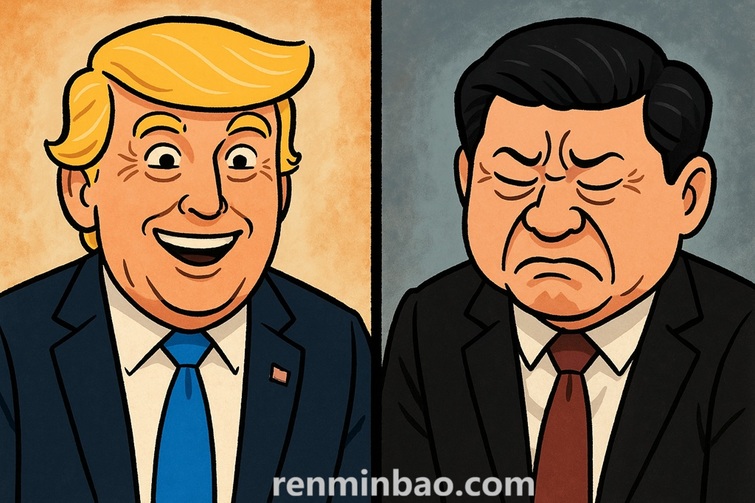
Thinking about taking action against Taiwan? Trump: You are free to think about it, but what are you actually going to do? (People News/AI-generated image)
[People News] On June 30, the Japanese House of Representatives and the House of Councillors publicly released the income report for members of parliament for the year 2025. The report includes 293 members of the House of Representatives and 178 members of the House of Councillors who were in office for the entire year, totaling 471 individuals. Each year, both houses of Japan publish this information based on the assets of their members.
According to the data in this report, Prime Minister Suga Yoshihide, who is deeply despised by the Chinese Communist Party, had an income of 36.41 million yen (approximately 224,900 USD) last year, placing him in 9th position.
The highest income was earned by Nakagawa Kenji, a member of the Liberal Democratic Party, who topped the list with 1.14 billion yen (approximately 700,000 USD). Notably, 90% of his total income last year came from stock sales and dividends.
Two individuals had total incomes exceeding 1 billion yen: Nakagawa Kenji and Tamura Norihisa, another member of the Liberal Democratic Party and former Minister of Health, Labour and Welfare.
Among the 471 members, a total of 6 had total incomes exceeding 100 million yen (approximately over 60,000 USD).
According to statistics from the World Bank, over 150 countries worldwide have established asset declaration systems for public officials. This has become a widely accepted and mature rule of law system. Such laws are commonly referred to internationally as 'Sunshine Laws' or 'Asset Disclosure Rules.'
The Chinese Communist Party (CCP) government, which claims to be 'wholeheartedly serving the people,' has been vocally advocating for 'anti-corruption' for over a decade. However, whenever informed individuals in the country suggest establishing a 'public declaration system for officials' assets' (known as the Sunshine Law), the CCP strongly opposes and suppresses these calls, even arresting and imprisoning those who advocate for it.
In another alarming development, Xi Jinping (Xi Jinping) and senior officials may find themselves sweating after reading a recent report. According to U.S. media on June 26, American intelligence agencies are preparing a public report for Congress that will disclose the wealth of mainland China's President Xi Jinping and several high-ranking Communist Party officials. This report is expected to be released by the end of this year and will represent the second instance of the U.S. publicly revealing the hidden assets of CCP leaders.
It is well known that CCP officials frequently criticize the United States publicly. However, within the CCP's ranks, including the vast majority of representatives at the Two Sessions, the sentiment is that 'anti-Americanism is part of the job, while living in America is a way of life.' Most of their significant assets, along with their mistresses and illegitimate children, are primarily located in Western countries, with the largest share in the United States.
As for the total amount of assets that CCP officials and the elite have transferred overseas, official statistics have never been provided. This is largely because these funds typically flow out through highly secretive means, such as 'white gloves,' offshore shell companies, fraudulent trade, and even cryptocurrencies and other underground channels.
However, assessments from internationally renowned think tanks, anti-money laundering organizations (such as Global Financial Integrity (GFI)), and several top economists who have closely monitored capital outflows from China suggest that this historically accumulated "red asset" is conservatively estimated to be between 2 trillion and 4 trillion US dollars (approximately 140 trillion to 280 trillion RMB).
Around 2019, reports emerged overseas claiming that Jiang Zemin's grandson, Jiang Zhicheng, had personal assets of at least 500 billion US dollars, while the entire Jiang Zemin family was said to control and launder funds and assets overseas totaling around 1 trillion US dollars.
As the third generation of the Jiang family, Jiang Zhicheng has, through intermediaries such as Boyu Capital, exploited privileges to siphon off hundreds of billions or even over a trillion RMB of national assets and transfer them overseas during the two decades of China's economic boom, a fact recognized by the international financial community.
Wall Street analysts and mainstream media outlets like Reuters and The Wall Street Journal have noted that the operational methods of Boyu Capital, founded by Jiang Zhicheng, serve as a textbook example of how the Chinese Communist Party's "princelings" leverage their privileges to accumulate wealth.
In 2002, during the 16th National Congress of the Communist Party of China, the Bank for International Settlements (BIS) uncovered a mysterious fund that had inexplicably flowed out of China, amounting to over 2 billion US dollars, which ultimately ended up in an offshore tax haven in the Caribbean.
According to Liu Jinbao, who was known as the 'big steward of Jiang's residence' and was in charge of the Chinese Communist Party's (CCP) overseas fund allocation, he confessed during his investigation that the $2 billion was personally ordered to be transferred by Jiang Zemin and was ultimately deposited into the Jiang family's account.
This occurred on the eve of Jiang Zemin's resignation as General Secretary, as he prepared to hand over power to Hu Jintao. Although Jiang had arranged for many loyalists from the 'Jiang faction' to enter the Politburo Standing Committee (including Zeng Qinghong, Jia Qinglin, Zhou Yongkang, etc.) to undermine Hu Jintao's authority, he adhered to the principle of 'a cunning rabbit has three burrows.' At this sensitive moment of power transition, transferring such a massive sum of money to a Caribbean tax haven, beyond the jurisdiction of Western law, represented the most rational 'insurance strategy' for the privileged families of the CCP's dictatorial regime.
Shortly after this, $2 billion was uncovered by the Bank for International Settlements, Liu Jinbao was secretly arrested in Shenzhen and taken to Beijing in May 2003. Some analysts suggest that after the Jiang family secured this $2 billion, they took drastic measures against Liu Jinbao to silence him. Reports from Hong Kong's 'Open' magazine and other media at the time indicated that Liu Jinbao revealed extensive confidential details about how the Jiang family utilized the Bank of China (Hong Kong) to transfer state assets to overseas accounts in the Caribbean in a bid to save his life while imprisoned.
The transfer of this $2 billion from China to overseas serves as a historical microcosm of the CCP's third generation leadership collectively 'quietly amassing wealth' while hollowing out the financial resources of China's lower class to transfer them abroad.
If Xi Jinping and the red nouveau riche behind him, along with the families of the red second generation, have concealed hundreds of billions, or even trillions of dollars in private assets in Swiss banks, the Cayman Islands, real estate in Europe and America, and under various 'white glove' names, and this information is publicly disclosed in a 'real-name system, specific' manner to the global community and the Chinese populace, it would represent the greatest fear of the high-ranking officials in Zhongnanhai, serving as an 'ultimate nuclear bomb' that cannot be touched. This would effectively threaten the lives of these officials and could ignite a movement among the Chinese people to rise up and overthrow the corrupt dictatorship of the Chinese Communist Party.
Firstly, this would lead to the ultimate collapse of the 'anti-corruption myth'. Xi Jinping has been in power for over a decade, and the foundation of his political legitimacy rests on his 'iron-fisted anti-corruption campaign, targeting both high-ranking officials and low-level bureaucrats'. If this asset list is made public, the public would be astonished to find that the highest 'wise leader', who constantly urges party members to 'live frugally' and calls for everyone to 'be honest and serve the public', has a family fortune abroad that rivals that of a nation. Such deception, where 'only officials are allowed to set fires while the common people are not allowed to light lamps', would lead to a complete erosion of trust both within and outside the system.
Secondly, the vast wealth of high-ranking officials would starkly contrast with the suffering of the lower classes. In the current context of China's economic downturn, local financial crises, grassroots officials lying flat out of fear of being investigated, and ordinary citizens facing unemployment and pay cuts, this asset list would be like adding fuel to the fire. The striking visual impact of 'the common people are even seeing their medical insurance reduced, while high officials have deposited hundreds of billions in Swiss banks' would transform the long-suppressed grievances of the public into tangible anger against the system for 'plundering the wealth of the people', potentially triggering unpredictable social unrest.
This explains why the Ministry of Foreign Affairs of the Chinese Communist Party (CCP) has consistently dodged questions from foreign media about whether it will implement a public asset declaration system for officials. They have even gone so far as to arrest and imprison domestic dissenters, such as those involved in the New Citizens Movement, who have raised this issue. The CCP is acutely aware that an asset declaration system represents the 'Achilles' heel' of their regime.
If, by the end of this year, the U.S. State Department actually discloses the personal assets of numerous high-ranking CCP officials in the United States, revealing that these officials possess wealth that is thousands of times greater than 'normal salaries,' it would effectively announce to the entire Chinese population that this regime, from top to bottom, is fundamentally a predatory group of a privileged class engaged in 'loot-sharing and harvesting.' Such a revelation would utterly undermine the moral legitimacy that the CCP relies on to sustain its rule. Consequently, the downfall of the CCP would be imminent, and the prophecy that 'the Year of the Red Horse and Red Sheep is the year of the CCP's end' will be fulfilled.
(First published by People News)
△







News magazine bootstrap themes!
I like this themes, fast loading and look profesional
Thank you Carlos!
You're welcome!
Please support me with give positive rating!
Yes Sure!