
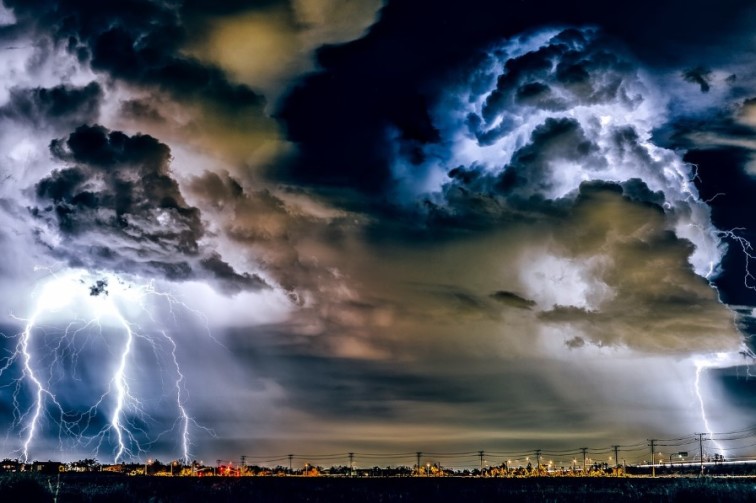
Heavenly signs and phenomena often correspond to the rise and fall of dynasties, the fortunes and misfortunes of the world, and the blessings and disasters of mankind. (pixabay)
[People News] As we reach the halfway point of 2026, it is undeniable that natural and man-made disasters, including heavy rains, extreme heat, hail, earthquakes, and coal mine collapses, continue to plague various regions in China. Recently, areas such as Guangxi, Hubei, and Gansu have been hit by heavy rainfall, resulting in dam failures and landslides. The Chinese Communist Party's (CCP) official media has once again reported these incidents in a subdued manner, even downplaying the number of casualties and the severity of the disasters.
Meanwhile, CCP leader Xi Jinping and Premier Li Qiang have continued to issue directives, urging local authorities to "fully organize rescue efforts, provide medical care for the injured, and facilitate the resettlement of affected populations, in order to minimize casualties and prevent secondary disasters." However, none of them, not even for the sake of appearances, have shown a willingness to visit the disaster sites and witness the harsh realities faced by the victims.
This situation is a stark irony, especially in light of the recent "July 1" concert held in Beijing, titled "People First," where Xi emphasized this principle in his speech. Where is the commitment to putting people first? It seems to be a blatant display of power supremacy. Such directives appear utterly trivial when confronted with the plight of countless citizens who have lost their homes and lives.
Furthermore, given their numerous past directives, it is clear that Xi and Li's instructions will not prevent further disasters. The root cause of this issue lies in their failure to recognize the fundamental reasons behind these calamities. In essence, influenced by the Communist Party's atheistic ideology, they do not believe that these disasters are connected to their own actions.
Ancient Chinese believed that 'heaven manifests signs to indicate fortune and misfortune.' The Confucian scholar Dong Zhongshu from the Western Han Dynasty clearly articulated the theory of 'heavenly-human resonance,' which asserts that heaven is the supreme deity and that there is a connection between heaven and humanity, allowing for mutual resonance. In essence, this means that heaven and humanity are similar and communicate; the rewards and punishments from heaven are contingent upon human actions, whether good or bad. Heaven employs auspicious signs and disasters to convey praise and condemnation to rulers, thereby guiding human activities. Dong also highlighted the cautionary role of disasters, asserting that variations in natural calamities are a result of the errors made by those in power.
Dong Zhongshu posited that different natural disasters correspond to distinct issues, with each disaster reflecting specific political failures, thus requiring tailored remedial actions.
For instance, earthquakes are interpreted as a sign that ministers harbor treacherous intentions, indicating instability in governance; the ruler must engage in self-reflection and cannot rely on distant peace for the safety of the people. The appropriate remedy is to appoint virtuous and upright individuals and to cease causing distress to the populace. Similarly, fires are seen as a consequence of wicked individuals in power, leading to the suffering of the righteous, serving as a warning to the ruler. Floods suggest that the monarch has 'misapplied punishments' or 'listened to slanderous words'...
Ancient dynasties, known as 'Sons of Heaven,' had enlightened rulers who took warnings from above seriously. In addition to self-reflection, they would issue self-criticism edicts, heed heavenly warnings, and implement necessary changes. This tradition persisted until the Qing Dynasty and reflects the ancient rulers' respect for the heavenly order and their commitment to virtuous governance. Here are a few examples of kings who issued self-criticism edicts.
A few years after Emperor Yuan of the Han Dynasty took the throne, a fire broke out at the Baihe Pavilion in the mausoleum of Emperor Wu of Han. Upon hearing the news, Emperor Yuan immediately removed his dragon robe, donned white clothing, and issued the first self-criticism edict in Chinese history, humbly acknowledging that the fire was entirely his fault.
During his reign, Emperor Taizong Li Shimin of the Tang Dynasty issued self-criticism edicts on several occasions. For example, in the second year of the Zhenguan era (628 AD), a severe drought struck Guanzhong, accompanied by a locust plague. In his self-criticism edict, Emperor Taizong expressed: "If the year brings abundant harvests and the world is at peace, I would willingly accept calamities upon myself to protect the nations, and I would do so without hesitation." Essentially, he conveyed that if it could ensure a bountiful harvest and the well-being of the people, he would gladly bear the disasters alone without any reluctance.
In the year he ascended the throne, Emperor Shenzong of the Song Dynasty experienced an earthquake in the capital. He asked his ministers about the cause. One minister responded, "The heavens are torn, the yang is insufficient; the earth is shaking, the yin is excessive. It is feared that this is caused by the misdeeds of petty individuals." Emperor Shenzong agreed wholeheartedly and subsequently issued a self-criticism edict.
On the second day of the ninth month in the twenty-sixth year of the Kangxi reign, an earthquake struck the capital. Following the earthquake, Kangxi promptly gathered all his ministers and stated: "I act according to the edict of the Empress Dowager, and the earthquake is due to my faults. It may be that the punishments for the ministers were too lenient, and I punished them too harshly, or it may be that excessive punishment caused innocent people to suffer, or it may be that the personnel I took for hunting caused hardship, leading to resentment among the people. All of this is my fault. From now on, I will no longer take you, ministers, hunting."
Historically, it has been noted that 15 emperors in the Han Dynasty issued self-reproach edicts. In the Three Kingdoms period, there was one such emperor, Wei Wendi; in the Wu Kingdom, there were two; in the Two Jin Dynasties, there were seven; in the Southern Dynasties, there were fourteen; in the Northern Dynasties, there was one; in the Sui Dynasty, one; in the Tang Dynasty, eight; in the Five Dynasties, six; in the Song Dynasty, seven; in the Liao Dynasty, one; in the Jin Dynasty, one; in the Yuan Dynasty, four; in the Ming Dynasty, three; and in the Qing Dynasty, eight. The reasons for these edicts included not only fires and earthquakes but also military defeats, droughts and floods, solar eclipses, and the simultaneous occurrence of droughts and locusts.
To avoid disasters, the renowned minister Fu Bi during the reign of Emperor Shenzong of Song advised: 'Promote utmost sincerity, practice utmost virtue, consider how to prevent changes, and express gratitude to heaven and earth for their admonitions.' This perspective aligns with that of Dong Zhongshu, who believed that if rulers heed the warnings from heaven and improve their governance, they will resonate with heaven and alter their fate; otherwise, they will inevitably face the downfall of their state and the loss of governance. Numerous examples in Chinese history illustrate this, such as Xia Jie, Shang Zhou Wang, and Han Shun Di, who ignored heavenly warnings and faced destruction.
During the reign of Han Shun Di, frequent disasters and unusual phenomena prompted him to summon Lang Yi, an expert in celestial observations and human affairs, for analysis. Lang Yi submitted a memorial stating that the heavens displayed unusual signs and the earth showed signs of disaster, indicating that heaven was admonishing the emperor to correct his behavior and moral conduct to restore normal governance. He earnestly hoped the emperor would heed advice, reflect daily, and examine his own faults to eliminate these disasters. He also referenced classical texts to highlight the current court's extravagance and debauchery, the neglect of virtuous officials, excessive punishments, and the complacency and indulgence of officials, explicitly warning that an earthquake would occur around the beginning of summer, with disasters such as ground fissures and floods likely to follow.
After reviewing the memorial, Emperor Shun (Shun Di) tasked the Minister of Personnel with questioning Lang Yi (Lang Yi). Despite the risk of execution for violating taboos, Lang Yi submitted another memorial, elaborating on the connections between various celestial phenomena and disasters with political affairs. He proposed specific methods to eliminate and mitigate these disasters and suggested four initiatives beneficial to the state, urging the court to implement them promptly. He warned that if governance improved immediately, there would be timely rain at the start of summer; otherwise, he was prepared to die as an atonement for his mistakes.
Nevertheless, Emperor Shun failed to reflect on his own shortcomings before heaven, and there was no sign of improvement in governance. In April of that year, an earthquake occurred, followed by ground subsidence; summer brought no rain, resulting in a severe drought; in autumn, the Xianbei invaded Mayi City; and the following year, the Western Qiang invaded Longxi, closely aligning with Lang Yi's earlier predictions. Subsequently, the court summoned him again, but Lang Yi declined.
In the first year of Jiankang (144 AD), Emperor Shun of Han died at the young age of 29, and that same year, his tomb, Xianling, was looted by thieves. Following his death, the Eastern Han entered a period of over 20 years of tyranny under Liang Ji, marking the beginning of its decline.
History has provided numerous lessons for contemporary society. The Chinese Communist Party (CCP), which boldly challenges both heaven and earth, dismisses any divine warnings as 'superstition' and harshly criticizes them. Generations of CCP leaders and high-ranking officials have become engrossed in power, ignoring the persistent warnings from above. Today’s Xi (Xi Jinping) and Li (Li Keqiang) are no exception. In other words, if they do not engage in self-reflection and fail to grasp the fundamental causes of disasters, then their numerous directives will amount to mere posturing, and they themselves will ultimately face divine retribution.
(First published in People News) △




News magazine bootstrap themes!
I like this themes, fast loading and look profesional
Thank you Carlos!
You're welcome!
Please support me with give positive rating!
Yes Sure!