
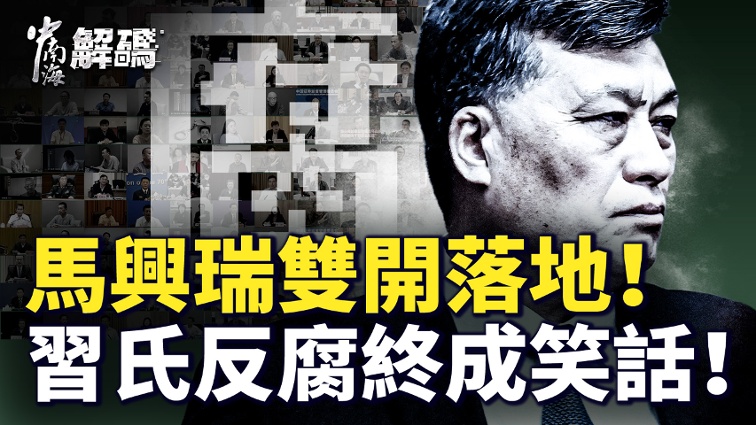
The 'Young Marshal of Aerospace' Ma Xingrui Dismissed Twice: Xi's Anti-Corruption Campaign Turns into a Historical Joke (Video)
[People News] Hello, dear viewers, and welcome to 'Decoding Zhongnanhai'. I am Sun Ning.
On July 14, the Political Bureau of the Central Committee of the Communist Party of China convened a meeting to review and approve the report from the Central Commission for Discipline Inspection and the National Supervisory Commission regarding Ma Xingrui's serious disciplinary and legal violations. As a result, Ma Xingrui has been officially expelled from the Party and removed from his public office. This deputy national-level 'big tiger', who is suspected of bribery, has finally reached the end of his political career.
At 67 years old, Ma Xingrui was once the chief scientist celebrated as the 'Young Marshal of Aerospace', having climbed the ranks in Shenzhen, Guangdong, and Xinjiang to become a regional leader. He is the third member of the Political Bureau to be officially announced as having fallen from grace during his term since the major purge of the Communist Party's senior ranks in 2025. Prior to him, military leaders Zhang Youxia and He Weidong had already been dismissed. Ma Xingrui's formal downfall also indicates that this wave of purges within the Communist Party has expanded from the military-industrial sector to the upper echelons of local bureaucratic systems.
The Dual Life of a 'Big Tiger'
In the announcement from the Central Commission for Discipline Inspection regarding Ma Xingrui's double dismissal, he was described as having 'lost his ideals and beliefs and political stance', and as having 'seriously violated political discipline and political rules'. The announcement also highlighted several key phrases: 'sought benefits for others in cadre selection and appointment processes', 'engaged in transactions involving power and sex, money and sex', and 'allowed relatives to exploit his position for personal gain, leading to rampant family corruption'.
According to information revealed by various domestic and international sources, Ma Xingrui has been accused of forming a faction during his time in Guangdong and Shenzhen, creating a 'small circle' for mutual benefit within the political sphere. The most alarming aspect of this circle's operations involves the use of so-called 'overseas high-ranking official insurance' and offshore trusts to channel funds to specific interest groups. Wealthy business figures with connections to Ma Xingrui have purchased offshore life insurance and trust financial products for their family members, with amounts often reaching tens of millions or even hundreds of millions, which are then directly 'gifted' to Ma's wife, Rong Li.
This method of 'gifted insurance' as a means of bribery is highly discreet: businessmen pay substantial premiums on behalf of Ma's family members abroad, allowing the policy assets to quietly appreciate overseas. Subsequently, Ma's family members can effortlessly launder and transfer large sums of bribes outside the scrutiny of the Chinese Communist Party's regulatory bodies by leveraging policy loans, receiving annuities in installments, or cashing out the policies directly.
However, this is merely the tip of the iceberg. During Ma Xingrui's time as governor of Guangdong Province, China's largest economic province, a peculiar phenomenon emerged in the political and business sectors: numerous well-known companies, real estate developers, and investment firms from Guangdong suddenly descended upon a remote city in Heilongjiang Province—Shuangyashan City—to engage in high-profile 'strategic investments' and project contracts. Why Shuangyashan? The reason lies in Ma Xingrui's brother, Ma Xingquan, who was serving as a representative in Shuangyashan at that time. When Guangdong businessmen were unable to secure projects in their home province, they would discreetly travel to Shuangyashan to present 'letters of allegiance' to Ma Xingquan, effectively channeling benefits to the Ma Xingrui family by investing in shell companies or collaborative projects controlled by him.
Ironically, this 'young aerospace marshal,' who maintains a respectable public image and carries the aura of a scientist, leads a similarly debauched private life. In Shenzhen and Guangzhou, many of Ma Xingrui's mistresses are well-connected real estate agents or executives from foreign companies. He leverages his absolute authority as the Secretary of the Shenzhen Municipal Committee and the Governor of Guangdong Province to act as a 'pioneer' for them behind the scenes. Projects involving billions in investment, such as rail transit support projects, urban renovation initiatives, or development rights in key high-tech zones, have been funneled to these mistresses and specific associates through seemingly legitimate bidding processes, utilizing tactics like 'making calls' and 'targeted bidding.' These mistresses secure projects and earn commissions, wielding considerable influence in the political and business circles of South China, effectively becoming the 'underground spokespersons' for Ma Xingrui's power extension.
From University Vice President and Rocket Scientist to Politburo Member Governing Shenzhen, Guangdong, and Xinjiang, over the course of several decades, Ma Xingrui went from serving as a university vice president and rocket scientist to becoming a Politburo member who governed Shenzhen, Guangdong, and Xinjiang. His career seemed to demonstrate one thing: within the Chinese Communist Party's unchecked power apparatus, even the most accomplished scientists and technocrats, once seated upon the throne of absolute power, ultimately become insatiable predators consumed by corruption.
The Palace Intrigue Behind the Ma Xingrui Case
If Ma Xingrui had fallen merely because of economic corruption, he would have been nothing more than another vice-national-level official on the Central Commission for Discipline Inspection's (CCDI) list of "tigers." What has truly excited political observers both inside and outside China—and left Zhongnanhai's leadership on edge—is the highly suggestive political label behind Ma: the so-called "Shandong Clique" and his faint but intriguing hometown connection with First Lady Peng Liyuan.
Although Ma Xingrui was born in Heilongjiang, his ancestral home is Yuncheng County, Shandong Province. Within Chinese politics, this place carries a particularly sensitive political significance because China's First Lady, Peng Liyuan, the wife of Xi Jinping, is also from Yuncheng, Shandong.
During Xi Jinping's more than a decade in power, alongside the rise of the Zhijiang New Army, another closely watched political group quietly emerged: the so-called "Shandong Clique," linked through Peng Liyuan. As the celebrated "young marshal of China's aerospace industry," Ma Xingrui not only possessed a distinguished scientific reputation but also shared Yuncheng ancestry, leading many outside observers to view him as naturally carrying the political aura of an "imperial in-law" or someone with direct access to the highest levels of power.
Perhaps for that reason, Ma's rise through the bureaucracy was nothing short of meteoric. After officially entering politics as Vice Minister of Industry and Information Technology in 2013, he was exceptionally promoted to the Politburo at the CCP's 20th National Congress in 2022 while taking charge of Xinjiang. His astonishing ascent from vice-ministerial rank to vice-national-level leadership took only nine and a half years.
Yet what brought him success also contributed to his downfall. Under an authoritarian system, being too closely associated with the ruling family often becomes a double-edged sword.
According to widespread speculation, during his tenure in Xinjiang and Guangdong, Ma Xingrui, relying on what was perceived as his powerful political backing, frequently acted in an overbearing and unilateral manner in cadre appointments and major local development projects, gradually forming an inner circle centered around himself.
In Xi Jinping's eyes—widely regarded as deeply suspicious and highly concerned with maintaining personal security—any official, regardless of whether they belong to the Zhejiang New Army or are technocrats with regional or family connections to the leadership, becomes a threat once they begin building an independent political network or cultivating influence within the system. Such behavior is viewed as an encroachment upon Xi's absolute authority.
To some extent, Ma Xingrui's downfall represents Xi Jinping's warning to the increasingly influential "Shandong Clique" and non-Zhejiang technocrats within the system. It signals that under today's political climate, even officials with seemingly close ties to the highest leadership will be discarded without hesitation if they cross the red line of absolute obedience.
Comparing the Ma Xingrui Case with the Zhang–Liu Cases
Ma Xingrui was officially announced to be under investigation on April 3 of this year and was expelled from both the Party and public office on July 14, a process that took just over three months. By contrast, Zhang Youxia and Liu Zhenli were reportedly placed under official investigation as early as January 2026, yet their cases remain unresolved to this day.
Why was the Ma Xingrui case handled so swiftly, while the Zhang Youxia and Liu Zhenli cases have dragged on for so long?
Some overseas political analysts argue that, compared with the Zhang–Liu cases, Ma Xingrui's case is more straightforward, involving relatively lower political risk and causing less institutional shock.
A close reading of the CCDI's accusations against Ma Xingrui reveals that the official charges are largely confined to economic corruption and personal misconduct. Removing him is portrayed as excising a malignant tumor from the bureaucratic system—painful, perhaps, but unlikely to destabilize the regime itself. Handling his case quickly also allows the authorities to reinforce the image of an uncompromising anti-corruption campaign that spares no one, regardless of connections.
The cases involving Zhang Youxia and Liu Zhenli, however, are fundamentally different in nature.
As one of the military's most influential figures, Zhang Youxia has deep-rooted connections throughout the People's Liberation Army, with protégés and loyalists spread across the various theater commands and service branches. Liu Zhenli, meanwhile, is one of the few senior officers with actual combat experience from the Sino-Vietnamese War and is regarded as a leading figure among the younger generation of military commanders.
Taking action against these two men—both of whom held substantial authority over troop deployments and operational planning—would likely provoke resistance within the military far beyond what many imagine. Any hasty or overly severe handling of their cases could potentially trigger widespread backlash among lower-ranking officers or even create localized military instability.
The prolonged handling of the Zhang Youxia and Liu Zhenli cases, according to this interpretation, exposes Xi Jinping's deep anxiety about confronting the military establishment. Unless he secures overwhelming consensus within the CCP—including support from retired party elders—Xi would not dare move aggressively against these once-powerful military leaders.
Xi's Anti-Corruption Campaign Has Become a Punchline
Since the CCP's 18th National Congress in 2012, Xi Jinping has waged his anti-corruption campaign for well over a decade. Marketed under the slogan, "Offend a thousand people rather than fail 1.4 billion," the campaign initially inspired high hopes among many ordinary Chinese citizens. State propaganda has repeatedly proclaimed that the fight against corruption has achieved "an overwhelming victory and fully consolidated its gains."
However, Ma Xingrui's expulsion has, in this narrative, shattered that carefully constructed political myth. It forces people to confront what the author characterizes as an absurd and harsh reality: the anti-corruption campaign has ultimately become a historical farce in which corruption only grows despite increasingly aggressive crackdowns.
According to figures released by the CCDI itself, although anti-corruption efforts have remained under constant high pressure, the number of senior officials—or "tigers"—brought down has continued to increase year after year. After more than a decade of anti-corruption campaigns and the punishment of millions of CCP members, ever more "tigers" have been uncovered, with investigations reaching increasingly higher levels, extending even to members of the Politburo and the Central Military Commission. Rather than representing a great victory of "self-revolution," the author argues that this reflects a political system in terminal decline, consuming itself and signaling the complete collapse of its credibility.
Ma Xingrui's formal expulsion, the author concludes, is merely a blood-red sunset in the twilight of political power. In what is portrayed as a political farce where anti-corruption breeds even more corruption, one clown after another takes the stage, while the final toll of the bell may already be quietly sounding in the distance.
That concludes today's episode. If you enjoyed our program, please like, subscribe, and turn on the notification bell. If you have your own thoughts on Ma Xingrui's expulsion from the Party and public office, feel free to leave a comment below. We'll see you again in the next episode!
( Decoding Zhongnanhai )



News magazine bootstrap themes!
I like this themes, fast loading and look profesional
Thank you Carlos!
You're welcome!
Please support me with give positive rating!
Yes Sure!