

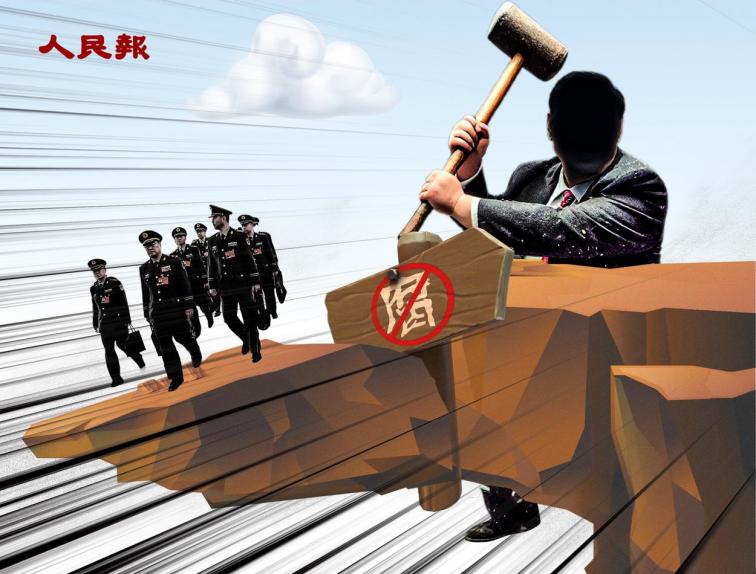
Xi Jinping. (People News)
[People News] Recently, Xi Jinping, the General Secretary of the Communist Party of China, led a delegation including Cai Qi to inspect Shanghai. According to party media, on July 15, Xi Jinping personally visited an old residential community in Shanghai, where he attentively listened to a report on the 'historic resolution of residents' toilet issues.' He emotionally emphasized that urban work must 'consider what the masses think and be concerned about what the masses are concerned about.'
During his visit to the grassroots in Shanghai, Xi Jinping avoided discussing Typhoon Bawei, ignored the flooding in Northeast China and Guangxi, and showed no concern for pressing issues such as weak consumer spending and residents' income. Instead, he feigned concern for the toilet issues faced by the people of Shanghai, which sparked ridicule and criticism online.
Whenever Xi Jinping steps out of the Zhongnanhai palace to visit impoverished areas, he tends to showcase some of the high-level, subtly ironic, people-friendly performances crafted by the Central Office. He often immerses himself in these roles, and the footage provided by CCTV is plentiful. A group of rotund officials surrounds him as they enter ordinary people's homes, opening refrigerator doors and lifting pot lids without hesitation, all while pretending to show concern and engaging in bureaucratic rhetoric, spitting as they speak. Xi Jinping asserts that he does not engage in capitalist practices, which is why he never distributes money to the public; instead, he only takes the pot lid, highlighting his achievements in poverty alleviation.
Whether it's refrigerators or pot lids, these items ultimately reflect the warmth and coldness of people's lives, as well as the essentials like oil, salt, sauce, and vinegar. They are closely tied to national agricultural production and the basic sustenance of residents, making them relevant to people's livelihoods. This time, it remains unclear whether it was Xi Jinping or Cai Qi whose head was metaphorically kicked by a donkey first, or if they both experienced this simultaneously, leading to a drastic shift from 'lifting the pot lid' to 'carrying the toilet', broadcast live around the world. Indeed, Shanghai's greatest challenge right now is not the exodus of foreign capital, the collapse of the real estate market, or the closure of shops, but rather that every household feels trapped by a stream of urine from the central party. Xi Jinping is truly visionary and has a broad perspective, considering what the masses think, worrying about what they worry about, and anticipating their needs.
Xi Jinping has a particular fondness for the underground economy. According to 'Xi Jinping's Seven Years as a Youth', in 1973, while stationed in Zhao Jia He, he led the effort to demolish and renovate the dilapidated old toilets, establishing the first gender-separated toilets in the area, which significantly improved the sanitary conditions for the villagers. This initiative laid the groundwork for his later promotion of the national 'toilet revolution'.
Since coming to power, Xi Jinping has remained fixated on toilets for defecation and urination, prioritizing the improvement of toilet environments as a key political issue. He has driven the toilet revolution in a manner reminiscent of the Great Leap Forward, with investments primarily sourced from government financial subsidies, special bonds, and the introduction of social capital. The scope of investment has expanded from merely constructing tourist public toilets to include the renovation of rural household toilets, fecal waste treatment, sewage pipeline construction, and smart environmental sanitation management systems, with the overall market scale reaching hundreds of billions to trillions.
In reality, the Chinese Communist Party (CCP) often speaks more eloquently than it acts when it comes to campaign-style construction. In 2019, a historian with experience living in a rural village in northern Jiangsu shared with BBC Chinese that since 2015, some residents in these villages received toilet equipment distributed by the organization, which encouraged them to renovate their latrines. However, the responsibility for constructing supporting facilities and drainage systems fell entirely on the villagers. The total cost of renovation ranged from several thousand to tens of thousands of yuan, which many farmers simply could not afford, resulting in toilets being discarded in the village alleys.
In 2021, the CCP's Xinhua Daily reported that during an interview in Shenyang, Liaoning Province, reporters discovered that due to significant design flaws, poor construction quality, and inadequate follow-up support, over 50,000 of the more than 80,000 toilets that the government invested over 100 million yuan to renovate in the past five years have been abandoned. Party media noted that these benefit projects have turned into 'heartbreaking projects,' ultimately due to a lack of practical approach and the influence of formalism. The government undertook the toilet renovations at no cost to the public. So why did such a good initiative fail? The public responded, 'In the cold northern winter, a small pit for excrement freezes after one use, and we can't boil water every time we need to use the toilet!'
What the party media hesitated to mention is that this reflects Xi Jinping's flawed thinking, with officials below him following orders without daring to express differing opinions, leading to wasted efforts and resources with no tangible results. BBC reported that many rural households in China construct thatched houses outdoors and dig pits inside to serve as toilets. These toilets lack flushing facilities but can store excrement to be used as organic fertilizer during the spring plowing season. This type of toilet has been in use in China for thousands of years, promoting ecological cycles. However, Xi Jinping believes this practice negatively impacts environmental sanitation.
From the initial concept of toilets in Liangjiahe to the nationwide toilet revolution, and now to the toilet project at Shanghai Grand Gateway, Xi Jinping has managed to transform the often-overlooked sewer economy into a leading force for new rural and urban development, as well as a beneficial initiative aimed at improving residential conditions. However, the questions of how much public funds have been spent, how much money corrupt officials have taken, and whether the general public has genuinely benefited are completely ignored.
During this visit to Shanghai, a key part of the agenda was attending the opening ceremony of the 2026 World Artificial Intelligence Conference and the High-Level Meeting on Global Governance of Artificial Intelligence. In his keynote address, Xi Jinping emphasized that in recent years, China has combined an effective market with a proactive government, enhanced innovation in artificial intelligence technology, actively promoted the 'AI+' initiative, and fostered a healthy ecosystem of mutual prosperity among various stakeholders. The scale of the core industry in the intelligent economy has surpassed one trillion yuan, and 'Made in China' has emerged as another impressive hallmark of Chinese-style modernization.
Despite Xi Jinping's fixation on his AI development vision and his dream of emerging victorious in the US-China tech rivalry, reality has once again delivered a harsh blow. Just before his arrival in Shanghai, the National Bureau of Statistics released data indicating that China's GDP growth rate in the second quarter was only 4.3%, down from 5.0% in the first quarter, marking the lowest growth rate since the end of 2022 and falling short of the market expectation of 4.5%.
Among these, the total retail sales of social consumer goods saw a modest increase of only 1.0%, while fixed asset investment fell by 5.7%, with real estate investment experiencing a significant decline of 18%. Reuters has candidly pointed out that real estate continues to be the largest structural burden on China's economy. The data for the second quarter indicates that investments and sales related to real estate have continued to worsen, clearly impacting the upstream and downstream sectors. The IMF had previously projected that China's GDP would be approximately 4.6% in 2026, with major risks arising from the real estate sector, weak domestic demand, and local government debt.
The recently deceased chief economist of the former Guotou Securities, Gao Shanwen, suggested on a discussion board in Washington that China's real GDP growth over the past few years may have been around 2%, highlighting discrepancies between various real indicators—such as real estate, consumption, employment, and profits—and official statistics. Recent comments from a professor at Tsinghua University's School of Economics and Management have also ignited considerable debate. He posits that the Chinese economy could enter a prolonged low-growth phase lasting 20 to 30 years, citing factors such as an ageing population, adjustments in the real estate market, debt issues, and insufficient domestic demand.
Regarding AI, which is a top priority for Xi Jinping, on June 11, Lu Ting, chief economist at Yecun China, discussed the potential macroeconomic impacts of AI during a media briefing. He remarked, 'As the real estate market declines, the macroeconomy is experiencing a dual 'K-shaped divergence, and the onset of the AI (artificial intelligence) era will intensify this divergence.'
Lu Ting remarked that the emergence of a 'K-shaped divergence' will impact overall macroeconomic demand. When wealth and income are heavily concentrated among a small segment of the population and a few cities, it becomes challenging to further boost domestic demand. To mitigate the potential negative effects of a K-shaped economy, Lu Ting stressed the importance of the government maintaining a cautious approach and avoiding blind optimism fueled by the current excitement surrounding AI.
However, will Xi Jinping listen to the warnings from experts? In the view of the party leader, such warnings are merely negative energy and will ultimately be silenced. Xi Jinping is determined not to relent until he has either dismantled or severely damaged the Chinese economy.
(First published by the People News)△




News magazine bootstrap themes!
I like this themes, fast loading and look profesional
Thank you Carlos!
You're welcome!
Please support me with give positive rating!
Yes Sure!