
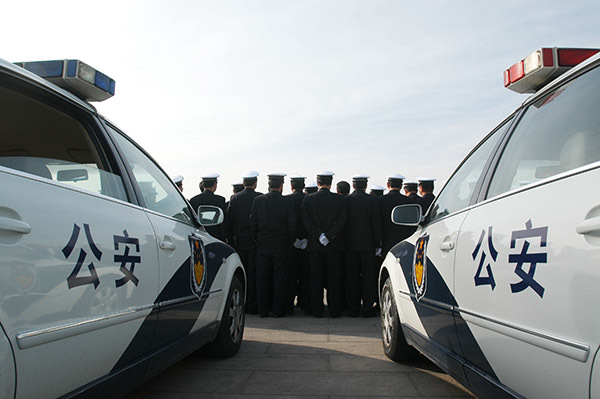
Illustration: CCP Police Vehicle (China Photos/Getty Images)
[People News] On August 1, an article titled "The Three Provincial Capitals of Northeast China Have All Lost Speed" was published on mainland social media but was taken down within a day due to a 404 error. The reason for this swift removal was that the article analyzed data and highlighted the economic difficulties faced by the three northeastern provinces.
The article notes that in the first half of the year, the GDP growth of the three northeastern provinces lagged behind the national average. Jilin's economy grew by 2.4%, ranking third from the bottom among 31 regions in mainland China. Liaoning's growth was slightly better at 2.5%, tying for fourth from the bottom with Yunnan. Heilongjiang saw a growth of 3.5%, placing it seventh from the bottom alongside Guangxi.
Examining the provincial capitals, Shenyang in Liaoning recorded a GDP growth rate of 2.1% in the first quarter, ranking third from the bottom among provincial capitals. By the end of the first half of the year, this growth rate had only slightly improved to 2.2%, still placing it at the bottom. Although Changchun in Jilin lagged behind the overall market last year, its performance was not too dismal. However, as we approach 2026, the economic pressure is clearly increasing. The growth rate in the first quarter was 4.5%, but it plummeted to 1.6% in the first half of the year. Harbin in Heilongjiang, which had a growth rate of 4.6% last year, has also seen a significant decline this year, with a growth of 4.2% in the first quarter and 3.8% in the first half.
Given that the data from the Chinese Communist Party is often manipulated, the reported growth rates for Liaoning, Jilin, and Heilongjiang should be viewed with skepticism. From the perspective of local residents, the situation everywhere appears to be one of desolation.
The author has a particular interest in Changchun due to friends and family living there. The article states that a significant reason for Changchun's decline is the downturn in the automotive industry, which is entirely accurate. The FAW (First Automobile Works) and the bus factory in Changchun are the only industries in the city with revenues exceeding 100 billion yuan, accounting for half of the city's industrial output and serving as major contributors to taxes and profits.
However, the rise of new energy vehicles has severely impacted FAW's production and sales in Changchun. According to data from the National Bureau of Statistics, in the first half of 2026, Jilin Province produced 531,100 vehicles, a decrease of 187,100 units from 718,200 units in the same period last year, marking a year-on-year decline of 26%. The total automobile production in Jilin for the previous year was 1,461,300 units.
Reports indicate that FAW in Changchun is currently implementing significant layoffs, with remaining workers only working four days a month and receiving a living allowance of 800 yuan. Official data reveals that the FAW Group employs 130,000 people, which translates to at least 130,000 families affected, impacting hundreds of thousands of individuals. How can their consumption not decline?
It is clear that the economic struggles of FAW in Changchun have a profound impact on the city's economy. Recently, the mayor of Changchun openly acknowledged at a meeting: 'Currently, the economic development of the entire city of Changchun is facing unprecedented difficulties and challenges.'
What should be done? Changchun officials have proposed a solution: "Implement multiple measures to stimulate consumption potential, boost effective investment, and stabilize the economic foundation. We must accelerate the transformation and upgrading of traditional industries like automobiles, and expedite the development of strategic emerging industries such as optoelectronics and biomedicine." However, stimulating consumption and upgrading industries is not an overnight task; it requires substantial capital investment.
At present, the most pressing issue for the Changchun municipal government is the sharp decline in fiscal revenue. A reduction in fiscal and tax income means that the salaries of officials within the system are also at risk, which consequently leads to decreased investment by the authorities in education, health, and other essential public services. What can be done?
Recently, I learned that the Changchun authorities have once again ramped up their enforcement of fines! Fines! Fines! Departments such as traffic police, health, and fire safety have been tasked with this initiative. Some traffic police begin their shifts as early as 5 a.m., and any vehicle parked even slightly in violation is met with a ticket, each costing 200 yuan. Additionally, some small restaurants have shut down due to fines related to health and fire safety regulations.
I am unsure when the fines imposed by the Changchun authorities will cease, but the trend of "profit-driven law enforcement" and "increasing revenue through fines" has become increasingly common in recent years due to economic pressures.
Reports from mainland scholars indicate that in 2022, the fines and confiscations (fines plus confiscations) collected by the Communist Party of China nationwide reached 428.3 billion yuan (RMB, the same below), marking a new ten-year high. In 2021, the state-run publication "Banyue Tan" reported that a mountainous county in northern China generated over 30 million yuan in traffic violation fines in just one year, while the local general public budget revenue was only slightly over 100 million yuan.
While the strategy of 'increasing revenue through penalties' has led to a short-term boost in fiscal income, it has simultaneously accelerated the erosion of public trust, which is a clear indicator of an impending regime collapse.
(First published by the People News) △







News magazine bootstrap themes!
I like this themes, fast loading and look profesional
Thank you Carlos!
You're welcome!
Please support me with give positive rating!
Yes Sure!