
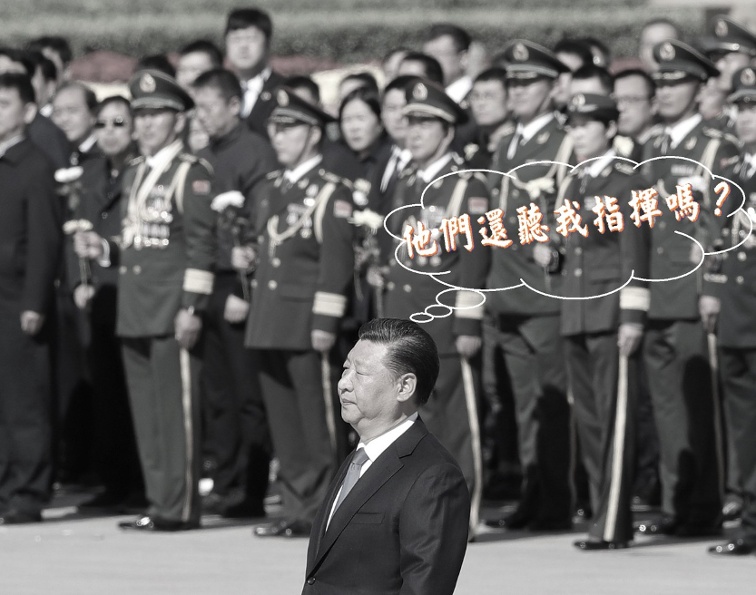
Is the military still following orders? Xi Jinping is uncertain! (Lintao Zhang/Getty Images)
[People News] Chinese Communist Party leader Xi Jinping recently addressed the military, asserting that 'the gun must always listen to the Party's command.' He reiterated the importance of ensuring that various projects maintain 'quality bottom lines, capability bottom lines, and integrity bottom lines.' However, these 'three bottom lines' expose his inner 'three insecurities.'
On July 30, the Political Bureau of the Central Committee held a collective study session focused on national defense and the military. During this meeting, Xi emphasized the necessity of ensuring that 'the gun must always listen to the Party's command,' while also calling for a deeper anti-corruption campaign, the improvement of the regulatory system for major projects, and the assurance that the quality, capability, and integrity of various constructions are upheld.
These three 'bottom lines' are not new concepts. During the 'Two Sessions' in March 2025, Xi Jinping made similar remarks at a plenary meeting of the military and armed police delegation.
Substandard equipment passed off as high quality—Xi is well aware of this issue
Xi Jinping has repeatedly highlighted the 'quality bottom line,' clearly indicating his awareness of corruption within the military that has resulted in substandard equipment, falsified data, superficial inspections, and the misrepresentation of inferior products as top quality.
By calling for a 'quality bottom line,' Xi is essentially warning the military: 'Do not use fake data or poor equipment to deceive me! When it comes time to engage in combat, I have no confidence that this batch of equipment can ensure victory.'
This situation highlights the extreme distrust that the highest decision-making body has towards corruption within the military-industrial complex and the quality of military equipment. To achieve this 'bottom line' goal, Xi Jinping is willing to make significant cuts to the generals and military-industrial leaders he personally promoted, attempting to enforce a strict cleansing with an iron fist and using 'fear' to compel the military to maintain 'political loyalty' to his central authority.
Is the military capable of fighting? Xi lacks confidence.
While the 'quality bottom line' addresses whether weapons and equipment are defective or counterfeit, the 'capability bottom line' focuses on whether personnel can actually engage in combat and whether they can develop effective weaponry.
In essence, the 'capability bottom line' means that military commanders, officers, and military-industrial researchers must possess 'genuine combat skills and professional technical abilities' that can serve as a 'final safeguard and reliable assurance' to respond to warfare at any moment and ensure victory.
This slogan fundamentally reveals the highest decision-making body's deep-seated concerns about the military's long-standing issues of corruption, mediocrity among its generals, and inflated claims in technological research and development. It raises doubts among the upper echelons of the Chinese Communist Party (CCP) about whether such a military can still engage in combat and what their chances of success would be.
The more it pushes back, the more corruption emerges. Xi Jinping has lost faith in the system.
The introduction of the term 'integrity bottom line' reflects Xi Jinping's inability to conceal his feelings of defeat and profound despair in the face of the predicament of 'the more we combat corruption, the more corruption seems to proliferate.'
For over a decade, the high-profile anti-corruption campaign has transitioned from 'hunting tigers and swatting flies' to 'scraping bones and removing poison.' A 'decisive situation has already formed,' characterized by 'zero tolerance' and the principles of 'not daring to corrupt, being unable to corrupt, and not wanting to corrupt.' However, under such intense pressure, anti-corruption efforts have not only failed to 'conclude,' but have instead resulted in 'increasing corruption as the crackdown continues.' In critical sectors such as the military, defense industry, finance, and healthcare, numerous trusted aides have been uprooted. Even newly appointed officials, such as the Minister of Defense and the Commander of the Rocket Force, have faced collective dismissal. The party leader is forced to confront a harsh reality: corruption cannot be eradicated within the current system. Regardless of who assumes the position or how political statements are made, once in that role, they will be consumed by the web of interests, leading to a complete erosion of Xi's trust in the 'anti-corruption achievements.'
The authoritarian regime of the Chinese Communist Party (CCP) rejects an independent judiciary, suppresses the oversight of free media, and strictly prohibits collective supervision by civil society. Relying solely on self-censorship within the CCP, disciplinary inspections, and secretive surveillance-style anti-corruption measures is destined to be a self-congratulatory fantasy of 'pulling one's own hair off the Earth.'
Xi's assertion of 'integrity as a bottom line' effectively signals the total failure of the goal of 'comprehensive integrity.'
The term 'bottom line' reflects an extremely passive and baseline mindset. It reveals Xi's disappointment and helplessness: 'I no longer expect you to achieve the lofty and noble ideals; I only ask that you maintain the final bottom line and prevent the entire structure from collapsing too quickly.'
Three Mechanisms to Prevent a Military Coup
Since coming to power in 2012, Xi Jinping’s purges of the military have never ceased, especially among the senior generals he personally promoted, who have been removed one after another. At present, within the Central Military Commission, only Chairman Xi Jinping and Vice Chairman Zhang Shengmin, who was promoted in October last year, remain; the other five members have all fallen.
Xi Jinping’s removal of a large number of high-ranking officers (especially full generals and lieutenant generals) has left the military system in a state of anxiety. To prevent anyone, out of fear, from developing disloyal intentions or attempting a coup, Xi’s team has implemented the following three “stability mechanisms” to control risks:
The political commissar system (political work system) and vertically managed discipline inspection: The Chinese military operates under a dual-leadership system. The disciplinary inspection and equipment auditing bodies report directly to the Central Military Commission, preventing commanders from monopolizing power.
Intelligence and digital surveillance: Under the modern system, the communications, movements, aides, and even family members of senior generals are subject to extremely strict digital monitoring. It is exceedingly difficult for generals to establish private horizontal connections or collude, greatly reducing the physical possibility of a “collective rebellion.”
High-frequency personnel rotation: Key positions (such as theater commanders and service chiefs) are subject to rapid rotation and frequent reassignment, ensuring that officers are separated from their troops and cannot build strong personal power bases within a single unit.
At the same time, the purges have created a large number of vacancies in senior positions, allowing for the rapid promotion of younger and mid-level cadres. For these newly elevated officers, this represents an opportunity for class advancement, making them objectively more dependent on the top leader who promoted them.
Can the Party Still Command the Gun?
Even so, Xi Jinping remains concerned that the military is not sufficiently loyal to him. He has repeatedly emphasized the principle that “the Party commands the gun” and has deeply tied anti-corruption efforts to political loyalty. Any dissatisfaction with the purges or dissenting views is immediately elevated to the level of “disloyalty to the Party” and punished severely.
This also explains why the central authorities repeatedly stress the “three bottom lines.” This serves both as a warning to newly promoted generals not to repeat past mistakes and reflects the leadership’s lingering hope that the military, despite serious corruption, can rebuild a baseline capacity for functioning.
It can be seen that Xi Jinping is internally uncertain about three aspects: the Chinese Communist Party’s authoritarian system, the military’s combat effectiveness, and whether the military will obey commands. Furthermore, he is uncertain about how long the Party’s rule can be sustained.
(First published by People News)






News magazine bootstrap themes!
I like this themes, fast loading and look profesional
Thank you Carlos!
You're welcome!
Please support me with give positive rating!
Yes Sure!