
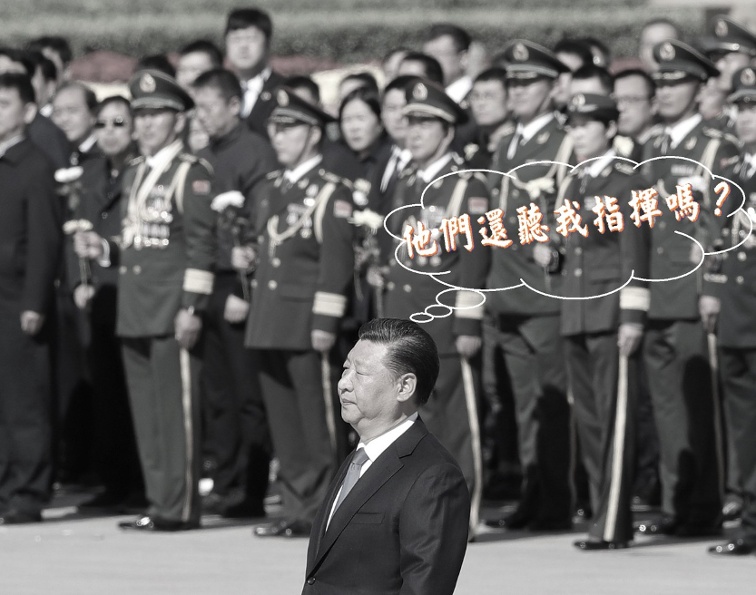
The Chinese Communist Party's internal purges continuously transform certain officials and senior generals into sacrifices for the party, creating a pervasive atmosphere of fear among all officials. The image depicts Xi Jinping (center) attending a ceremony at Tiananmen Square in Beijing on September 30, 2018. (Lintao Zhang/Getty Images)
[People News] On July 30, the Chinese Communist Party held a Politburo meeting where it announced plans to convene the Fifth Plenary Session of the Central Committee in October. The main agenda for this session is clearly defined as studying "advancing comprehensive and strict governance of the party on several major issues."
Immediately following this announcement, the latest public report from the Standing Committee of the National People's Congress, released in August, revealed for the first time that three generals—Xu Xueqiang, Li Fengbiao, and Guo Puxiao—along with three lieutenant generals—Wang Kangping, Yin Hongxing, and Zhang Minghua—are all "suspected of serious violations of discipline and law," leading to their dismissal from their roles as national representatives.
Earlier, on June 26, the Standing Committee of the National People's Congress had already announced the termination of the national representative qualifications for 14 officials, including Politburo member Ma Xingrui and the aforementioned three generals (Xu Xueqiang, Li Fengbiao, Guo Puxiao) and three lieutenant generals (Wang Kangping, Zhang Minghua, Yin Hongxing).
This effectively communicates to the outside world: the more the Communist Party combats corruption, the more severe the corruption becomes. Furthermore, the more the CCP attempts to govern the party comprehensively, the darker the party becomes.
For 41 years of "strict governance of the party," the more the party is governed, the darker it becomes.
The term 'strict governance of the Party' was first officially used during the political work conference of the entire military in December 1985 and the national political and legal work conference in 1986. It was later formally included in the report of the 13th National Congress of the Communist Party of China (CPC) in 1987 (Zhao Ziyang's report), which emphasized that 'the Party must be governed strictly, and Party discipline must be upheld rigorously.'
Since Xi Jinping assumed power at the 18th National Congress in 2012, 'strict governance of the Party' has evolved from a sporadic campaign held every few years into a systematic, long-term approach that is continuously enforced.
On October 8, 2014, Xi Jinping publicly introduced the concept of 'comprehensively advancing strict governance of the Party' for the first time. Later, during a research visit to Jiangsu in December 2014, he elaborated on this idea, emphasizing 'comprehensive strict governance of the Party' and aligning it with the goals of building a moderately prosperous society in all respects, deepening reforms comprehensively, and governing the country according to law, thus forming the strategic framework known as the 'Four Comprehensives.'
In essence, Xi Jinping declared that the Party governance prior to his leadership had failed, leading to increased corruption within the Party, which necessitated a more robust approach and an upgrade to 'comprehensive strict governance of the Party.'
There are many examples to illustrate this point, but one notable instance is the latest data released by the CPC, which confirms that in 2025, the Chinese disciplinary inspection and supervision agencies opened a total of 1.012 million cases, with disciplinary actions taken against approximately 983,000 individuals (nearly one million), marking a historical high in the past 20 years.
This raises a contradiction between the 'great achievements' and the 'record-breaking numbers.'
If the "comprehensive and strict governance of the Party" since the 18th National Congress has indeed achieved a series of "overwhelming victories and comprehensive consolidations" as claimed by the authorities, then logically, after more than a decade of suppression, the number of anti-corruption cases and the number of individuals punished should show a year-on-year decline and tend to stabilize. However, in 2025, the number of individuals punished reached a nearly 20-year historical high (close to one million), which objectively demonstrates that corruption has not been suppressed; rather, it has proliferated like weeds.
The transition from the "strict governance of the Party" during the Deng era to the "comprehensive and strict governance of the Party" in the Xi era, with the official term "upgrade," ironically acknowledges the complete failure of the governance model over the past few decades. Corruption within the bureaucratic system has spread to a point where it is now at a limit where "without comprehensive high-pressure rectification, the regime will face collapse."
Thus, it is clear that the aspiration for the Communist Party to become a ruling party free of corrupt officials is entirely delusional. This is because the corruption of the Chinese Communist Party (CCP) is not merely an issue of individual officials' morals, but rather a "systemic genetic problem," as absolute power without any oversight inevitably leads to absolute corruption.
The authoritarian system of the CCP does not permit an independent judiciary, lacks free media oversight, has no opposition parties for checks and balances, and does not allow for civil society supervision. In such a single-party authoritarian system, the Communist Party controls the country's land, finance, administrative approvals, and law enforcement privileges. Power itself is the greatest commodity, and the complete corruption of the officialdom is an inevitable economic and political phenomenon.
The core principle of 'comprehensively enforcing strict party governance' is that the party's internal discipline is responsible for monitoring its own officials, essentially requiring this power structure to oversee itself. History has shown that self-supervision, without independent external oversight, can only serve as a mechanism for 'factional purges' or 'selective law enforcement', making it impossible to eliminate the roots of corruption.
The shocking statistic of nearly one million Chinese Communist Party (CCP) officials facing punishment by 2025 does not signify a 'successful self-revolution' for the CCP; rather, it highlights a diagnosis of an authoritarian system caught in a vicious cycle of 'the more it combats corruption, the more corruption proliferates; the more it investigates, the more it becomes paralyzed'.
As long as the structure of absolute power remains intact, 'comprehensively enforcing strict party governance' will continue to function as a political meat grinder that generates corruption while simultaneously purging officials. Expecting it to create a ruling party that is 'pure and flawless, free of corrupt officials' is as futile as trying to catch fish in a tree.
Political narratives such as 'comprehensively enforcing strict party governance' and 'self-revolution is always ongoing' effectively create a relentless political meat grinder in practice.
For officials within the system, this represents a form of public and normalized political deterrence (fear control) — any official who disobeys, fails to align closely with the party line, or shows even a slight hesitation regarding the 'two safeguards' risks having the anti-corruption hammer come down at any moment under the guise of 'justice'. This open political deterrence compels all officials to demonstrate excessive obedience to protect themselves. In other words, any CCP official who raises doubts about their political loyalty from superiors can find themselves sacrificed to the party flag at any time.
The relentless purges are a necessary aspect of the self-sustaining mechanism of the Chinese Communist Party's (CCP) meat grinder. The Party lures officials with 'privilege and benefits' to act as enforcers, while simultaneously instilling a fear of 'being toppled at any moment and subjected to political grinding' that looms over them. While this governance strategy may ensure that the bureaucratic system refrains from resistance and complies in the short term, it also has deadly side effects— it creates an environment where 'everyone feels threatened, and collectively opts for passivity.' This paralysis in governance, driven by collective fear, will ultimately become one of the most significant internal factors hastening the system's collapse.
(First published by People News)
△



News magazine bootstrap themes!
I like this themes, fast loading and look profesional
Thank you Carlos!
You're welcome!
Please support me with give positive rating!
Yes Sure!