

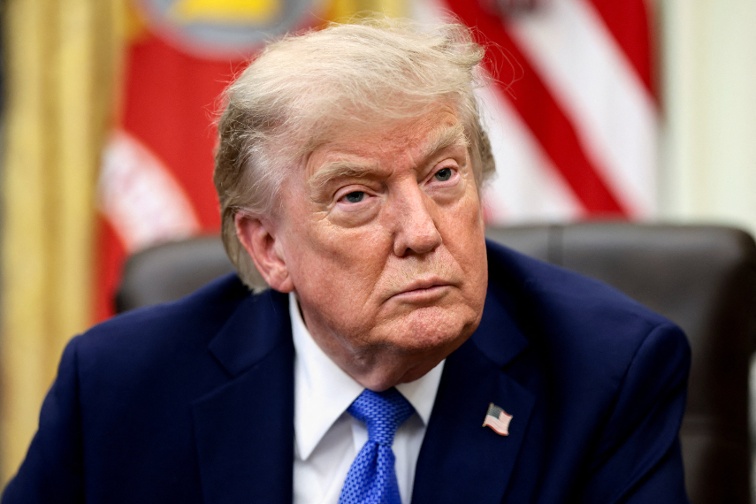
Xi Jinping. (People News)
[People News] On July 31, the Political Bureau of the Central Committee of the Communist Party of China held a collective study session focused on strengthening military governance. Party leader Xi Jinping reiterated the importance of deepening the fight against corruption within the military, stating that it is essential to "uphold and strengthen the Party's absolute leadership over the military" and to "ensure that the military always obeys the Party's command."
Following this, China's Minister of National Defense, Dong Jun, in his recent "August 1" speech, declared that the military must "listen to the Party and follow the Party" and "fully implement the responsibility system of the Chairman of the Military Commission," as well as "strengthen political military building."
Xi Jinping has been in the roles of General Secretary and Chairman of the Military Commission for a full 14 years, yet he continues to emphasize the military's "loyalty" and purges senior military generals, highlighting his deep anxiety regarding military power.
This anxiety is closely tied to two major paradoxes that Xi Jinping finds himself entangled in.
What are these two major paradoxes?
The first paradox: The more one seeks "absolute loyalty," the less one can achieve it.
Since Xi Jinping took office, one core requirement for the military has remained constant: the military must not only heed the Party's commands but also his commands as the Chairman of the Military Commission. Essentially, listening to the Party means listening to him. In his own words, there must be "no one in the military who harbors doubts about the Party." This pursuit of "absolute loyalty," driven by Xi Jinping's excessive desire for power and vanity, has reached a pathological level.
But can the military truly be "absolutely loyal" to Xi? I believe it is ultimately impossible.
Why is it impossible? Although Xi attempts to position himself alongside Mao, he cannot be compared to Mao in any meaningful way.
When comparing Xi Jinping with Mao Zedong, it is evident that historically, the Chinese Communist Party (CCP) army has demonstrated "absolute loyalty" to Mao.
Mao's ability to achieve this loyalty can be attributed to his rise as the CCP leader through strategic maneuvering during intense power struggles. In contrast, Xi Jinping's ascent to power is a result of a compromise between the Jiang faction and the Youth League faction, leveraging his status as a 'red second generation'.
Additionally, Mao Zedong was not only the founder of the CCP army but also served as its supreme leader for an extended period, personally overseeing military operations. In Xi Jinping's case, he has never even held a gun, let alone engaged in combat; he is entirely unversed in military affairs.
Therefore, the CCP army's historical loyalty to Mao was rooted in their genuine respect for him, as he had the necessary capital to earn their allegiance. Although Xi occupies the prominent roles of General Secretary and Chairman of the Central Military Commission, he lacks the capability and resources to command their loyalty; thus, it is implausible for the army to be loyal to him, let alone exhibit "absolute loyalty".
From another angle, even if Xi Jinping were to be considered the Mao Zedong of the new era, the army would still not be able to show him "absolute loyalty". Unlike the past when the CCP fought for power, today's military leaders join the CCP primarily for personal gain. They will pledge their loyalty to whoever can offer them benefits. For their own interests, they can easily abandon their old allegiances and align with new ones. The adage goes, "Whoever provides milk is their mother." Furthermore, the concept of "absolute loyalty" is, to some extent, founded on shared political ideals and values. Is there such a foundation between them and Xi Jinping? No, and it is unlikely to ever exist.
To illustrate, Xi Jinping is determined to unify Taiwan by force in order to match Mao Zedong and fulfill his dream of lifelong rule. However, most military leaders understand that, given the capabilities of the People's Liberation Army, a military unification of Taiwan would be a reckless gamble that could lead to self-destruction and jeopardize their own vested interests. This means that on the issue Xi values most, their perspectives are fundamentally different from his. Where, then, can 'absolute loyalty' come from?
As a result, even though the Xi family army consists entirely of individuals promoted by Xi himself, nearly all of them are 'double dealers'.
Despite being unlikely to receive 'absolute loyalty', Xi Jinping desperately seeks it. To ensure the military's 'absolute loyalty' to him, he has gone to great lengths. His most ruthless tactic has been to create a widespread network of spies within the military, subjecting military leaders, especially senior generals, to comprehensive surveillance. Consequently, those 'double dealers' who have doubts about Xi cannot help but reveal their true intentions.
When Xi learned that the generals he had personally promoted were disloyal, his anger was understandable. This marked the beginning of purges within the Xi family army. These purges exposed the entire military to Xi's suspicion and cold-bloodedness, further diminishing the generals' already negative perceptions of him, making 'absolute loyalty' even less attainable.
Yet, rather than learning from this experience, Xi intensified the spy surveillance. As a result, new 'double dealers' continued to be uncovered, leading to further rounds of purges. This cycle perpetuates, trapping Xi Jinping in a paradox where the more he seeks 'absolute loyalty', the less he actually receives.
The second paradox: the more one seeks political security, the less one achieves it.
Why does Xi Jinping pursue 'absolute loyalty'? The answer lies in his desire to ensure political security and solidify his hold on power.
It is easy to envision a scenario where the military, from top to bottom, especially the senior generals, are all 'absolutely loyal' to Xi Jinping. In such a case, they would support whatever he says and follow his directives without question; they would 'listen to the Party and follow the Party' and 'fully implement the responsibility system of the Chairman of the Military Commission'. With such a military backing him, how could Xi Jinping possibly feel insecure? How could he not feel confident in his position?
However, as we have analyzed earlier, Xi Jinping is fated to never attain the 'absolute loyalty' he yearns for, and the more he seeks it, the less he actually receives. What does the absence of 'absolute loyalty' imply? It indicates that many military leaders are 'two-faced', including those who serve as Xi Jinping's closest aides in the Military Commission. In such a situation, how could he feel secure? How could he not be concerned about his position? Consequently, he is compelled to carry out continuous purges.
The scale of military purges during Xi Jinping's tenure is unprecedented in the history of the Communist Party of China, reaching a level of astonishing shock.
According to a database released by the Center for Strategic and International Studies (CSIS) in February this year, at least 101 senior military officers of the Communist Party of China (CPC) have been purged or are suspected of being purged since 2022. Among the 52 key military leadership positions tracked, only 11 are still held by individuals who are clearly in office. Of the 47 senior military officers who were already generals in 2022 or were promoted to generals afterwards, 41 have been purged or are believed to have been purged, which represents 87%.
The most alarming revelation is that out of the seven members of the Central Military Commission of the CPC's 20th Central Committee, only Xi Jinping and Zhang Shengmin remain in their positions. The other five have all been removed from their posts, with one receiving a death sentence with a two-year reprieve, two expelled from the Party and awaiting retrial, and two others currently under investigation, one of whom is Zhang Youxia, the First Vice Chairman of the Central Military Commission.
In the face of such a large-scale purge, those still in power today are uncertain whether they will be the next to be purged tomorrow. Those promoted by Xi Jinping today are left wondering if they too will become a
Xi Jinping aims to create an army that is completely obedient, entirely loyal, and fully controllable. However, the more he seeks this 'absolute' state, the more he must work to eliminate uncertainty; the more he strives to eliminate uncertainty, the more purges he feels compelled to conduct; and the more purges he initiates, the greater the sense of insecurity within the military becomes. As insecurity grows, genuine trust diminishes; with less genuine trust, Xi Jinping feels the need to tighten his control even further. This increased control leads to a decrease in authentic information, and as real information dwindles, Xi Jinping's suspicions deepen, making him less willing to trust anyone. Consequently, what began as Xi Jinping's goal of achieving absolute security has ironically resulted in a continuous atmosphere of insecurity. As some analysts have noted, the real danger lies not in generals failing to express loyalty, but in everyone merely performing loyalty.
Consider this: how could Xi Jinping, caught in a web of 'double-faced individuals', lacking 'absolute loyalty' and feeling insecure, not be anxious about military power?
△






News magazine bootstrap themes!
I like this themes, fast loading and look profesional
Thank you Carlos!
You're welcome!
Please support me with give positive rating!
Yes Sure!