
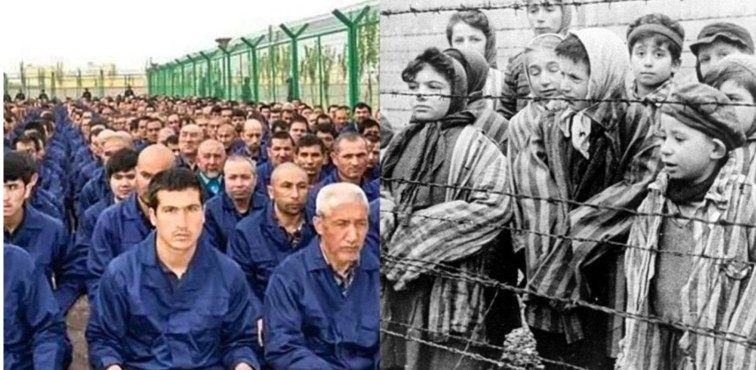
Former guards and imprisoned women from Xinjiang re-education camps have confirmed the existence of systematic rape and sexual abuse within the facilities. The image shows a composite of a Xinjiang re-education camp and a World War II Jewish concentration camp. Photo: Screenshot from the official website of the East Turkestan Government-in-Exile (file photo).
[People News] The CCP has introduced new regulations for exit and entry management. Although these regulations will officially take effect on September 15, various online sources have confirmed that the CCP has already begun to enforce strict measures on Chinese citizens attempting to exit the country. Additionally, the new rules have legalized the inspection of electronic devices and data carried by individuals leaving China.
On August 12, a Twitter user named 'Shen Tong' reported that he observed 'stricter customs' procedures at a domestic airport, noting that 'many people were advised to return' and that 'traveling abroad feels like facing a formidable enemy.'
On August 15, a video surfaced showing a girl at Nanning Airport in Guangxi having her passport canceled. The reason for this was that a student from her university was stranded in Spain, leading to a ban on all students from that institution from leaving the country.
On August 19, an anonymous whistleblower shared that while preparing to fly to Seattle, USA, he was required to fill out an exit information form at Shanghai Pudong International Airport. This form delved deeply into personal privacy, causing many passengers on the same flight to feel 'frozen,' while he himself 'put on a brave face.'
To his surprise, customs also checked his phone upon arrival. He was first questioned about the accuracy of his form, and then his phone, along with those of 20 other passengers, was taken to a separate room for both manual and machine checks after he was asked to unlock it. One individual ahead of him was taken away by police for being suspected of using a backup phone to avoid inspection, as the app installation date was deemed too recent.
He noted that once on board, he observed that half of the seats on the plane were empty, indicating that half of the passengers on the same flight had failed the inspection and were either placed under border control or advised to return.
Recently, a woman who had been working abroad for an extended period returned to China to visit her family and shared her experience online regarding mobile phone checks conducted by the police under the Chinese Communist Party. Since her return, she has faced multiple inquiries from the police about her overseas work and entry-exit status. Just before she was about to leave again, she was summoned to the police station for questioning. Although she brought various documents with her, the police only asked her to unlock her phone. They then connected her device to a specialized machine using a data cable and conducted a two-hour 'information collection' session. This process resulted in the automatic uploading of her photo albums, WeChat chat histories, and keywords she had searched on Taobao.
Before she could board her flight, she was advised to turn back, had her passport unjustly revoked due to collective punishment, and was subjected to arbitrary phone checks and data collection. These frequent experiences of ordinary citizens with exit controls suggest that the Chinese Communist Party is increasingly confining its citizens, indicating a troubling trend towards 'Xinjiangization' across the country.
In 2019, an international human rights organization published a report stating that since 2016, the Chinese Communist Party has been surveilling 13 million Uyghurs and other ethnic minorities through an 'integrated combat platform,' leading to the detention of up to 1 million individuals in 're-education camps.'
The 'integrated combat platform' in Xinjiang links each person's identity information with various surveillance data, allowing authorities to track individual movements by monitoring personal mobile phones and vehicle locations. If there are unusual patterns in electricity usage at home, if someone leaves their registered residence without permission, or if they contact individuals with overseas connections, the system automatically alerts the police to investigate.
The 'integrated combat platform' assigns a 'threat level' to each individual based on monitored data, which serves as the basis for imposing varying degrees of restrictions on their freedom of movement. These restrictions can include house arrest, prohibitions on leaving one's registered residence, entering public places, or leaving China; in some cases, individuals may even be imprisoned or sent to 're-education camps'.
In Xinjiang, the Chinese Communist Party has been monitoring mobile phones for some time, with commonly reported surveillance software including 'Net Cleanser', 'Bee Collection', and 'National Anti-Fraud Center'. At checkpoints and traffic intersections, police can request to inspect residents' mobile phones at any time. They employ technical methods to scan the internal contacts, audio and video files, and app lists on the devices, and use specific software programs to track mobile phones, monitoring daily travel and social interactions.
In 2019, investigations by several foreign media outlets revealed that tourists entering Xinjiang via land routes from Kyrgyzstan are required to unlock their phones and submit them for inspection. For iPhones, police connect to a computer to scan the phone's information, while for Android devices, a forced installation of an app called 'Bee Collection' occurs. This app secretly collects personal privacy information from tourists' phones, including emails, audio and video files, text messages, contacts, and phone models, and is automatically uninstalled afterwards.
In his book 'Re-education Camps in Xinjiang: China's High-Tech Exile', Canadian author Darren Byler provides a detailed account of the high-tech surveillance and terror monitoring situation in Xinjiang.
In addition to the extensive network of cameras monitoring everyone's movements like a 'Sky Net', there are checkpoints every 200 meters where individuals must scan their ID cards or undergo facial recognition to pass through. At this point, the basic information of the person appears on the computer screen of the checkpoint staff, showing either a green frame or a yellow frame. The green frame signifies that you are a 'person with no issues', while the yellow frame indicates that you are someone 'who needs attention'. Police can request your phone at any time to check for 'suspicious' contact records, and you may also be compelled to install official surveillance app software.
According to the author, in 2011, many young people in Xinjiang began using domestically produced Huawei phones, but this quickly turned into a 'mobile disaster'. By 2014, the Chinese Communist Party started monitoring people's phones. Software provided by high-tech companies could track individuals' locations, automatically record and translate every word spoken by Uyghurs on WeChat, and identify Uyghur ethnicity through facial recognition.
Among these tools, the police also utilized a type of software that, once installed on a phone, could automatically begin checking tens of thousands of different behaviors, thus calculating the 'trustworthiness' of the phone user. A green light indicates 'trustworthy', while a red light signifies 'highly suspicious', which could likely result in being sent to a 're-education camp'.
It is alarming that the Chinese Communist Party not only tracks what individuals are doing 'now' through their mobile phones but also investigates their 'past' actions and even predicts their 'future' behaviors. For instance, if a phone is found to have used a VPN, installed WhatsApp, or contains electronic documents with religious content, it can be classified as 'preparatory crimes', resulting in the individual being detained or sent to 're-education camps'.
In an interview featured in the book, a Xinjiang student named Kaise'er recounted an incident when the school unexpectedly gathered all students in the playground to check their phones. He had previously shared a news article on WeChat about a Uyghur intellectual sentenced to life imprisonment. He recalled, 'I pretended to be calm, but my heart was racing. Fortunately, the teacher who checked my WeChat was somewhat careless.'
Sadly, one of his classmates was taken away because he had a video of a 2009 protest sent to him by someone else, which he had failed to delete in time. He was detained for nine months, during which the police beat him and coerced him into confessing to all the charges against him. It is believed that he was subsequently held in a re-education camp.
Kaise'er noted that after 2016, the Xinjiang government tightened its scrutiny of mobile phones. Whenever he had to go out and could not avoid a checkpoint, he would leave his phone at home. At the checkpoint, police would order everyone to exit their vehicles, and those with Xinjiang residence permits would line up for facial scans. The police would then demand that they hand over their phones and insert them into a scanning machine for inspection.
After Kaiseier escaped from China, the policies in Xinjiang became even more stringent. All Uyghurs were subsequently compelled to surrender their passports to the Chinese Communist Party (CCP) for 'safekeeping', and any travel required approval from the local police station. Many of his relatives were detained as 'preparatory terrorists'.
The practice of checking mobile phones at any time and place is intended to control people's thoughts, treating everyone as if they have a 'preparatory criminal' mindset. This reflects the CCP's profound insecurity in the current climate. With a sluggish economy, soaring unemployment rates, young people adopting a laid-back attitude, and growing social discontent, the CCP is also grappling with severe internal divisions. The implementation of strict and oppressive controls is, in fact, a sign of the CCP's own fragility.
The CCP's approach to controlling Xinjiang effectively surrounds all Chinese citizens, adopting a 'doubt everything' and 'spare no one' mentality, treating everyone as a potential criminal. Those within the country wishing to travel abroad must relinquish all their privacy and undergo the CCP's digital scrutiny. Meanwhile, individuals returning from abroad may face exit restrictions lasting from six months to three years if any behavior deemed undesirable by the CCP is detected. This regressive method of exit control resembles an experiment in 'Xinjiang-ization' being applied throughout all of China. △



News magazine bootstrap themes!
I like this themes, fast loading and look profesional
Thank you Carlos!
You're welcome!
Please support me with give positive rating!
Yes Sure!