
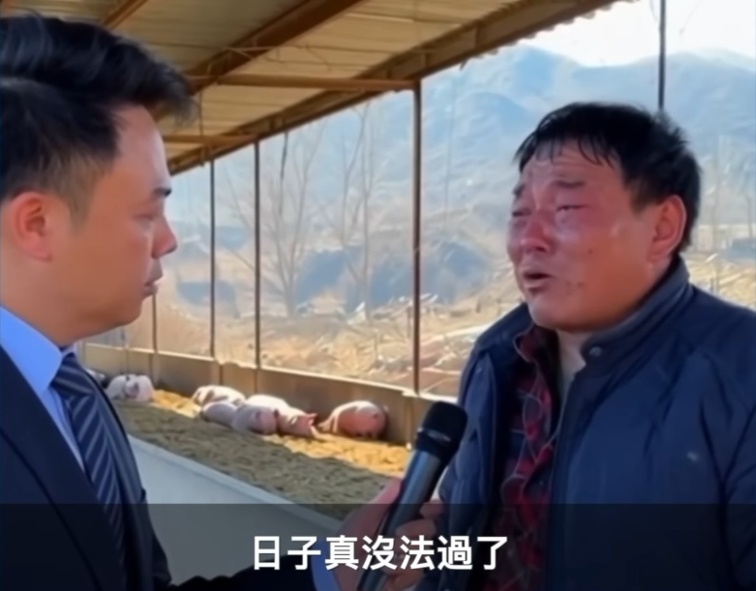
Pig farmers are lamenting: the more pigs they raise, the more they lose; life has become unbearable. (Video screenshot)
[People News] China's leading pig farming company, Muyuan Foods, recently released its performance report for the first half of 2026, revealing dismal figures: first, business income has significantly decreased, with total operating revenue for the first half of the year at 59.41 billion yuan, down over 20% from 76.462 billion yuan during the same period last year (a decline of 22.3%). After accounting for various costs and expenses, the net loss for the parent company's shareholders reached 6.078 billion yuan.
It's worth noting that during the same period last year, they reported a net profit of 10.53 billion yuan! This drastic change represents a staggering profit drop of 157.72% compared to last year, plunging from a situation of 'making hundreds of billions' into a 'bottomless pit'.
Another major player in the pig farming industry, Wens Foodstuffs, also released its performance report for the first half of 2026, finding itself in a similarly dire situation of 'losing more the more they raise': the total operating revenue from selling pigs and meat in the first half of the year was 46.765 billion yuan, a decrease of 6.23% compared to the same period last year.
After deducting all costs, including feed, labor, and depreciation, Wens Foodstuffs faced a total net loss of 4.398 billion yuan. Of this, the net loss attributed to its own shareholders reached 4.366 billion yuan. Compared to the same period last year, profits plummeted by over 220%, transforming from last year's profitable scenario into this year's widespread losses.
What has shocked observers is that this year, it is not just individual pig farming companies that are incurring losses; rather, the entire Chinese pig farming industry is currently facing a collective crisis of severe financial hemorrhaging and massive losses.
As discussions unfold regarding the underlying causes of this 'catastrophe in the pig farming industry,' an increasing number of agricultural economists and industry analysts are pointing out that this situation is the inevitable outcome of the authorities' aggressive promotion of state intervention policies, which are heavily influenced by a 'new planned economy' approach that distorts market principles through political will.
Disguised as a market, the 'new planned economy'
On the surface, the Chinese pig farming industry appears to have publicly listed companies and market transactions; however, it is fundamentally characterized by a strong 'state-guided capitalism' mechanism. So, how does state capital exert control over the pig farming industry?
Since the outbreak of African swine fever, the Chinese Communist Party has employed extremely stringent administrative measures under the guise of 'environmental protection and modernization' to systematically eliminate millions of small pig farmers. Concurrently, both central and local governments have directed special subsidies, land allocations, and low-interest loans towards major corporations such as 'Muyuán,' 'Wēnshì,' and 'Xīnxīwàng.' They have also set targets for live pig production and self-sufficiency rates, mandating that companies cooperate in 'dividing production capacity,' which reflects a clear legacy of planned economy principles.
In the political framework of the Chinese Communist Party, pork prices are closely tied to the Consumer Price Index (CPI) and social stability, which is why they are included in the local officials' evaluation system known as the 'basket of goods provincial governor responsibility system.' When 'pig farming' is elevated to a political priority, local officials go to great lengths to pressure enterprises into expanding 'high-rise pig farms' without regard for costs, even resorting to local protectionism. This has led to a complete replacement of market mechanisms with political considerations.
Micro-intervention and resource monopolization: The government has set up a large 'two-tier pork reserve system' at both central and local levels, aiming to control prices through the National Development and Reform Commission's 'pig-to-grain price ratio' early warning mechanism. Additionally, with administrative privileges for land approvals and targeted financial support from state-owned banks, the land and financial resources for pig farming have become detached from market allocation.
The consequences of power's heavy-handed market manipulation: the more they try to intervene, the greater the surplus.
Authorities have attempted to 'eliminate the pig cycle' through administrative directives, but this has led to significant capacity misallocation and structural crises.
Previously, individual farmers could quickly shut down operations during periods of low pork prices and restock moderately when prices rose, creating a flexible market adjustment mechanism. However, following the official push for 'monopoly by a few major players,' large enterprises tied to substantial fixed assets and bank loans found it impossible to halt operations; they could only stubbornly endure during price crashes, resulting in a prolonged chain reaction of defaults lasting several years.
In a normal market, companies that blindly expand production and incur massive losses would typically face bankruptcy and liquidation. However, under the protection of state capital, these giants receive extensions and relief, creating an administrative safety net of 'too big to fail.' As a result, surplus capacity cannot be eliminated by market forces, leading to persistently low pork prices and a protracted battle of attrition throughout the industry.
The National Development and Reform Commission (NDRC) has been frequently involved in both 'storage' and 'release' activities. However, the delay in decision-making by officials has not only failed to stabilize market fluctuations but has also disrupted companies' ability to accurately predict real supply and demand, leading to the situation where 'the more control, the more chaos'.
Public Discontent: The Burden of Policies Falls on Everyone.
The staggering losses reported by Wens Foodstuff Group have triggered strong reactions and sarcasm from netizens on social media platforms like Weibo, Zhihu, and Xueqiu.
Netizens have openly criticized, saying, 'Back then, they hastily expanded production, and now the public is left to pay the price.' They pointed out that the aggressive promotion of high-rise pig farming and low-interest loans has pushed out small investors. Now, with overcapacity compounded by weak consumer demand, this situation is indeed the bitter result of 'administrative intervention replacing market rules'.
Stock investors have humorously remarked, 'Buying pork is worse than buying stocks,' noting that while large corporations receive bank bailouts to stay afloat, the investments of individual stockholders have dried up. Many netizens have also connected the downturn in the pig farming industry with the current high unemployment rate and declining consumer spending, candidly stating, 'It's not that there are more pigs; it's that ordinary people can no longer afford them.'
Rural netizens expressed their frustration, observing that while large corporations can incur losses in the billions and still secure loans for survival, the millions of ordinary pig farmers who were forced out by administrative directives a few years ago no longer even have the opportunity to incur losses; they have been pushed out of the market with no means of survival.
The Industrial Chain Decaying Under a Planned Economy.
Since Xi Jinping took office, he has placed a strong emphasis on 'state-owned enterprises advancing while private enterprises retreating', reinforcing the Communist Party's micro-management of the economy and redirecting resources on a large scale towards state-owned enterprises and strategic national industries. This governance model, which resembles a 'new planned economy', has frequently replaced market mechanisms with administrative orders and political will, leading to significant damage to several previously vibrant or large-scale industries, even resulting in a phenomenon of 'collective decay'.
The catastrophic failure of the pig farming industry serves as a microcosm of the broader decline experienced by various sectors in China in recent years, driven by the 'state advancement and retreat of private enterprises' and political intervention.
From the sweeping devastation of the education and training sector caused by the blanket 'double reduction' policy, to the real estate industry facing a cascade of defaults due to the 'three red lines'; from the reduced vitality of the internet platform economy under antitrust and data regulations, to the film and cultural industry subjected to rigorous scrutiny, the decline of these sectors reveals a common underlying issue—government attempts to reshape market dynamics through political correctness and administrative directives.
When the 'visible hand' of state power intervenes too deeply, forcibly disrupting the micro-economy and constricting the space for free markets, the self-correcting and innovative capabilities of the free market are suppressed. As a result, capital and businesses opt to contract or withdraw, ultimately leading to widespread industry failures and an employment crisis.
The collective losses in the pig farming sector further illustrate that reliance on the decisions of the Central Committee of the Communist Party cannot eradicate economic principles. The consequences of heavy-handed government intervention will inevitably lead to more severe market disasters and costs borne by the entire populace.
(First published in People News)
△








News magazine bootstrap themes!
I like this themes, fast loading and look profesional
Thank you Carlos!
You're welcome!
Please support me with give positive rating!
Yes Sure!