
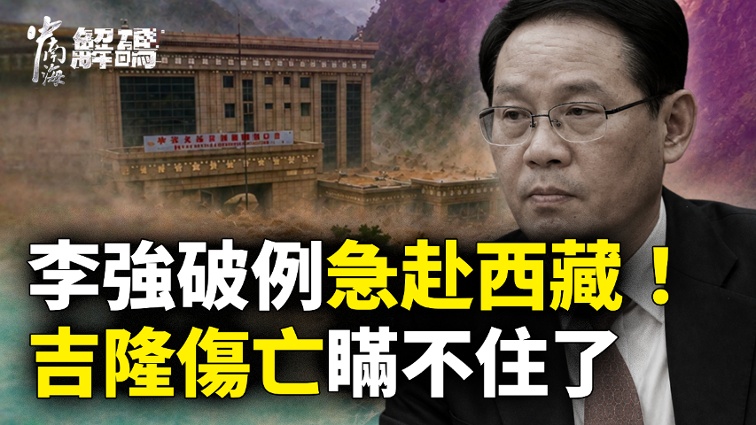
Li Qiang has made an unprecedented visit to Tibet! The casualties in Jilong can no longer be hidden!
[People News] After recently conducting research in Heilongjiang and Jilin, Chinese Premier Li Qiang swiftly traveled to the mudslide-affected area in Jilong Town, Jilong County, Tibet, on August 27. State media reported that he went to 'guide the disaster relief efforts, visit the rescue personnel, and check on the displaced residents,' acting on the orders of Xi Jinping. The day before, Vice Premier Zhang Guoqing had already headed to Tibet.
In my view, this is quite unusual. In recent years, whenever significant disasters have struck, such as the floods in Zhengzhou, Henan, the water crises in North China and Heilongjiang, the mountain floods in Sichuan, the flooding in Zhuozhou, Hebei, and the floods in Guangxi, Xi and Li have not, like their predecessors, promptly visited the disaster areas to inspect, comfort, and oversee relief efforts. Instead, they primarily issued directives and comments, only visiting the sites long after the disasters had subsided to stage a performance. In many instances, they did not even bother to put on a show.
Xi Jinping's avoidance of public appearances, aside from concerns about his health and fear of accidents, fundamentally reflects his lack of genuine regard for the common people; the phrase 'the country is the people, and the people are the country' is merely a self-serving slogan.
Li Qiang, as the second-in-command, did not visit the disaster area because his role as Premier differs significantly from that of his predecessors Zhu Rongji, Wen Jiabao, and Li Keqiang. For an extended period, particularly after Xi Jinping's consolidation of power, Li Qiang has essentially acted as a subordinate, lacking independent opinions and fully following Xi's directives. His decision to stay away from the disaster area suggests a desire not to overshadow Xi and risk incurring his displeasure. One reason for the ambiguous circumstances surrounding the death of his predecessor, Li Keqiang, was his opposition to Xi on certain issues, which made Xi feel threatened. Having spent many years in the Chinese Communist Party (CCP) bureaucracy, Li Qiang understands how to navigate the political landscape to ensure his own safety.
So, why did Li Qiang rush to the disaster area immediately following the landslide in Tibet?
Firstly, the severity of the disaster is notable, with many customs officials within the CCP system among the casualties, which is distinctly different from other major disasters in mainland China that primarily affect ordinary citizens. The CCP can no longer conceal this situation; on one hand, the leadership needs to reassure the domestic audience, and on the other, they must also present a favorable image to the international community.
On August 26, floods and landslides struck the border area between Nepal and Tibet, devastating numerous villages and causing significant damage to roads and infrastructure. The scenes of destruction are harrowing. As of now, the disaster has resulted in at least 160 fatalities and over 1,300 individuals reported missing.
The landslide also severely impacted Jilong in Tibet. The Jilong port serves as a crucial land border crossing and trade hub between China and Nepal, and Beijing views it as a vital node in the 'Belt and Road' global connectivity initiative. Jilong, which falls under the jurisdiction of Lhasa Customs, was elevated from a county-level to a department-level institution in 2015, and it reportedly has hundreds of permanent staff members.
The video reveals that the entire port building and surrounding structures were quickly submerged, indicating that the survival chances for the border inspection personnel working for the Chinese Communist Party (CCP) are extremely low. It is quite rare in recent years for so many individuals within the system to face disaster at the same time. Logically, Li Qiang must visit the site to provide reassurance; otherwise, it could dishearten many who serve the CCP.
Additionally, high-ranking officials from Nepal and other affected countries are closely monitoring the disaster. Nepal's Prime Minister Pushpa Kamal Dahal, also known as Prachanda, not only expressed his condolences on social media but also visited the severely impacted Nuwakot disaster area for an on-site inspection on August 27. If a leader of a small nation can take such action, then Li Qiang, as a leader of a major country, must also visit the disaster area, regardless of his personal wishes.
Moreover, Li Qiang's willingness to visit the disaster area without hesitation may be linked to his diminished concern about overshadowing Xi Jinping, which could potentially provoke Xi's resentment. Since the CCP's meetings in June have reiterated the importance of 'centralized and unified leadership,' while Xi's image and news continue to dominate the media, there are many indications that his military and party powers are being curtailed, and Li Qiang is no longer as deferential to Xi as he once was.
On the morning of July 28 this year, which marks the anniversary of the Tangshan earthquake, Li Qiang was entrusted by Xi to lay a wreath and offer condolences in Tangshan City. Traditionally, on the 'tenth' anniversary of the Tangshan earthquake, the highest leaders of the Communist Party of China (CPC) pay their respects. For instance, on the 40th anniversary on July 28, 2016, Xi visited the Tangshan earthquake site park and laid a wreath at the memorial wall. On the 30th anniversary in 2006, then CPC leader Hu Jintao visited the Tangshan Earthquake Memorial Square, and on the 20th anniversary, then CPC leader Jiang Zemin was present.
Whether Xi's absence was due to health issues or fear of assassination is not the main concern; what is significant is that Li Qiang was able to perform the duties expected of a party leader. Does this carry any political implications?
Recently, two new deputy secretaries of the Central Commission for Discipline Inspection of the CPC, who were promoted at the recent plenary session, are both aligned with Li Qiang's faction. If Li Qiang's power is indeed growing, such a scenario would be difficult to explain otherwise.
There have been recent reports from overseas suggesting that Xi may step down and that Li Qiang could succeed him. If this is accurate, then Li Qiang's visit to Tibet to bolster his image, without concern for Xi's resentment, becomes understandable.
(First published by People News) △








News magazine bootstrap themes!
I like this themes, fast loading and look profesional
Thank you Carlos!
You're welcome!
Please support me with give positive rating!
Yes Sure!