
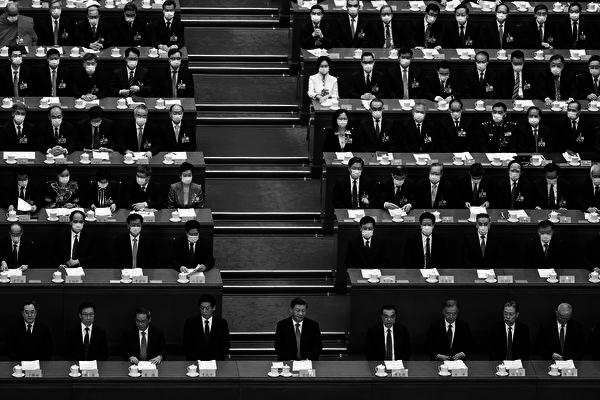
On March 5, 2023, CCP leaders attended the opening session of the National People's Congress.
[People News] In 2026, China finds itself on the brink of a historic crisis. Official media continues to broadcast daily claims of 'economic stability and improvement' and 'a sustained recovery in domestic demand,' creating an illusion of normalcy. However, recent figures released by the Ministry of Finance and the Standing Committee of the National People's Congress reveal a drastically different reality: by the end of 2025, the national government debt balance (including hidden debts) had soared to 102.5 trillion yuan, with local government statutory debt at 54.8 trillion yuan and hidden debt at 6.5 trillion yuan. By the end of May 2026, the total stock of government bonds had already surpassed 101 trillion yuan, with an increase of nearly 2 trillion yuan in just one month.
This situation does not indicate sound fiscal management; rather, it serves as a warning that the regime's finances are nearing collapse. The structure of the CCP's fiscal revenue is undergoing a fundamental shift—from reliance on land finance and export benefits to directly reaching into the pockets of ordinary citizens. The ongoing diversification of external markets, the trend of de-risking supply chains, and various trade restrictions imposed by other countries on China's overcapacity products are all undermining the export earning potential of China's manufacturing sector.
As external financial support diminishes and internal economic vitality wanes, the entire economic system is left with only the option of redistributing existing wealth—essentially, resorting to desperate measures to extract resources by any means necessary.
Wealth outflow, capital flight, the exodus of the rich, and the wave of party withdrawals—these seemingly unrelated phenomena actually point to a single core truth: an increasing number of Chinese citizens are voting with their feet, actively distancing themselves from this regime.
History does not repeat itself in a vacuum, but it often follows similar patterns—land reform, suppression of counter-revolutionaries, the Three Anti and Five Anti campaigns, public-private partnerships, the anti-rightist movement, and extending all the way to the Cultural Revolution. The history of the Chinese Communist Party (CCP) over its more than eighty years of rule is fundamentally a continuous quest for new adversaries and the initiation of new purges. Today, faced with fiscal exhaustion, the targets of its struggles have shifted to the wealthy, internet influencers, and every ordinary taxpayer.
1. Fiscal Cliff: Land finance has dried up, leaving only the option to reach out to the populace
The two main pillars supporting local government operations—land finance and export revenue—have now come to an end. National land transfer fees plummeted from nearly 9 trillion yuan in 2021 to less than 5 trillion yuan in 2025, a nearly fifty per cent decrease; the scale of land acquisition by urban investment companies fell from a peak of 3 trillion yuan in 2022 to just 1.02 trillion yuan in the first eleven months of 2025, a decline of over sixty per cent.
The severity of the local fiscal crisis is clear from the financial records of a county-level city: last year, Zhijiang in Hubei reported fiscal revenues of 4 billion yuan, while expenditures soared to 5.75 billion yuan. The shortfall was partially covered by 2.57 billion yuan in transfers from higher authorities, while 'non-tax revenue' was forcibly increased from 540 million yuan the previous year to 1.12 billion yuan within a year.
Such fiscal deficits are not isolated incidents in China's third and fourth-tier cities; they are a widespread issue. As land sale revenues dwindle and borrowing capacity is restricted by the central government, local governments face the challenge of maintaining a large civil service, repaying maturing debts, and managing various stability-related expenditures. This leaves them with only one option — to increase taxes on local enterprises and citizens.
This reflects the old logic that the Communist Party of China has relied on since its founding, using struggle to build the nation and plunder to maintain stability, now reemerging in a new form amid fiscal constraints. In the past, it involved classifying people and fighting landlords to seize land; today, it involves auditing accounts and pursuing tax payments to seize deposits. While the methods have evolved, the underlying essence remains unchanged.
2. Inspection Storm: Auditing for Thirty Years, Enterprises Fall Silent
Although the State Administration of Taxation has publicly stated that it has not organized a nationwide, industry-wide, or concentrated 'auditing for thirty years' initiative, several listed companies have announced tax payment supplements since the beginning of this year. For instance, Zhi Jiang Liquor Industry, a subsidiary of Wei Wei Foods, was required to pay back consumption tax for 15 years, from 1994 to 2009, totaling over 85 million yuan. Bo Hui Co., Ltd. was ordered to pay an additional 500 million yuan in taxes and subsequently announced a production halt. Hua Lin Securities supplemented over 29 million yuan in corporate income tax for 2018 to 2021, along with late fees of about 18 million yuan. Bei Da Pharmaceutical also supplemented 19.44 million yuan. Additionally, several other companies, including Shun Hao Co., Ltd. and Lian Jian Optoelectronics, have issued similar announcements.
These cases highlight a troubling reality: the investment incentives once promised by local governments have now been reclassified as "tax violations" in tax documents, resulting in business owners receiving hefty tax bills overnight. Some have even lost their entire fortunes and faced imprisonment as a consequence. Lawyers have publicly criticized this retroactive investigation of actions spanning decades, arguing that it contravenes the fundamental principle of administrative law that "laws do not have retroactive effect," and is essentially a frantic and misguided response to the looming financial collapse of local governments.
This reflects the typical logic of this regime—it operates without regard for any contracts or commitments; its only guiding principle is its immediate interests at any given moment.
Online influencers and self-media practitioners have also been caught in this wave of inspections. The State Administration of Taxation revealed that since 2021, tax authorities have investigated over 360 cases of tax evasion involving online influencers, recovering more than 3 billion yuan in unpaid taxes. In 2024 alone, inspections were carried out on 169 online influencers, recovering a total of 899 million yuan in income. From January to November 2025, 1,818 individuals categorized as "high-income" (including celebrity influencers) were investigated nationwide, recovering 1.523 billion yuan in taxes.
Among those penalized, the prominent streamer Sydney (Zhu Chenhui) received a fine of 65.55 million yuan, while Lin Shanshan was fined 27.67 million yuan. Car reviewer Chen Zhen was found to have underpaid personal income tax by 1.1867 million yuan from 2021 to 2023, leading to a requirement to repay taxes along with late fees and fines, amounting to a total of 2.4748 million yuan. Behind these high-profile streamers, there exists a vast number of small and medium-sized streamers, freelance writers, and online education workers, all living in fear and uncertainty about whether they will be the next victims of a 'precise strike.'
This unpredictable and retrospective tax inspection storm, which can reach back decades, is exactly the atmosphere that this regime aims to instill in society—forcing everyone to live in constant fear of potential accountability, thereby discouraging any thoughts of resistance or independent thinking. This widespread sense of panic is permeating throughout society.
People are starting to understand that under this system, no one can genuinely possess 'legitimate and stable' property and income, as the rules can always be retroactively altered, with changes consistently favoring the regime and disadvantaging individuals.
3. Targeting the wealthy and the middle class: liquidating the idols it has fostered
Since the introduction of the 'common prosperity' slogan, leading entrepreneurs and well-known private enterprises in China have been under the intense scrutiny of high-pressure regulations. Internet platform companies have faced anti-monopoly investigations, the education and training sector experienced a sudden policy overhaul, leading real estate companies have been compelled to 'share profits,' and major financial capital figures have been repeatedly prosecuted and put on trial.
Simultaneously, the scrutiny of high-income groups under personal income tax is intensifying. The cross-border information exchange of financial accounts (CRS) has been fully implemented, regulations on equity holding and family trusts are becoming increasingly stringent, and discussions about inheritance tax legislation are frequently resurfacing. This situation bears a striking resemblance to past practices of classifying and defining class enemies—today's focus on 'regulating the disorderly expansion of capital' mirrors yesterday's campaign of 'seizing the rich and distributing land.'
It is important to note that this wealth redistribution is not a 'robbing the rich to help the poor' approach; the wealth that has been collected has not genuinely been directed towards social welfare. Instead, it has been used to repay 102 trillion yuan in local government debt, sustain a vast bureaucratic system, and fill the ever-growing demands for stability maintenance expenditures.
The middle class is also feeling the pressure: education costs for children remain high, out-of-pocket medical expenses are on the rise, mortgage burdens have yet to ease, and various taxes and fees are increasing simultaneously, with the base for social security contributions also being raised. Many middle-class families that once believed they had 'made it' are shocked to discover that the gap between them and ordinary citizens, who have never truly been wealthy, is closing at an alarming rate.
Ordinary citizens see no real improvements in social welfare, no relief from the burdens of medical and educational expenses, and no enhancements in pension security. Instead, they only observe their bank accounts dwindling while government scrutiny and intervention in their assets are increasing.
This encapsulates the essence of tyrannical governance — first, it creates idols, then it systematically dismantles them, thereby manipulating public sentiment and reinforcing its own authority. Over the past two decades, the Chinese Communist Party (Zhongguo Gongchandang) has elevated numerous private entrepreneurs to the status of 'advanced models', only to now unceremoniously bring these former idols down one by one, placing them on the list for liquidation.
4. Income increases by 50% while tax burden surges over 2 times
Examining the policy adjustments of a single tax type may not fully capture the immense pressure ordinary citizens are facing. The real issue lies in the significant disparity emerging between income and tax burden, and these figures serve as irrefutable evidence: in 2025, the nominal growth of per capita disposable income for residents nationwide is projected at 5%, with the median growth rate lagging at just 4.4%; meanwhile, personal income tax revenue is expected to soar to 1.62 trillion yuan, marking an astonishing 11.5% increase from the previous year — more than double the growth rate of residents' income.
Concurrently, overall national tax revenue has only risen by 0.8%, with corporate income tax seeing a mere 1% increase, while personal income tax stands out with remarkable growth, and stamp duty has skyrocketed by 24.1%.
These figures, released by the government, clearly illustrate that it is not a genuine economic recovery at play, but rather the comprehensive implementation of the 'Golden Tax Phase IV' big data tax inspection system. Additionally, since last October, internet platform companies have been mandated to report tax-related information, effectively bringing every bit of income that ordinary citizens and middle-class families previously kept in grey areas into the tax net.
The wallets of ordinary citizens have not noticeably thickened, yet the portion taken by the government from their pockets is expanding at a rate that far exceeds income growth. To address fiscal shortfalls, many local governments are increasingly focusing on various administrative fees and fines; traffic violation fines have quietly increased, and the frequency of inspections by market regulatory agencies is rising alongside the amounts of fines issued.
This dual pressure of 'slowly rising income and rapidly increasing tax burdens' is quickly eroding the disposable income and consumption capacity of average Chinese families, undermining society's confidence in the fundamental belief that 'hard work can lead to a better life.'
In several industries, a peculiar situation of 'having work but no money' has arisen—while order volumes do not appear to have significantly decreased, companies are facing squeezed profit margins, which ultimately leads to salary reductions, delayed wage payments, and even disguised layoffs for employees. Additionally, the income of flexible workers, such as delivery riders and ride-hailing drivers, is continuously declining due to the rising commission rates taken by platforms.
An increasing number of people are starting to realize that within this system, individual diligence and effort are becoming increasingly ineffective against the rapid wealth loss caused by systemic exploitation.
5. Capital and Talent Exodus: Casting a Vote of No Confidence with Real Money
The internationally recognized firm Henley & Partners has published the "Global Wealth Migration Report," indicating that in 2024, approximately 15,200 millionaires from China are expected to emigrate, making it the largest outflow in the world; this figure was 13,500 in 2023. The United States remains the primary destination, projected to attract around 7,500 wealthy individuals from China in 2025 alone.
Simultaneously, the demand among high-net-worth individuals in China for offshore asset allocation, overseas insurance policies, and cross-border trusts is on the rise. It is noteworthy that the participants in this wave of emigration are no longer confined to the traditional "top wealthy individuals." An increasing number of professionals, previously regarded as upper-middle-class—such as doctors, lawyers, engineers, and mid-level corporate managers—are now seriously contemplating the possibility of emigrating with their families.
Alongside the capital outflow, there is a significant loss of talent, as many key professionals with extensive experience and skills in sectors like technology, finance, and education are actively seeking opportunities abroad through various channels.
This talent drain poses a much more serious threat to the long-term potential of China's economic development than the short-term capital outflow—because while capital may return partially after policy changes, the chances of bringing back individuals who have left with their families and skills are exceedingly low.
When the most capable and resource-rich class in a country is taking concrete actions and literally voting with their money to leave, it serves as a profound vote of no confidence in the legitimacy of the regime and its future outlook.
History has shown time and again that a regime genuinely backed by its people does not need to impose foreign exchange controls or border restrictions to keep its citizens from leaving; they will choose to stay of their own accord. Yet, the Chinese Communist Party (Zhōngguó Gòngchǎndǎng) is currently confronted with a situation where even its wealthiest and most privileged citizens are hastily seeking to depart.
6. The Wave of Party Withdrawals: A Deeper Awakening than Capital Flight
While the flight of capital and the loss of talent reflect the social elite's distrust in the economic prospects under the Chinese Communist Party (CCP), the unprecedented wave of party withdrawals that has persisted for over twenty years signifies a deeper and more fundamental awakening. An increasing number of ordinary Chinese citizens are no longer just disappointed with economic policies; they have fundamentally recognized the evil nature of a regime that is founded on hatred and governed through struggle, leading them to make a decisive choice to sever ties with it.
The term "three withdrawals" refers to quitting the Chinese Communist Party, the Chinese Communist Youth League, and the Young Pioneers of China. Within China's educational and social system, the vast majority of individuals are automatically enrolled in the Young Pioneers during their youth, and a significant proportion later transition to become members of the Youth League in middle and high school, with many core members eventually being absorbed into the Party.
Upon joining the Party, individuals are required to take an oath to "dedicate" their lives to the organization, even pledging to be "ready to sacrifice everything for the Party" at any moment. These oaths serve as shackles that bind people's hearts and manipulate their souls under this regime.
This almost "inherent" connection to a gang-like organization means that many individuals, despite being nominally members of the Party, League, and Pioneers, have long since lost their identification with this organization and often feel a deep sense of aversion towards it.
Since the release of the "Nine Commentaries on the Communist Party" series in 2004, the wave of resignations from the Party has persisted for over twenty years. The total number of individuals who have withdrawn has surged from hundreds of thousands to more than 460 million today. This enduring wave, which has intensified alongside the growing social tensions in China, can be attributed to an increasing number of Chinese citizens who, through their personal experiences with various social events—such as abrupt changes in economic policies, information blockades during the pandemic, selective law enforcement by the judiciary, and the rampant wealth plundering in recent years—have come to recognize the malevolent nature of the CCP regime, which prioritizes the Party's interests over the welfare of the people.
Currently, as ordinary citizens see their savings depleted by tax audits and experience the dual pressures of declining income and rising tax burdens, their distrust and disappointment in the regime are evolving into more determined actions.
7. Latest Statistics: The Choices of Over 460 Million People
According to the latest statistics from the Global Service Center for Quitting the Party, as of September 1 this year, the total number of individuals who have declared their withdrawal from the Chinese Communist Party, the Communist Youth League, and the Young Pioneers through various channels worldwide has reached 465,726,020, and this figure continues to grow daily.
This indicates that despite the Chinese Communist Party (CCP) continuously tightening its internet controls and intensifying its crackdown on the dissemination of information regarding the wave of party withdrawals, a steady stream of Chinese individuals are still choosing to exit this malevolent organization. They do so by circumventing the Great Firewall to access overseas information, sharing insights through word of mouth among friends and family, and utilizing various discreet yet determined channels.
Each statistic represents a specific individual and a distinct journey of awakening: some have become disheartened after experiencing tax audits or witnessing their friends and family face unjust asset freezes; others have had a sudden realization upon seeing the local government's overwhelming debt of 102 trillion yuan and the resulting heavy taxation; and an increasing number of people have recognized the harsh and unyielding attitude the CCP regime holds towards its citizens after observing wealthy individuals and middle-class families opting to flee.
The persistent rise in party withdrawals serves as the most direct reflection of the CCP regime's eroding governance foundation. A regime that genuinely enjoys the support of its people does not need to rely on stringent internet censorship or the pursuit and interception of information about party withdrawals to naturally garner public support.
What the CCP confronts today is that even with the entire state apparatus mobilized to obstruct these actions, it remains unable to prevent a growing number of individuals from taking tangible steps to sever ties with it. This reality starkly illustrates the profound legitimacy crisis facing the regime.
8. On the Eve of Economic Collapse: Signs of Retribution Approaching
Historically, many regimes have shifted from prosperity to decline, ultimately leading to their collapse. A common pattern is that when a regime begins to aggressively plunder the wealth of its citizens, it often signals that its moral, social credit, financial, and governance foundations are nearing depletion, indicating that a final collapse is imminent.
The signs currently displayed by the Chinese Communist Party—over one hundred trillion yuan in government debt, a decades-long audit crackdown, the targeting of billionaires, and tightening capital controls—align closely with the characteristics of many regimes on the verge of collapse throughout history.
A healthy and sustainable governance system must be founded on the ability of its citizens to live and work peacefully, with their wealth receiving basic protection. When rulers begin to use unscrupulous methods to seize the wealth of those they govern, it indicates that the regime has lost its capacity for normal operation and self-sustainability, and can only survive by depleting its resources.
This is not an alarmist view, but a clear judgment grounded in a deep understanding of the patterns of human history.
The principle of retribution for good and evil is a natural law. The violence and malevolence of the Chinese Communist Party, which has brought calamity to the Chinese people and the world, will inevitably face consequences and punishment. The current financial and trust crisis confronting the Chinese Communist Party serves as a warning of this impending retribution.
A gentleman does not stand beneath a precarious wall; he distances himself from the Chinese Communist Party (CCP), rejects being tied to it, renounces the toxic oath taken upon joining, and separates from the CCP to ensure his safety. When the true moment of the CCP's collapse arrives, the resulting social unrest, competition for resources, and potential chaos will be part of the CCP's reckoning, catching many who could have escaped off guard and leading them into desperate situations.
9. Understanding the essence is the first step in protecting oneself and one's family.
In light of this situation, many ordinary citizens in mainland China may feel lost and powerless, as individual strength seems minuscule against the vast machinery of the state. However, history has consistently shown that it is the countless ordinary people, after recognizing the truth, who can truly dismantle an unpopular regime through a series of seemingly small yet profoundly impactful choices.
Withdrawing from the party is not merely a matter of organizational separation from the CCP; it signifies a spiritual awakening and a choice—not to endorse the malevolent logic of the CCP regime, which places party interests above the welfare of the people, and to no longer tie one's fate to an organization that is destined to face the historical consequences of its actions.
Furthermore, the 'three withdrawals' can be made by anyone, whether through pseudonyms on the overseas global withdrawal service center website or by processing certificates under their real names. For ordinary Chinese citizens currently facing a staggering 11.5% increase in personal income tax, while their income has only risen by 5%, recognizing the evil nature of this regime—founded on hatred and governed by struggle—becoming disengaged from the Party, Youth League, and Young Pioneers, and nullifying the toxic oaths made in the past, is the first step towards regaining control over their own destinies and seeking a peaceful future for themselves and their families.
As more individuals make this choice, the resulting collective movement will form a historical tide capable of shaking the very foundations of this regime's rule, marking a process of self-rescue for the Chinese people.
Conclusion: Choosing Clarity and Peace on the Eve of Collapse
China stands at a pivotal historical crossroads. With government debt reaching 102 trillion yuan, land finance halved over five years, personal income tax growth surging to more than double the income growth rate, over 15,000 wealthy individuals fleeing overseas in a single year, and an unprecedented and continuously rising wave of withdrawals from the Party, these factors intertwine to reveal various signs of the impending end of the CCP regime.
History does not offer many opportunities or escape routes for those who remain obstinate and continue to align themselves with an evil regime that is destined for decline.
For those who can recognize the situation early and make informed choices, today presents a genuine, albeit brief, window of opportunity. Before the regime completely collapses and social order experiences severe upheaval, everyone still has a chance to understand the true nature of this regime, to mentally and organizationally distance themselves from it, and to secure a way out for themselves and their families' future.
When the actual moment of collapse arrives, the resulting social unrest and competition for resources will catch many who could have prepared off guard, leaving them in desperate situations.
The figure of 460 million—still on the rise—represents not only a psychological detachment from the Chinese Communist Party (CCP) but also reflects the contributions of hundreds of millions of Chinese individuals in their own ways towards the disintegration of the CCP. The balance of history is gradually shifting, bit by bit, with the increasing involvement of more forces for justice.
I hope that every Chinese person navigating the currents of this era can see the truth early, recognize the right direction, and make truly wise and informed choices for their and their families' futures before the regime collapses completely, avoiding danger and moving forward safely.
(Source: The Dajiyuan)
△





News magazine bootstrap themes!
I like this themes, fast loading and look profesional
Thank you Carlos!
You're welcome!
Please support me with give positive rating!
Yes Sure!