

Jilong Port is set to be rebuilt on its original site. When will the Chinese Communist Party's belief that 'man can conquer nature' come to an end? (Video)
[People News] Hello, dear viewers, and welcome to "Forbidden News Decoded." I am Sun Ning.
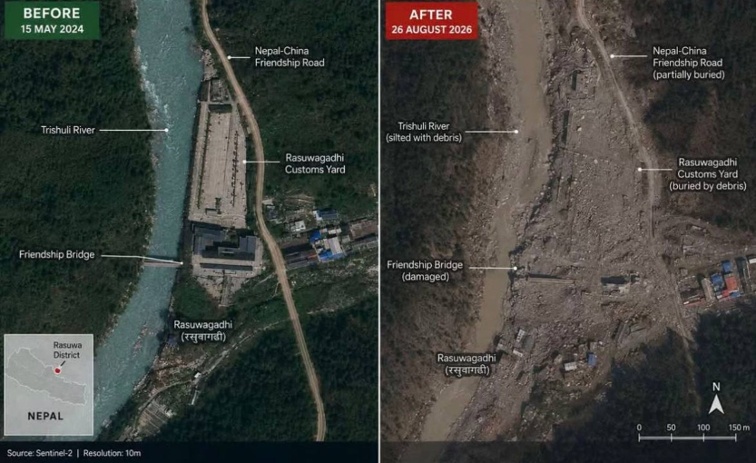
On the afternoon of September 6, 2026, a meeting reported that as of 6 PM on September 5, the Jilong '8.26' mudslide disaster had resulted in 43 fatalities and 519 individuals missing on the Chinese side. Meanwhile, on the other side of the border, Nepal confirmed that the mudslide disaster had caused 1,344 deaths and left 4,898 people missing.
In total, nearly seven thousand lives have been tragically lost. Yet, in light of such devastating casualty figures, the Chinese Communist Party has already begun discussing the next steps for reconstruction and functional recovery during the press conference.
This stark contrast forces us to reconsider the decision-making logic behind this disaster: why was there a necessity to construct a large national-level border port in a 'mudslide flood channel' that the geological community recognizes as a death zone? Is this cycle of 'disasters every year, reconstruction every year' the outcome of scientific evaluation, or is it political will leading a reckless gamble against nature?
To grasp the current predicament of Jilong Port, we must adopt a broader historical perspective. At the China-Nepal border, traders and drivers often humorously remark that this area 'experiences disasters every year and is rebuilt every year.' This statement reflects not only a sense of helplessness towards extreme weather but also highlights the long-standing shortsightedness of decision-makers—attempting to defy the cold and immutable laws of nature with sheer political determination.
The shift of the China-Nepal land corridor stems from a geological disaster that was not assessed for the long term. Initially, the Zhangmu Port was the largest land port between China and Nepal. Following the devastating earthquake in Nepal in 2015, a catastrophic landslide occurred on the mountain above Zhangmu Port, effectively paralyzing the entire port. To quickly showcase its strategic expansion into South Asia, the decision-makers of the Chinese Communist Party shifted the focus of foreign trade and infrastructure investment entirely westward, directing resources to the Kerung Port, located several dozen kilometers away, without rigorous transnational geological assessments.
However, while administrative orders changed the corridor, they could not alter geological realities. The Kerung Port is also located in a narrow valley surrounded by high mountains and deep gorges. In recent years, nature has repeatedly issued warnings against this kind of reckless infrastructure development:
In November 2018, a large-scale alpine landslide in the Kerung Valley blocked the upstream river, creating a high-risk landslide lake that nearly submerged the downstream port.
In July 2020, a rapid melting and collapse of a glacial lake upstream of the Kerung Valley caused a mountain flood that destroyed the foundation of the China-Nepal Friendship Bridge, resulting in a halt to border crossings.
In the summer of 2024, frequent mudslides struck the Kerung Valley again, leading to a significant backlog of cross-border goods.
If these disasters can be seen as intermittent warnings, then by 2025, the political arrogance of the decision-making system, which operates under the belief that 'man can conquer nature,' would face a direct confrontation with natural forces.
In the early hours of July 8, 2025, the 'Pujie Puzangbu' glacial lake in Tibet suddenly collapsed, unleashing a massive mountain flood and mudslide that instantly destroyed the China-Nepal Resuo Bridge.
Confronted with such a high-risk geographical environment, the appropriate scientific response should have been to halt construction, restart risk assessments, and even consider a strategic withdrawal. However, to ensure the strategic progress of the 'Belt and Road' South Asia Corridor, the Chinese Communist Party (CCP) swiftly reorganized teams for rapid repairs, attempting to create a 'miracle of reopening' amidst the dangers.
Yet, natural laws do not heed the commands of the 'Party.' Just three weeks later, on July 30, 2025, a powerful summer monsoon triggered flash floods once again, destroying the roads and protective embankments that were under repair by the Chinese side.
In less than a month, the same site was washed away twice. This served as a clear warning from nature regarding the risks involved, but under the prevailing mindset that political objectives take precedence over all else, the CCP chose to ignore geological risks and continued to pour substantial funds into on-site repairs. They spent nearly six months constructing a temporary steel frame bridge and announced the resumption of customs clearance with great fanfare on January 1, 2026.
However, this costly and scientifically unsubstantiated blind investment lasted only eight months before it was deemed a failure. On August 26, 2026, a more powerful and complex 'high-altitude ice collapse mudslide' erupted, completely obliterating Jilong Port.
Building a Car Behind Closed Doors
During a meeting on September 6, the CCP disclosed that it was engaged in in-depth discussions regarding the functional restoration and reconstruction of Jilong Port. Almost simultaneously, a new conceptual plan purportedly aimed at the reconstruction of Jilong Port emerged in the media and online.
This plan appears to be remarkably futuristic: to protect against mudslides, the designer proposes elevating the core buildings of the port and constructing them along the mountainside; building high-strength diversion channels on both sides of the mountain to manage glacial meltwater; and even planning multiple vertical escape staircases, underground storage shelters, and a helicopter pad on the roof.
This seemingly comprehensive plan has received considerable praise online. However, a careful analysis from the perspectives of engineering geology and economics reveals significant engineering blind spots.
Firstly, there is a fundamental misalignment regarding the core functions of the port. The customs port is fundamentally designed to facilitate international trade, requiring it to handle hundreds of heavy trucks, each weighing dozens of tons, for customs clearance and inspection daily. If the joint inspection building and inspection area are elevated to be constructed halfway up the mountain or on a cliff to avoid mudslides, how will heavy trucks navigate efficiently? Is there a plan to build an extremely steep mountain highway bridge? This would undoubtedly increase the already high costs of cross-border logistics.
Secondly, there are geological risks associated with construction on fractured mountains. The mountains flanking the Jilong Valley have suffered extensive damage from thawing permafrost and earthquakes over the years, resulting in very loose rock layers. Excavating and constructing large-scale vertical escape staircases and underground storage shelters on such unstable slopes could easily trigger significant landslides and collapses during construction or periods of heavy rainfall. These anticipated 'escape routes' may, in the event of extreme geological disasters, instead pose new safety risks.
Regarding the helicopter pad and drone supply, while they may function as an emergency backup in extreme situations, depending on them to sustain regular international trade logistics is nothing short of a financial fantasy. This approach appears to seek defensive measures, yet it fundamentally remains entrenched in the infrastructure obsession of 'battling the laws of nature with reinforced concrete.'
Geological Forbidden Zone
In reality, regardless of how much the architectural design is refined, the original site of the Jilong port is inherently unsuitable for the construction of a large customs port. The geological conditions in this area have long been deemed by nature as an absolute no-go zone for human infrastructure.
The Jilong Gorge is one of the five renowned gorges in the Himalayas. Over a horizontal distance of several dozen kilometers from north to south, the elevation drops sharply by thousands of meters. The steep mountains flanking the Jilong Gorge rise dramatically, and the river valley is as narrow as a line, creating a classic deeply cut V-shaped valley. This type of terrain acts as a natural 'debris flow engine' in hydrological geology—water converges at an incredibly rapid pace, and the slope is extremely steep. If a mountain flood occurs upstream, the water will quickly accumulate downstream, violently eroding the valley floor and debris along the sides, resulting in destructive waves several meters high in the narrow flood channel at the original site. Constructing a port in such a flood channel is akin to building a house next to an erupting volcano.
Historically, infrastructure defenses relied heavily on historical hydrological data, but the climate of the Qinghai-Tibet Plateau has changed dramatically. Global warming has accelerated the thawing of permafrost in high-altitude regions, and the melting of underground ice, which once helped to stabilize rocks, has made these mountainous areas highly vulnerable to ice-rock collapses. The origins of these 'high-altitude chain disasters' are located at such high elevations and distances that current technology cannot provide accurate pre-disaster warnings. When debris flows cascade down to the valley floor, personnel typically have only a few minutes to react. Any ground defense structures are rendered as fragile as paper against the immense gravitational forces of millions of tons crashing down.
The many lethal hidden dangers confronting the Jilong port primarily stem from within Nepal. On the Chinese side, authorities can mobilize administrative resources to construct dams and manage the mountains upstream; however, on the other side of the border, China lacks jurisdiction, and Nepal itself is severely under-equipped to manage its high-altitude mountainous regions. This indicates that the safety of the Jilong port is, in essence, passively dependent on the unstable mountains and glaciers in the neighboring country that could collapse at any moment. China's unilateral efforts to build protective walls on its side cannot effectively mitigate the source threats posed by cross-border debris flows.
The Ambitious China-Nepal Railway
If the narrative were to end with merely the reconstruction of the port's original site, it would be seen as a financial waste. However, what is even more alarming is that within this fragile canyon, which is frequently affected by geological disasters, the decision-makers of the Chinese Communist Party have set their sights on a much grander political ambition—the China-Nepal Railway.
In line with the grand narrative of the Chinese Communist Party's 'Belt and Road Initiative', the China-Nepal railway is set to extend from Shigatse in Tibet, moving south through the majestic peaks of the Himalayas, passing through Gyirong Port, and ultimately reaching Kathmandu, the capital of Nepal. The Chinese Communist Party views this railway as a strategic tool aimed at South Asia, designed to disrupt India's trade monopoly over Nepal and to project its influence directly into the heart of South Asia.
To achieve this, the Chinese Communist Party has invested substantial funds in surveying, with initial plans to complete the feasibility study for the entire line by 2026. However, a recent major disaster has effectively derailed the blueprint for the China-Nepal railway.
Consider this: railways differ significantly from roads. When a road collapses, off-road vehicles can often find a detour, and a temporary route can be established within days. In contrast, railways have stringent requirements regarding gradient, foundation settlement, and tunnel safety.
If the China-Nepal railway is to traverse the Gyirong Gorge, it will need to construct elevated bridges and dig extensive tunnels on these high-risk mountains, which are susceptible to large-scale landslides, mudflows, and glacial lake outburst floods at any moment.
Should a rock and ice collapse of this scale occur, unleashing millions of tons of mud and debris, any railway bridge pier would be twisted beyond recognition, and the entrance to the tunnel would be instantly filled and sealed. If a train carrying passengers or goods were to be passing by at that moment, it would result in an unimaginable catastrophe.
Local scholars in Nepal and international geological experts have repeatedly warned that the geological conditions in the trans-Himalayan region are a 'no-go zone' for railway construction. Nevertheless, the senior leadership of the Chinese Communist Party (CCP) has stubbornly pursued this as a political project aimed at 'demonstrating the superiority of the socialist system.' They intend to use the experience gained from building the Qinghai-Tibet Railway to replicate it for the Himalayan Railway, completely overlooking the fact that the interior of the Tibetan Plateau is relatively flat, while the border area is characterized by extremely steep terrain and intense geological activity.
The recent floods and landslides, which devastated the Gyirong Port, can be interpreted as nature's early warning for the China-Nepal Railway.
An Unfinished Tragedy
Within the CCP's political narrative, there exists a core belief known as 'man conquers nature.' They are convinced that as long as the highest leadership issues an order and the budget is allocated, even the Himalayas must yield to the will of the 'Party.'
However, this time, the relentless landslide in the Gyirong Valley has starkly exposed the complete failure of this 'willpower theory.'
Nature does not heed official documents or the deliberations of party committees. It adheres strictly to the unforgiving laws of physics and geology. If you construct a port in the flood channel of a landslide, it will reclaim its territory during the flood season without fail. If you insist on 'rebuilding every year' for the sake of appearances, it will repeatedly destroy your infrastructure achievements at a frequency of more than once a year.
Each failure of the 'man conquers nature' gamble results in countless ordinary families facing loss and devastation; every financial black hole created by reckless infrastructure projects consumes the hard-earned money of taxpayers.
In light of the golden passage that has now vanished, if the decision-makers continue to hold onto their arrogance and attempt a third makeshift repair on the ruins of the original site, the next blow will inevitably come in the not-so-distant future, manifesting in an even more brutal and destructive manner.
That concludes today’s segment. If you enjoyed our program, please give us a thumbs up, subscribe, and activate the notification bell. We also welcome your thoughts on the troubled fate of the Jilong port in the comments section. We look forward to seeing you in the next episode!
(“Forbidden News Decoded”)
△





News magazine bootstrap themes!
I like this themes, fast loading and look profesional
Thank you Carlos!
You're welcome!
Please support me with give positive rating!
Yes Sure!