
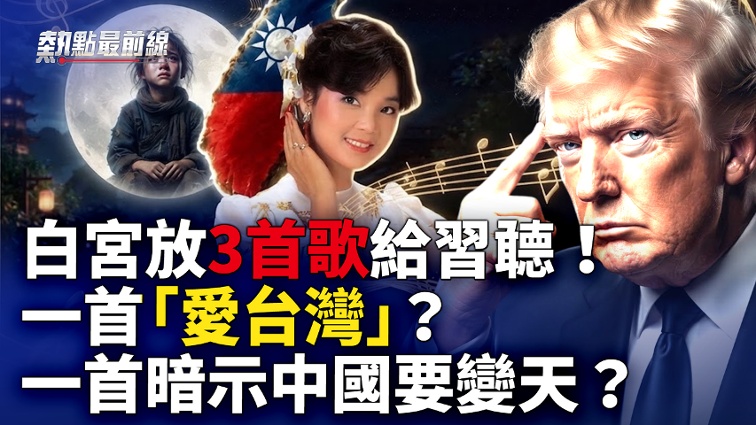
The White House Plays 3 Songs for Xi, Suggesting Affection for Taiwan and a Shift in China (Video)
[People News] Hello, dear viewers, welcome to 'Hotspot Frontline,' I am Xiaokun.
On September 25, Xi Jinping's three-day visit to the United States officially came to an end, and he departed from Washington. The red carpet was rolled out, military honors were given, formal discussions took place, and he attended a state dinner at the White House. The level of hospitality extended to Xi Jinping by Trump during these three days was notably high.
However, after three days of festivities, what remains? The answer may have begun to reveal itself during the state dinner on the evening of the 24th.
The state dinner was indeed grand, but where are the significant deals?
On the evening of the 24th, the White House East Room was bustling with prominent figures. A host of heavyweight personalities from the American tech and business sectors, including Musk, Huang Renxun, Cook, Zuckerberg, and Bezos, were in attendance. In contrast, Xi Jinping's official delegation lacked corresponding Chinese corporate CEOs.
This suggests that Beijing did not prioritize the business sector during this visit, which does not resemble a business summit aimed at facilitating large contracts between the two countries' companies.
As the three-day visit wraps up, the public outcomes appear to be disproportionate to the grandeur of the state visit. Reuters characterized this visit as marked by high-level hospitality and personal diplomacy, yet no significant public breakthroughs were observed regarding a series of major disagreements.
In other words—while the outward display was impressive, how much substance lies beneath? That may need to be assessed separately. Nevertheless, while the anticipated big deals did not materialize, the few songs played by the White House over the past two days have prompted many netizens to engage in 'political interpretation.'
Three songs, what a coincidence!
The first song is "The Moon Represents My Heart." When Xi Jinping arrived at the White House, a harp began to play this familiar tune beloved in the Chinese community.
Given that it was the Mid-Autumn Festival, selecting a song related to the moon was certainly appropriate. However, with so many Chinese songs connected to the moon and the festival, why was it specifically "The Moon Represents My Heart," popularized by the Taiwanese singing legend Teresa Teng (Deng Lijun)?
This led netizens to speculate: "The Moon Represents My Heart" - could this be a subtle hint that America's affection for Taiwan remains constant, like the bright moon? Of course, this is merely a political interpretation from netizens; the White House did not make such a statement.
Later that evening, an even more intriguing moment occurred. While Xi Jinping was attending a state banquet at the White House, the performers suddenly began singing "One Day More" from the musical "Les Misérables."
This song is set on the eve of the June 1832 uprising in Paris, where the students in the story are gearing up to take to the streets. This prompted netizens to wonder: is the White House suggesting that today's China resembles a "Les Misérables" scenario? Or is it alluding to some larger social changes?
But the surprises didn't end there. During the day, Melania Trump accompanied Peng Liyuan to the Smithsonian National Museum of Asian Art, where local children in Washington sang another song - "Songs and Smiles." This song emerged in the 1980s, a time marked by China's reform and opening up and the rapid advancement of Sino-American relations.
A song from Taiwan, "The Moon Represents My Heart"; a song from the eve of rebellion, "Les Misérables"; and another song that brings back memories of the reform and opening-up era, "Songs and Smiles." When these three songs converge, is it merely a coincidence, or is there a hidden agenda from those at the White House responsible for the arrangements? We cannot jump to conclusions. However, it must be noted—there are indeed exceptional individuals at the White House.
At the state banquet on the 24th, there was also a particularly interesting set of diplomatic gifts.
Xi Jinping announced that two giant pandas, Ping Ping and Fu Shuang, would be sent to Atlanta, while Trump presented Xi Jinping with a bald eagle.
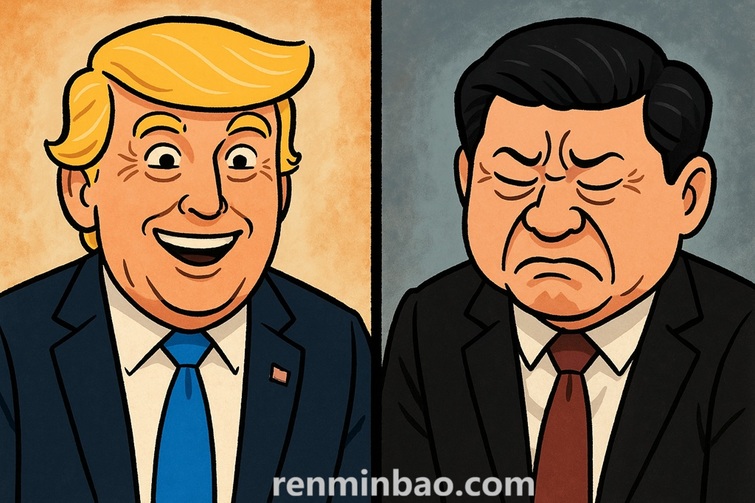
On one side is the round, endearing panda; on the other is the sharp-eyed American eagle, ready to take flight. One is meant to charm, while the other is poised for action. The visual themes are indeed completely different.
However, if that eagle symbolizes the image of the United States, then on the 25th, the three items that Trump showed Xi Jinping likely represent the true foundation of America.
Returning to the final day of Xi Jinping's visit to the U.S.
The "Leader" unveiled three treasures.
Does everyone recall? When Xi Jinping delivered his speech at the White House, he inadvertently referred to the American officials as "leaders." Surprisingly, on the last day, Trump, the highest "leader" of the United States, indeed revealed three of America's most prized "treasures."
Trump and Melania first hosted a tea gathering with Xi Jinping and Peng Liyuan at the White House, and then they all proceeded to the National Archives. What was presented to Xi Jinping were the "Declaration of Independence," the "U.S. Constitution," and the "Bill of Rights."
Is Trump intentionally sending a message to Xi Jinping through these three documents? We cannot say for sure. However, the image itself is quite intriguing. The 'Declaration of Independence' addresses fundamental human rights and the legitimate source of governmental authority; the 'Constitution' outlines the framework and limitations of government power; and the 'Bill of Rights' safeguards a range of essential civil liberties.
China also possesses a constitution that includes civil rights such as freedom of speech, publication, and assembly. What is truly worth comparing is whether the rights inscribed on paper can effectively limit governmental power.
Additionally, Trump made a very straightforward remark at the state banquet, stating that he and Xi Jinping represent 'different systems.' Despite the red carpet treatment and state banquet for Xi Jinping in recent days, along with Trump's ongoing compliments, not everyone in the U.S. political sphere is so accommodating towards Beijing.
Republican Senator John Kennedy, during an interview with CNN on the 24th, used very strong language to characterize Xi Jinping, calling him one of the 'most deceitful individuals' he has ever encountered. The host promptly asked him: Are you concerned that Trump might be misled by Xi Jinping? Kennedy responded succinctly: 'I don't believe the President will be fooled.'
This certainly reflects Kennedy's personal political viewpoint, but it indicates that in Washington, even with the White House hosting Xi Jinping at the highest level, there remains a significant wariness towards Beijing within the political community. Furthermore, outside the White House, there is another narrative.
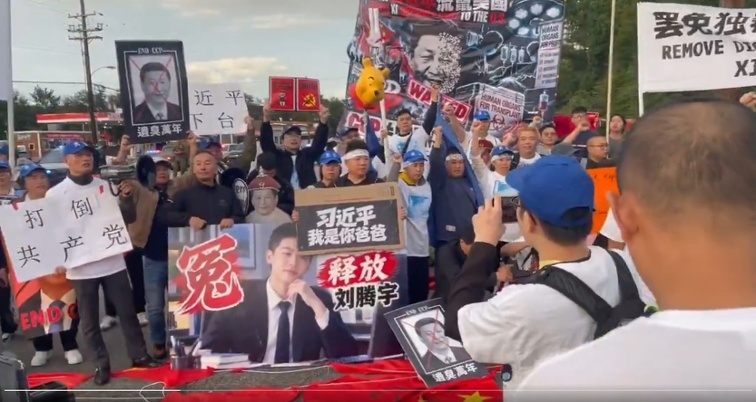
Protests have been persistent.
Since Xi Jinping's arrival in Washington, protests outside have persisted throughout these days, whether during the White House talks, the state banquet, or other public events.
Thus, for these three days in Washington, two starkly different scenes have unfolded: inside the White House, there were red carpets, military honors, state banquets, and the highest level of diplomatic treatment; outside, the voices of protesters could be heard intermittently. Amidst the clash of these two narratives, Xi Jinping's three-day visit to the United States has finally reached its conclusion.
In the end, they held hands once more.
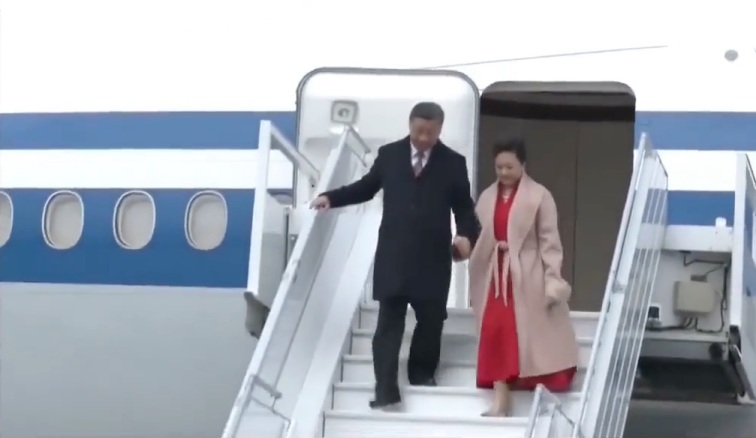
After the visit concluded, the Trump couple bid farewell to Xi Jinping and his wife at the National Archives. The four of them descended the steps together. At that moment, the camera captured a familiar gesture — Xi Jinping once again took Peng Liyuan's hand.
Three days have passed, and at the final moment of the visit, it was once again down the stairs and holding hands. Is this simply a display of affection between Xi Jinping and his wife, or does Xi Jinping require a support point while descending? Audience friends, do you have an answer?
Thus, Xi Jinping's three-day visit to the United States has officially concluded. Do you believe the three songs played at the White House were merely coincidental? Behind the highest level of hospitality during these three days, how much has the China-U.S. relationship truly changed? We invite you to share your thoughts in the comments section.
If you think our coverage of the Xi-Trump meeting has highlighted some noteworthy details, please like, share, and spread the program to more friends. Thank you for watching. I am Xiaokun, and I look forward to seeing you in the next episode.
△




News magazine bootstrap themes!
I like this themes, fast loading and look profesional
Thank you Carlos!
You're welcome!
Please support me with give positive rating!
Yes Sure!