

After winning by a large margin, Sanae Takaichi holds a press conference. (Video screenshot / NTD)
[People News] Following the summit this week at the White House between U.S. President Donald Trump and Chinese Communist Party leader Xi Jinping, there has been significant interest in whether any concrete results were achieved. As Xi Jinping concluded his visit to the U.S. on Friday (September 25) and departed the country, both sides issued statements simultaneously—late Friday night in the U.S. and Saturday afternoon in Beijing—detailing the specific agreements and outcomes from the Trump-Xi summit.
Voice of America reports that while the statements from both sides are largely similar in content, with some phrases being identical, the order of the points differs, highlighting the distinct emphases and priorities of the U.S. and China.
The White House statement primarily emphasized that China agreed to classify a category of lethal drugs, specifically opioid substances (orphines), as controlled substances.
"The United States also noted that the Chinese Communist Party has enacted new export controls on two types of fentanyl precursor chemicals, while strongly urging that these and other substances be permanently classified as controlled to help prevent illegal precursors from reaching North America and falling into the hands of dangerous drug traffickers," the White House statement indicated.
Many drug traffickers exploit precursors and precursor precursors of fentanyl exported from China to produce drugs, which they then smuggle into the United States, creating a significant threat to the lives and property of American citizens. Addressing drug manufacturing and smuggling, and urging the Chinese Communist government to impose strict bans on the export of chemical precursors, has consistently been a key objective of the Trump administration.
The second achievement highlighted by the White House at the summit is Trump's call for Xi Jinping to increase the production of refined oil products to stabilize global supply.
In light of the ongoing U.S.-Iran conflict, Iran has been obstructing navigation through the international shipping lanes of the Strait of Hormuz. Additionally, the Iran-backed Houthi forces control coastal areas along the Red Sea, hindering Saudi Arabia, the largest oil producer in the Middle East, from exporting crude oil. Consequently, international oil prices have surged, causing significant distress for the American public due to soaring gasoline and diesel prices. Trump has identified the push for China to boost refined oil production as the second achievement agreed upon with the Chinese side.
The American public has a particular affection for giant pandas, which is why the White House has included the upcoming arrival of two giant pandas, rented by the Chinese Communist Party to the Atlanta Zoo, as the third achievement of the summit.
The statement from the Ministry of Foreign Affairs of the Communist Party of China outlines the eight major outcomes of the summit.
The first and foremost outcome is the mutual agreement to establish a "constructive strategic stable relationship between China and the United States based on respect, fairness, and equality." For the Xi Jinping administration, the ups and downs of Sino-U.S. relations, along with ongoing disputes, have created significant challenges for China's economy, which is already struggling, as well as for the Communist Party's foreign economic relations. Thus, stabilizing Sino-U.S. relations is not only the primary goal of Xi Jinping's visit to the United States but also a proposal that the Chinese side strongly advocated during President Trump's visit to China in May this year.
The second outcome highlighted by the Communist Party is that "both sides agree to support each other in successfully hosting the informal meeting of APEC leaders and the G20 leaders' summit, and both heads of state intend to attend the meetings organized by the other side." This statement is also reflected in the announcement made by the White House.
Analysts were surprised by the third outcome listed by the Beijing Ministry of Foreign Affairs: "The two heads of state agree that Iran should adhere to its commitment not to develop nuclear weapons, and no country or organization should impose tolls on international waterways."
Analysts suggest that the Communist Party maintains a strong relationship with Iran. While Beijing denies providing military assistance to Iran, Chinese companies continue to supply Iran with components for civilian drones and other equipment that could be used in combat. During this Sino-U.S. summit, the Communist Party not only aligned with President Trump's position that Iran should not possess nuclear weapons but also included this agreement as the third major outcome of the summit, which is viewed as a significant breakthrough.
Additionally, many members of the U.S. Congress have expressed dissatisfaction with Trump’s lavish reception of Xi Jinping, partly due to the Chinese Communist Party's support for Iran. Analysts suggest that by highlighting the Iran issue as one of the top three outcomes of the summit, Beijing may be attempting to placate discontented lawmakers.
On Saturday, President Trump took to his Truth Social platform to declare, "Iran must never have nuclear weapons!" This statement reaffirms his strong focus on the Iran issue.
The fourth major outcome cited by the Chinese Communist Party is that "the two heads of state recalled that China and the United States were allies in World War II, fighting side by side to achieve victory in the war." The White House echoed this sentiment in its statement, although it placed this point towards the end of its list.
Some analysts believe that Xi Jinping’s reference to the allied relationship between China and the U.S. during World War II in his conversation with Trump may be aimed at Japan.
Japanese Prime Minister Takaichi Sanae confirmed on X that President Trump called her at 9 PM local time in Tokyo on Saturday.
Takaichi Sanae noted that President Trump provided her with a detailed overview of the U.S.-China summit with Xi Jinping, and they exchanged views on issues concerning China.
"Shortly after Xi Jinping's visit to the U.S., Trump called me to discuss the recent U.S.-China summit in detail. Furthermore, President Trump and I primarily exchanged views on various issues related to the Chinese Communist Party, including economic security and other security-related matters, and reaffirmed Japan-U.S. cooperation." Takaichi Sanae also mentioned her commitment to continue working closely with President Trump, "to elevate the steadfast Japan-U.S. alliance to a higher level."
Takaichi Sanae has publicly expressed that Japan may consider military intervention if Beijing attacks Taiwan, a statement that has provoked strong discontent from the Chinese Communist Party, which has repeatedly demanded that Tokyo retract this assertion.
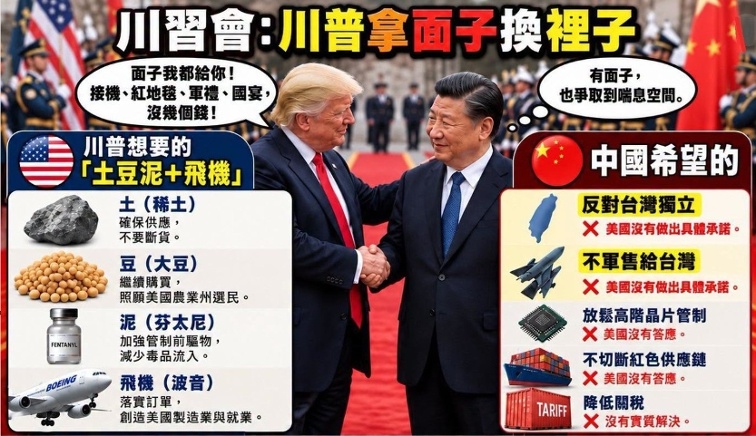
The bilateral statement also highlights achievements in economic and trade relations, with both parties largely in agreement on this front. This includes the initiation of two committees focused on trade and investment, and a consensus on providing more favorable tariff treatment for non-sensitive goods valued at $30 billion each way.
The U.S. side indicated that China is set to import at least 10 million tons of coal from the United States in 2027 and 2028, a detail that was notably absent from the Chinese Communist Party's statement.
Both parties expressed a commitment to dialogue on the development and regulation of artificial intelligence (AI). The White House noted that Xi Jinping concurred with Trump’s suggestion to refer to AI as superintelligence (SI) moving forward, although the Chinese statement continued to use the term artificial intelligence.
Furthermore, the U.S. statement emphasized that both nations are dedicated to addressing U.S. concerns regarding shortages in the supply chain of rare earths and other critical minerals, aiming to restore the transportation volume of these materials to appropriate levels. However, this issue was completely omitted from the Chinese statement.
The U.S. statement also referenced President Trump’s proposal for trilateral arms control negotiations involving the U.S., Russia, and China, but the Chinese statement did not address this matter either. Beijing has consistently refused to engage in U.S.-Russia arms control discussions.
The most surprising element of the joint statement from both parties is that neither mentioned the Taiwan issue, which Beijing refers to as the 'core of core interests.' Analysts note that in past statements, the U.S. typically did not proactively address the Taiwan issue, while the Chinese side would always take the opportunity to restate its position. However, this time, both sides omitted any reference to Taiwan.
Bonnie Glaser, the executive director of the German Marshall Fund's Indo-Pacific program, remarked that the differences between the two sides regarding Taiwan appear to be greater than any consensus.
She stated, 'The content of the statements from both sides was not unexpected. They both emphasized issues where they share some consensus, but I believe the differences on the Taiwan issue outweigh the consensus.'
Some analysts argue that the absence of Taiwan in the joint statement is more surprising than its inclusion would have been. Additionally, some commentators suggest that President Trump has put the $14 billion arms sale to Taiwan on hold and is hesitant to bring up the issue again, while the Chinese side may also wish to avoid excessive pressure that could strain Xi Jinping's relationship with Trump.
Shortly after the statement was released at the White House on Saturday morning, Trump spoke with reporters. When asked if he discussed the Taiwan issue with Xi Jinping, Trump responded, 'We talked about it, we talked about it.'
'We didn't discuss it much. Things are going well, moving along. But we didn't spend much time on Taiwan,' Trump said. 'He (Xi Jinping) understands my feelings on this (Taiwan issue) very well,' Trump added. △





News magazine bootstrap themes!
I like this themes, fast loading and look profesional
Thank you Carlos!
You're welcome!
Please support me with give positive rating!
Yes Sure!