

Illustration: On March 12, 2023, CCP Politburo Standing Committee members Cai Qi and Li Xi attend a session of the National People’s Congress. (Noel Celis/AFP)
[People News] Recently, a personnel announcement from Beijing Institute of Technology has become a trending topic.
On September 29, the Beijing Institute of Technology released a 'Situation Report' indicating that the school had received information regarding issues related to teacher Pei Yi and had formed a special working group to investigate. The investigation confirmed that Pei had seriously violated the professional ethics and conduct standards for teachers, resulting in significant negative consequences. Consequently, the school made three decisions: to revoke her qualifications as a graduate supervisor, to cancel her eligibility for the teaching position, and to terminate her employment.
The report concludes here, providing only a framework without specific details. The official statement did not clarify which actions were serious enough to justify the termination of her employment. This leaves room for speculation regarding the Pei Yi incident: what exactly was said or done that led to the abrupt removal of a law teacher who had been at Beijing Institute of Technology for many years, served as a master's supervisor, and taken on various teaching responsibilities.
Public records indicate that Pei Yi, a woman from Lanzhou, Gansu, is a member of the Democratic League. She graduated with dual bachelor's degrees in Science and Law from Tianjin Normal University, later earning a master's degree in law from both the University of Liverpool and the University of Southampton, a PhD in law from Nankai University, and a postdoctoral degree from China University of Political Science and Law. Since 2021, she has been an assistant professor at the School of Law at Beijing Institute of Technology, a master's supervisor, and an assistant dean. In the fall of 2026, her elective course 'Protection of Women's Rights in the Digital Age' faced accusations of male discrimination due to comments regarding the 'chocolate attribute' of the course selection group, sparking controversy and leading to the suspension of the class.
Is this a conflict between feminist narratives and official positions? This attractive associate professor from Beijing has made some shocking statements, including in private chats where she claimed to "support men being inferior." After her comments went viral, some individuals began to investigate her for potential academic misconduct. The central question remains: why is Beijing Institute of Technology being so secretive about the negative rumors surrounding Pei Yi, failing to disclose factual evidence, and simply announcing the punishment results? Furthermore, it is surprising that the party media outlet Xinhua News Agency has chosen to reprint and report on this personnel notice from Beijing Institute of Technology. What significant hidden issues could lead the top party media to take such action, yet still maintain a level of ambiguity and vagueness?
Among the various classroom remarks attributed to Pei Yi that have circulated in public discourse, one particular recording has garnered considerable attention. In an earlier lecture, Pei Yi remarked, "There should be a few women among the seven members of the Standing Committee," and she even referenced the famous quote from U.S. Supreme Court Justice Ruth Bader Ginsburg: "Why can't there be nine women on the Supreme Court?" Additionally, there are sensational remarks attributed to Pei Yi in private conversations: "All seven members of the Politburo Standing Committee of the Communist Party of China are men; don't you think that's extreme?"
This issue is clearly more complex than just a "network controversy between a female rights teacher and her male students." Pei Yi has struck at the most sensitive nerve within the political structure of the Chinese Communist Party (CCP). Currently, all seven members of the Standing Committee of the Political Bureau of the Central Committee of the CCP are men, and throughout the history of the CCP, there has never been a woman at the Standing Committee level. Jiang Qing was merely a member of the Political Bureau in her time. Since the founding of the CCP, only a handful have managed to ascend to the ranks of Political Bureau member or alternate member, including Jiang Qing, Ye Qun, Deng Yingchao, Chen Muhua, Liu Yandong, and Sun Chunlan. Notably, there are no women among the current members of the Political Bureau from the 20th National Congress.
In class, a law professor specializing in women's rights posed the question: "Why is the highest decision-making body entirely male?" From an academic standpoint, this is a valid inquiry. In modern political science, the concept of "descriptive representation" refers to whether the composition of a political institution reflects the demographic structure of the society it represents, including aspects such as gender, age, and region. Given that women constitute about half of the population, the persistent absence of women in the highest political decision-making bodies certainly raises questions worthy of exploration in gender politics research.
In other words, if Pei Yi were discussing "women's political rights" and suddenly asked, "Isn't it extreme that all seven members of the Standing Committee are men?" this question aligns well with the logic of feminist political science. She is not questioning, "Why doesn't Xi Jinping allow women to serve on the Standing Committee?" Instead, she is raising a more abstract issue: In a society where the male and female populations are roughly equal, should we not discuss the long-standing male dominance in the structure of the highest political power? Academic classrooms are indeed the appropriate venues for such discussions.
In Western universities, it seems quite normal for a political science professor to ask, 'Why are there no women in the highest political power institutions?' However, the situation is different in the political environment of the Chinese Communist Party (CCP), where discussions must adhere to the logic of CCP politics. In a 985 university, once the conversation directly addresses the Standing Committee of the Political Bureau of the Central Committee of the CCP, the nature of the discussion changes significantly. From a purely academic standpoint, this could be termed a 'political representation issue,' but from the perspective of CCP political rules, it questions the personnel arrangements of the core leadership of the Central Committee. This is a serious matter; to put it mildly, it is seen as reckless commentary on central authority, and more severely, it challenges the highest authority, which is considered anti-Party and anti-socialism.
What began as a classroom discussion has transformed into a question of political stance and loyalty. Pei Yi, despite being a member of the Democratic League, has nonetheless touched a sensitive nerve with the CCP and Xi Jinping through her academic rhetoric grounded in feminist perspectives. During Jiang Zemin's era, power was shared among many, whereas in Xi Jinping's era, it is concentrated among seven Standing Committee members. Although these comments were made by the esteemed professor several years ago, they still pose a challenge to Xi Jinping's authority.
When women's rights collide with national will, when feminist demands approach the political landscape of Zhongnanhai, and when Xi Jinping's top-level designs and directives face scrutiny from the academic community, the nature of the issue escalates rapidly. Pei Yi also remarked in a video, 'Without political rights, everything above is just empty talk, everyone.' 'If we truly seek equality, then it should be the capable rising to the top, but are the genuinely capable really rising to the top?'
Reports indicate that on September 26, a whistleblower letter targeting Pei Yi was shared on social media. Besides complaints regarding gender-related comments, the whistleblower also labeled support for the MeToo movement and feminism as 'inappropriate political speech,' calling for an investigation into whether Pei Yi posed a threat to national ideological security.
This explains why Beihang University emphasized in its announcement: 'The school takes this matter very seriously and has promptly established a special task force to conduct a thorough and detailed investigation.' The phrases 'zero tolerance' and 'absolutely no leniency' were highlighted. Although the announcement specifically addressed issues of teacher ethics, it refrained from mentioning any ideological concerns, likely out of fear of creating a problematic situation for itself.
The university's decision to 'only publish the title of the judgment and not disclose the case details' has created a suspenseful situation regarding the Pei Yi incident: If her statement about 'all seven members of the Standing Committee being male' was included in the school's investigation, how would the university classify this remark? Is it a discussion on gender politics? An inappropriate expression of political views? A mistaken political stance? Or did it not even form the basis for any disciplinary action? Currently, the public remains unaware. This is precisely the missing piece in the entire incident, which Beihang University seems to be deliberately obscuring and glossing over.
This presents yet another paradox that reflects the characteristics of censorship by the Chinese Communist Party (CCP). Pei Yi (裴軼) focuses on women's rights. A subject known as 'gender representation' in academic papers, referred to as 'women's political rights' in the classroom, and possibly labeled 'bold questioning' on social media, could, within the highly sensitive political context of the CCP, be interpreted as 'slander against the central authority.' From a risk management standpoint, such remarks can indeed pose significant challenges for university administrators, as what they least want to deal with is not merely a typical classroom controversy, but rather an issue that could have been discussed in class suddenly erupting beyond campus and evolving into a nationwide political public opinion crisis.
Beijing Institute of Technology (北理工) is a university with a strong background in the defense industry, and the most prudent risk management strategy might be to quickly distance itself from the situation. Consequently, the narrative could shift from 'What exactly did this teacher say?' to 'This teacher has committed serious ethical violations,' and from 'Which specific statement is problematic?' to 'The school has completed its investigation.' If this is indeed the case, then the rationale for Beijing Institute of Technology may be that the institution cannot afford to be drawn into a larger political public opinion and risk a maelstrom due to the academic comments of a single educator.
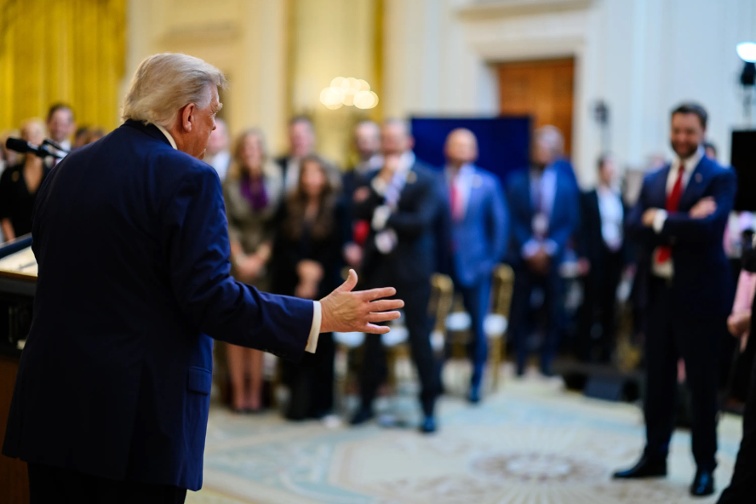
During the same period that the Pei Yi (裴軼) incident was unfolding, Xi Jinping visited the United States in September and held discussions with Donald Trump (川普). On September 25, Xi Jinping and Peng Liyuan (彭麗媛) also had a tea gathering with the Trump couple at the White House. Peng Liyuan's visibility at this diplomatic event was notably high. From a public opinion perspective, juxtaposing several key moments creates a striking sense of dissonance: on one side, Peng Liyuan made a prominent appearance as the First Lady on the international diplomatic stage representing China's top leadership; on the other side, a female teacher focused on women's rights became the center of national discourse for addressing the absence of women in the highest echelons of political power. One is present in high-level diplomatic settings, while the other is absent from university classrooms. Together, these two scenes indeed evoke the effect of a 'political cartoon.'
'Could she have inadvertently exposed Xi Jinping's secret political motives?' Pei Yi may have merely taken a step forward in advocating for women's rights, yet she inadvertently trespassed into a sensitive political taboo within Zhongnanhai. Nonetheless, Pei Yi did raise a rather peculiar and sensitive question regarding the highest power structure of the Chinese Communist Party (CCP): why are there no women among the members of the Standing Committee of the Politburo?
While there are no explicit rules in the CCP's constitution or national laws that 'prohibit women from joining the Standing Committee,' a strong path dependence and selection mechanism has developed in practice, with 'hard power' positions such as provincial party secretaries, military regions, organization, discipline inspection, and political law almost entirely occupied by men. Women are more frequently placed in 'soft sectors' or deputy roles in education, health, women's federations, united front work, and culture, making it challenging to gain the qualifications and practical experience necessary to reach the highest levels of decision-making.
Furthermore, the power structure of the Chinese Communist Party (CCP) has long displayed patriarchal traits, with informal networks such as banquets, drinking gatherings, factions, and regional or school affiliations being more favorable for men to build trust and loyalty. The CCP's emphasis on 'gender equality' is more evident in areas like labor participation, basic education, and marriage laws within the socio-economic context, rather than in the distribution of power at the highest decision-making levels.
Women who entered the upper ranks early on, such as Jiang Qing, Ye Qun, and Deng Yingchao, often secured significant political positions due to their husbands' revolutionary status rather than through their own bureaucratic experience. Although women like Wu Yi, Liu Yandong, and Sun Chunlan have risen based on their own qualifications since the reform and opening-up period, they have still only reached the Politburo and have not advanced further.
Notably, the absence of women in the CCP Politburo following the 20th National Congress indicates that the Xi Jinping administration maintains a cautious and conservative stance regarding female involvement in high-level decision-making within the CCP. In this light, if Xi Jinping aims to integrate Peng Liyuan and his daughter Xi Mingze into the core power structures of the CCP, it appears there is still a considerable distance to cover, and success is not assured.
(First published in People News)△





News magazine bootstrap themes!
I like this themes, fast loading and look profesional
Thank you Carlos!
You're welcome!
Please support me with give positive rating!
Yes Sure!