
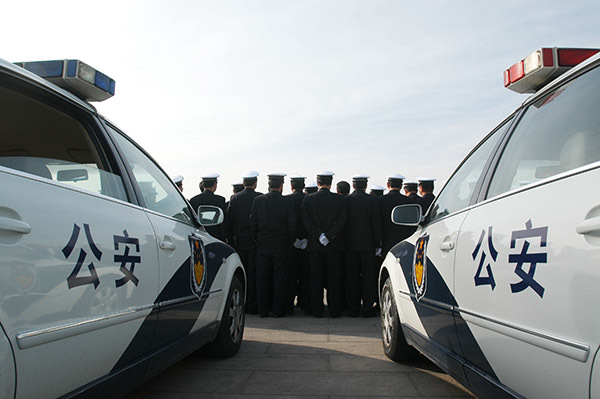
Illustration: CCP Police Vehicle (China Photos/Getty Images)
[People News] On September 25, 2026, at 9:52 AM, Liu Huan passed away in Shanghai at the age of 63. Coincidentally, this day fell on the Mid-Autumn Festival, the 15th day of the eighth month. The following day, the University of International Business and Economics, where he had taught for over thirty years, released an obituary stating that, in accordance with his wishes, the funeral would be kept simple, without forming a funeral committee, and there would be no body farewell ceremony or memorial service.
Following the announcement, many people revisited his classic works on social media and short video platforms, with the 1987 song 'Youth's Ambition Does Not Speak of Sorrow' being shared widely once again.
This was the moment when many Chinese first recognized Liu Huan's voice. The television drama 'Undercover Police' aired during that time, and this theme song, with lyrics by Lin Ruwei and music by Lei Lei, became a nationwide hit, catapulting the then twenty-something Liu Huan to fame overnight. 'Golden shield, forged with blood and passion, showcasing skills in times of danger,' this song has nearly become a spiritual emblem of the Chinese Communist Party's public security system over the decades, and at various gatherings and events within the police community, nearly everyone can sing it.
While many hum along to the melody, very few actually remember the plot of the television drama.
The Forgotten Mother Body Plot
The TV drama 'Undercover Police' is based on the novel of the same name by Hai Yan. The main character, Zhou Zhiming, is a young undercover investigator in the Nanzhou City Public Security Bureau. Around the Qingming Festival in 1976, local residents mourned Zhou Enlai and distributed flyers opposing the 'Gang of Four.' During a search operation, Zhou Zhiming discovered that those involved were his own lover and friends. Driven by his conscience and a sense of justice for the people, he secretly exposed the film from his camera and took full responsibility for the situation.
In this narrative, the young police officer did not receive commendation for protecting his fellow citizens; instead, he was branded a counter-revolutionary, suspected of espionage, and sentenced to 15 years in prison, where he was sent to a labor reform farm. Years later, following the Third Plenary Session of the 11th Central Committee of the Communist Party of China, a wave of rectification for wrongful convictions emerged, allowing Zhou Zhiming to finally leave prison, clear his name, and return to the public security forces.
In the context of the TV drama, the well-known lyric 'Enduring hardships without changing one's heart' reflects not the achievements of the institutional machinery, but rather the story of a kind-hearted young man within the system who, by adhering to basic moral principles, was imprisoned for several years by the very power he served.
This script was adapted for the screen in 1987, reflecting the ideological nuances of that unique era. The devastation of the Cultural Revolution had just ended, and the atmosphere of reflecting on the extreme leftist chaos of the system still persisted. In November 1978, the Beijing Municipal Committee of the Communist Party of China officially rehabilitated the April 5th Tiananmen Incident of 1976, recognizing that the public's mourning at that time was a revolutionary act and that the arrests were a mistake. During this period of artistic creation, the authorities at least permitted the acknowledgment of one fact: the police system could also mistakenly arrest innocent individuals, and an individual's conscience could indeed conflict with the cold directives from superiors.
The Inverted Mission in Reality
Many did not foresee that this recognition of the system's capacity for error and the allowance for reflection on power would soon be completely shut down in the ensuing historical developments.
Twelve years after the airing of 'The Undercover Policeman,' on July 22, 1999, the Ministry of Public Security issued a sweeping ban on Falun Gong, strictly prohibiting any form of practice or petitioning. The role of police officers underwent a profound distortion in reality. The undercover officers, who had shown sympathy for innocent victims in the script, were now thrust to the forefront of suppressing ordinary believers whose core principles were Truth, Compassion, and Forbearance.
A significant number of undercover police appeared in Tiananmen Square. Whenever a believer calmly displayed a banner inscribed with 'Truth, Compassion, Forbearance,' the undercover officers would swiftly rush in, pinning the individual to the stone ground and forcefully placing them into police vehicles. The absurdity and brutality that Zhou Zhiming experienced in the script were amplified a thousandfold in reality, where the system no longer allowed any space for conscience or repentance.
Across detention centers, labor re-education camps, and brainwashing classes nationwide, the police's primary assessment metric has shifted to enforced 'transformation', which involves using various methods to coerce believers into signing documents renouncing their faith.
One of the victims is Chen Zixiu, a 58-year-old retired female worker from Weifang, Shandong. In February 2000, she traveled to Beijing to advocate for her beliefs and was illegally detained by local officials, who brought her back to the Weifang Chengguan Street Office. The guards alternated in using batons and electric rods to inflict violence, even forcing her to run barefoot in heavy snow. Chen Zixiu steadfastly refused to compromise until her last moment, ultimately succumbing to persecution on February 21, 2000. Ian Johnson, a reporter for The Wall Street Journal, later conducted a thorough investigation in Shandong, published an extensive report, and was awarded the 2001 Pulitzer Prize for International Reporting for his work.
From 'Golden Shield' to 'Golden Shield Project'
The lyrics proclaim, 'The golden shield is forged with blood and passion, demonstrating its strength in times of peril.' In the original spirit of literature and art, a shield is meant to stand between tyranny and the vulnerable, serving as a protective barrier for the people.
However, almost immediately following the initiation of the crackdown, the Ministry of Public Security launched a nationwide public security information and network surveillance system, aptly named the 'Golden Shield Project'.
As the Golden Shield transformed into the expansive 'Golden Shield Project', its role underwent a deeply ironic shift. This high-tech shield, created at a significant cost, ceased to serve as a protector against injustice and oppression, instead becoming an impenetrable firewall and surveillance network, obstructing the public's access to the truth.
Liu Huan's soaring and heartfelt voice has transcended both time and borders, resonating widely both inside and outside the walls. In stark contrast, the name Chen Zixiu, along with the harrowing experiences of countless ordinary believers, remains tightly sealed within the high walls of the Golden Shield Project, preventing the domestic population from learning the truth.
Throughout this brutal persecution that has spanned 27 years, the public security system continues to perform on stage, singing in unison, 'After enduring hardships, my heart remains unchanged.' However, the true recipients of this lyric are no longer the executioners and officials in the audience, but rather the compassionate individuals who, deep within prisons and black jails, refuse to sign false guarantees under torture, even at the cost of their lives.
One of the most poignant lines in this song is, 'For the smile of my mother, for the harvest of the earth.' Liu Huan delivers it with deep emotion, and countless listeners have shed genuine tears. Yet, in the frigid early spring of 2000, Zhang Xueling, the daughter from Weifang, was sentenced to three years of re-education through labor for speaking out about the truth behind her mother Chen Zixiu's death due to persecution. Despite her desperate efforts, she could never bring back her mother's smile.
△





News magazine bootstrap themes!
I like this themes, fast loading and look profesional
Thank you Carlos!
You're welcome!
Please support me with give positive rating!
Yes Sure!