
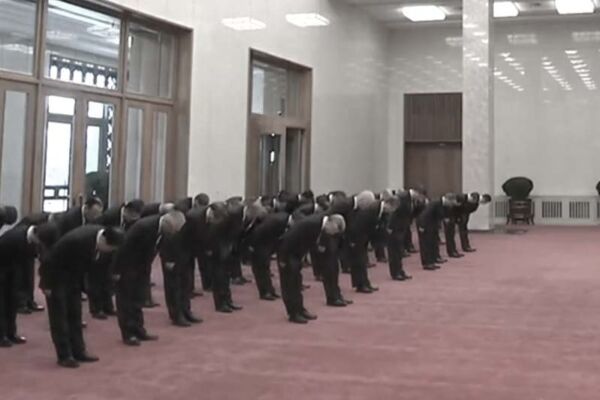
"Paying Respects" Is Actually a Tactic for "Drawing Vital Energy" (Photo: On December 26, 2023, members of the CCP Politburo Standing Committee and senior officials in Beijing bowing to the statue of Mao Zedong. Screenshot from a video.)
[People News] On the morning of September 30, Xi Jinping, the leader of the Chinese Communist Party, led senior officials including Li Qiang and Zhao Leji to Tiananmen Square in Beijing to participate in the "Martyrs' Memorial Day" event and to pay respects at the "Monument to the People's Heroes." This commemorative activity has been ongoing for at least thirteen years. In my opinion, the monument that Xi and others honor is fated to be brought down.
This monument was the first large-scale structure erected after the CCP took power in 1949, and it was completed in 1958. Ironically, in July 2024, under the auspices of the CCP, this monument was included as part of the "Beijing Central Axis - A Masterpiece of the Order of China's Ideal Capital" on the World Heritage list.
World Heritage refers to cultural, natural, and mixed heritage recognized for their outstanding universal value by the UNESCO World Heritage Centre. Yet, this monument, which is merely a few decades old and rife with falsehoods, has been packaged by the CCP to become a World Heritage site, cloaking its shameful history in a glamorous facade, which is indeed lamentable!
The reason I assert it is filled with lies is that most of the so-called "People's Heroes" cited by the CCP died while serving the party, deceived by the lie of "establishing a free and democratic China." This is evident from the inscription drafted by Mao Zedong and penned by Zhou Enlai, as well as the reliefs adorning the monument.
In the two-tiered base designed by Lin Huiyin, the lower tier features ten large white marble reliefs. The eight key events depicted include 'Destruction of Opium at Humen', 'Jintian Uprising', 'Wuchang Uprising', 'May Fourth Movement', 'May Thirtieth Movement', 'Nanchang Uprising', 'Anti-Japanese Guerrilla Warfare', and 'Victory Crossing the Yangtze River: Liberation of All of China'. Additionally, two reliefs on either side of 'Victory Crossing the Yangtze River' illustrate 'Support for the Frontline' and 'Welcome to the People's Liberation Army'.
Of the ten reliefs, seven are associated with the Chinese Communist Party (CCP). Each of these seven reliefs is rife with falsehoods, indoctrinating billions of Chinese people under the CCP's narrative, including many high-ranking officials. Let’s take a closer look at each one.
The 'May Fourth Movement' is Nonsense
According to CCP propaganda, the 'May Fourth Movement' is depicted as a 'student movement against imperialism and for patriotism' initiated by 'advanced youth' who could no longer tolerate the corruption and darkness of the social status quo, motivated by a desire to 'save the country and the people, and reform society'. Many of the initial participants were from Peking University. However, research by Hong Kong historian Feng Xue Rong reveals that this movement 'yielded no benefits other than injuring one person, burning down a building, removing three officials, and leaving behind the seeds of violence: it neither saved the country nor established virtue. It was merely nonsense, nothing more.'
The CCP commemorates this movement because, aside from leaving a violent legacy for the ritualistic nation of China, its only outcome was to create an opportunity for the widespread dissemination of Marxism-Leninism in China.
Historical records show that on the night following the first demonstration of the 'May Fourth' movement, student leaders visited Li Dazhao's office at Peking University to report on the day's events. Li Dazhao urged members of the Marxist Research Society to extend the May Fourth movement to other cities. Among those who answered this call was Deng Zhongxia, a student of Li Dazhao, who later became a member of the Chinese Communist Party. It is clear that the CCP took advantage of the May Fourth movement to enhance its propaganda efforts, leading more intellectuals to embrace Marxism and consequently veer off course.
The Death of Child Laborers Behind the 'May Thirtieth Movement'
In the CCP's narrative, the 'May Thirtieth Movement,' which took place on May 30, 1925, is depicted as a 'mass anti-imperialist patriotic movement' led by the party, 'signifying the peak of the Chinese Revolution.' However, the immediate trigger for the 'May Thirtieth Movement' was the murder of a child laborer in February. The CCP orchestrated this event to control the workers and solidify its own position, exploiting the existing labor disputes within Japanese enterprises, rather than genuinely pursuing 'anti-imperialism and patriotism.'
In reality, the true culprit behind the death of the child laborer was Liu Hua, a CCP member, whose intention was to incite chaos. The person who confronted the Japanese employer and was ultimately killed by the boss out of exasperation, Gu Zhenghong, was simply Liu Hua's assistant.
Investigations by the authorities revealed that Liu Hua (Liú Huá) was connected to a series of violent crimes and was a prominent figure in organized crime, which disrupted social order. As a result, he was sentenced to death. Concerned that Liu Hua's residual influence in society could incite unrest, the government decided to execute him secretly by firing squad on the night of December 17, 1925. It is reported that before his execution, the executioner asked if he had any final words. Liu Hua paused, looked up at the sky, and stated slowly: 'The greatest regret of my life is having taken that poisonous oath and becoming a member of the party. I hope that after my death, heaven will allow me to nullify this poisonous oath, and that I can be free from being a ghost of the party.'
According to the history of the Chinese Communist Party (CCP), during the nearly 20 days from Liu Hua's arrest to his execution, the CCP 'organized multiple rescue attempts, and workers from the Shanghai cotton mill staged several strikes demanding Liu Hua's release,' but these efforts were largely ineffective. The intent behind these actions was likely to further intimidate Liu Hua in prison, ensuring that he would not disclose any information even as he faced death.
Only after confirming Liu Hua's death did the CCP release a statement 'commemorating the martyr Liu Hua.' However, subsequent party histories intentionally omitted Liu Hua from this account, instead promoting Gu Zhenghong (Gù Zhènghóng), likely aware that this aspect of history was not suitable for public scrutiny.
The 'Nanchang Uprising' was an attempt by the CCP to seize power.
In the narrative of the Chinese Communist Party (CCP), August 1 is commemorated as the founding day of the CCP army. On this day in 1927, He Long, Zhou Enlai, Ye Ting, Zhu De, and Yun Daiying led an armed rebellion involving over 20,000 troops from the Northern Expedition National Revolutionary Army in Nanchang, Jiangxi, marking He Long's entry into the CCP. However, this uprising conceals an unspeakable secret of the CCP, rife with conspiracy and betrayal, and the fates of its leaders and participants were largely tragic.
The Nanchang Uprising occurred against the backdrop of Chiang Kai-shek's realization of the significant threat posed by the CCP's strategy of 'borrowing a shell to develop,' prompting him to initiate a 'party purge' that resulted in the mass arrest of CCP members. The uprising was an attempt by the CCP to seize power amid a crisis. Among the participants, aside from Yun Daiying, who was killed by the Kuomintang, and Ye Ting, who died in a plane crash, the others lived to see the establishment of the CCP's regime, but very few had a favorable outcome.
For example, He Long was persecuted to death during the Cultural Revolution under Mao's directive. Zhu De was also overthrown during this period and ultimately met a tragic end. Lin Biao was killed by the CCP in 1971 due to the so-called 'defection.' Zhou Enlai, who had a dual nature, was diagnosed with bladder cancer in 1972 and died in agony, having already lost his vitality. Following the 'February Countercurrent' incident, Chen Yi faced criticism during the Cultural Revolution and was sent to labor, passing away in 1972 from rectal cancer. Nie Rongzhen was also criticized during this time and died in 1992 from heart failure. During the Cultural Revolution, Ye Jianying was marginalized, and his second son, Ye Xuanning, suffered severe injuries when his right arm was caught in machinery during re-education, resulting in lifelong disability, among other misfortunes.
The notion that 'anti-Japanese guerrilla warfare' could defeat the Japanese army is misguided.
In the ongoing propaganda of the Chinese Communist Party (CCP), it is claimed that the victory in the War of Resistance Against Japan was achieved under its leadership, positioning the CCP as the backbone of the resistance. However, any sensible Chinese person might question: Did the CCP really secure an eight-year victory solely through guerrilla warfare, tunnel warfare, the Anti-Japanese United Army, and underground parties? Was the Japanese army that incompetent? Was the CCP truly the main adversary of the Japanese army on the front lines? If so, why does the CCP refrain from prominently celebrating the heroic and inspiring battles such as the Battle of Shanghai, the Battle of Taiyuan, the Battle of Xuzhou, the Battle of Wuhan, the Battle of Changsha, the Northern Myanmar and Western Yunnan Campaign, and the Battle of Western Hunan?
The answer is that the CCP is reluctant to do so because these significant battles were fought by the Nationalist government’s army under the leadership of Chiang Kai-shek. The notion that the CCP defeated the Japanese army through guerrilla tactics and tunnel warfare is simply absurd. Thus, the historical truth is clear: the true backbone of the anti-Japanese effort was the government of the Republic of China, which delayed the Japanese army's advance southward and engaged them in a protracted conflict.
In fact, the academic community has long established a consensus regarding the pivotal role of the Republic of China government during the war of resistance. Regardless of how much the CCP boasts, it can only mislead the uninformed public. What many Chinese people may not realize is that during the war, the CCP secretly negotiated with the Japanese army, aiming to collaborate against the Nationalist forces. To conceal this treasonous behavior, the CCP even rejected war reparations prior to the normalization of diplomatic relations between China and Japan in the 1970s. How would the Chinese populace react if they were aware of the truth?
The phrase 'Victory across the Yangtze River' does not imply that the Communist army is particularly formidable.
Following the conclusion of the Anti-Japanese War, the Chinese Communist Party (CCP) was the first to instigate a civil war. Over the course of three years, the CCP managed to seize control, forcing the Kuomintang (KMT) to retreat to Taiwan. The KMT's defeat was not solely due to the prowess of the CCP's military; rather, it stemmed from the CCP's exploitation of the KMT's growth during the war against Japan, its deception of the United States, support from the Soviet Union and Japanese forces, and the internal strife within the Nationalist government. The CCP also leveraged the fifth column, particularly the 'heavyweight' spies embedded within the Nationalist government, to undermine both the Nationalist government and the National Revolutionary Army, ultimately leading to Chiang Kai-shek's (Jiang Jieshi) retreat to Taiwan.
This monument, laden with numerous falsehoods, is fated to be consigned to the annals of history alongside the CCP's demise. Those who fell for the CCP's lies and died in loyalty to it should also anticipate the fall of a regime that oppresses its people. The author is convinced that the day will come when this monument is finally toppled.
Source: Dajiyuan website△





News magazine bootstrap themes!
I like this themes, fast loading and look profesional
Thank you Carlos!
You're welcome!
Please support me with give positive rating!
Yes Sure!