
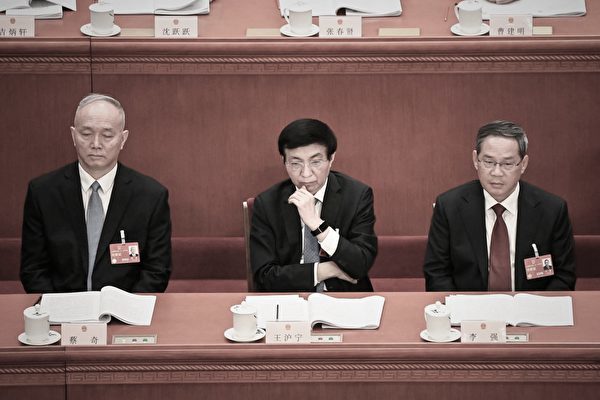
On March 7, 2023, (from left to right) Cai Qi, Wang Huning, and Li Qiang at the Chinese Communist Party's National People's Congress. (Greg Baker/AFP via Getty Images)
[People News] On October 4, 2026, Taiwanese artist Cai Kangyong made an appearance at the establishment meeting of the campaign headquarters for Shen Boyang, the Democratic Progressive Party's (DPP) candidate for Taipei mayor. Wearing a light-colored gentleman's hat and a black mask, he sat in the front row holding a support item that read 'Taipei, let's go.' After a brief stay, he left the venue.
When approached by the media, Cai Kangyong was cautious in his remarks, stating only, 'I just came to see for myself' and 'I want to hear opinions from all sides.' He also mentioned that he would like to visit each candidate if given the opportunity. His agent clarified that this visit was intended for preliminary understanding in preparation for potential follow-up interviews.
Shen Boyang had previously been listed by the CCP's Taiwan Affairs Office as a 'stubborn pro-independence figure,' and Cai Kangyong's appearance at Shen's campaign headquarters quickly became a trending topic on Weibo, garnering over 100 million views. In response, the CCP swiftly banned Cai Kangyong, and several commercial partners cut ties, with brands like Zero Run Automobile issuing statements late on the night of the 4th, affirming their commitment to the One China principle and removing related content.
In the context of Taiwanese politics, it is quite common for public figures to seek to understand the political views of various candidates. In response to the CCP's reaction, Shen Boyang remarked that Cai Kangyong simply wanted to hear different voices, which is entirely normal in a democratic society. Kuomintang (KMT) Taipei mayoral candidate Jiang Wan'an also publicly supported this, inviting Cai Kangyong to the rock zone of his own campaign event and calling for respect for Taiwan's democratic way of life. Both the blue and green camps emphasized that anyone wishing to hear political views does not require external approval.
However, in the mainland's public opinion landscape, the same action was quickly politicized and interpreted as a public endorsement of 'Taiwan independence.' An incident that could have been managed quietly ultimately turned into a political controversy that demanded a high-profile response. Ironically, the event that led to this costly backlash was a flaw within the Chinese Communist Party's (CCP) own propaganda system.
The commentator known as 'Wuyue Sanren' on YouTube incisively highlighted the core issue in his remarks on his 'X' account. He relayed comments from a friend within the domestic propaganda department, stating that the government had no intention of intervening in such matters and was effectively hijacked, with the rope for this hijacking being woven by the CCP itself. Typically, such issues are best handled discreetly; after all, Cai Kangyong did not make any serious declarations of support for anyone, and his agent merely stated that they were going to conduct an interview. The crux of the problem lies in the fact that over the years, in an effort to create targets and straw men, the sensitivity surrounding issues related to the United States, Japan, Taiwan independence, Tibetan independence, and Xinjiang independence has been heightened to an extreme. Consequently, when it comes time to manage these matters discreetly, they find themselves unable to do so.
The essence of the comments made by the propaganda personnel within the system can be summarized as follows: In reality, only a fool would care whether Taiwanese artists congratulate the National Day or participate in specific events; their words are of no consequence. The issue is that over the years, the situation has been escalated excessively, with a group of misguided individuals fixating on these trivial matters daily. The propaganda department is not composed of fools either; if they ban an artist at an election event, everyone understands that this effectively gives Shen Boyang an advantage. Even Jiang Wan'an can only step forward to support Cai Kangyong, which ultimately proves to be a case of more losses than gains. The problem is that those who previously enjoyed deceiving the domestic audience, when faced with critical moments, believed they could control the situation at will, but in reality, they often struggle to manage the situation. Forcing control could very well result in backlash. Wuyue Sanren ultimately described this as 'raising a poisonous insect': it’s a living bug, who told you to raise poisonous insects in the first place? He also drew a parallel to Pelosi's visit to Taiwan: emotions were running high and martial spirit was abundant, but in the end, they ended up slapping themselves in the face, which was futile and led to a significant loss of face.
From a political science standpoint, the actions of the Chinese Communist Party (CCP) exemplify a classic case of 'self-limitation' or a 'policy commitment trap.' In an effort to achieve short-term mobilization goals, a political system may continuously heighten the political sensitivity surrounding certain issues, ultimately becoming ensnared by its own propaganda logic. When the government repeatedly tells the public, 'This is a major issue,' the public begins to genuinely believe it is a major issue, making it difficult for the government to later downplay it by saying, 'Actually, it's not that significant.' In terms of public cognitive psychology, this phenomenon is referred to as 'cognitive dissonance' among the so-called 'little pinks,' which aligns with concepts of 'issue escalation' and 'mobilization machine out of control' in political communication studies. Public expectations can exceed the available policy space, and while the CCP government may wish to de-escalate tensions, the long-standing nationalist sentiments it has fostered prevent any cooling of the situation. Ultimately, the CCP finds itself in a position akin to a 'dog on a leash that cannot control the dog,' compelled to endure the backlash from its own political mobilization efforts.
The CCP's reaction to this incident illustrates the dilemma of being caught between conflicting pressures while feeling compelled to 'prefer the left over the right.' A more discreet approach would have been most suitable, especially since Tsai Kang-yung has not taken a clear stance, and censorship would only benefit the opposition. However, silence can also be perceived as a sign of weakness or a double standard. A single concession might be interpreted as a retreat, leading decision-makers to favor maintaining a high-pressure stance. This passive cycle generates new challenges, as all potential unifying forces are pushed into opposition. In essence, regarding the Tsai Kang-yung incident, the CCP's propaganda apparatus has effectively created numerous new adversaries, pushing both Tsai Kang-yung and Jiang Wan-an into the Democratic Progressive Party (DPP) camp.
Cai Qi has been in charge of party affairs and the propaganda system for a long time and is seen as one of Xi Jinping's most trusted aides. He holds several key positions, including Director of the General Office and Secretary of the Central Secretariat, and is deeply involved in ideology and cybersecurity policy. Meanwhile, Wang Huning, as the Chairman of the Chinese People's Political Consultative Conference, oversees Taiwan's united front efforts. In this context, Cai Qi has dealt a significant blow to Wang Huning by aggressively intervening in Wang's strategy for Taiwan, effectively undermining it from the ground up.
This kind of foolishness is not unprecedented. In August 2022, U.S. House Speaker Nancy Pelosi visited Taiwan. Before her visit, Foreign Ministry spokesperson Zhao Lijian publicly warned that the People's Liberation Army (PLA) 'would never sit idly by and would take resolute and strong countermeasures.' The Eastern Theater Command of the PLA posted on Weibo, stating they were 'waiting for combat orders' and 'to bury all invading enemies,' which received over a million likes, and related videos garnered over 47 million views. Former editor-in-chief of the Global Times, Hu Xijin, even suggested on Twitter that planes could be shot down. The intense mobilization by official and semi-official channels led many to believe that China might take strong military action to prevent the visit. However, after Pelosi's plane landed safely in Taipei, the mainland only announced military exercises around Taiwan and did not take direct military action. Consequently, many young nationalists in Guangdong felt deceived, with some even crying on Douyin and expressing thoughts of suicide.
Let’s examine how wolf warrior diplomacy has backfired. On November 30, 2020, then Foreign Ministry spokesperson Zhao Lijian retweeted a satirical cartoon titled 'Peacekeepers' by the online artist 'Wu He Qilin' on Twitter. The cartoon depicted an Australian soldier holding a knife to the throat of an Afghan boy, with the caption 'Don't be afraid, we are here to bring you peace!' This was a reference to allegations of war crimes against the Australian Defence Force in Afghanistan. Australian Prime Minister Scott Morrison strongly protested, demanding the removal of the image and a public apology; however, Zhao Lijian pinned the tweet, and Hua Chunying also refused to apologize. This incident directly led to a further deterioration of diplomatic relations between China and Australia, and Zhao Lijian was later reassigned from his spokesperson role to the Deputy Director of the Department of Border and Ocean Affairs, marking a decline in the once-prominent image of wolf warrior diplomacy.
The Chinese Communist Party's forced intertwining of art with politics and the suppression of artists has become increasingly prevalent. In January 2016, Taiwanese artist Chou Tzu-yu, a member of the South Korean girl group TWICE and only 16 years old at the time, was reported for 'Taiwan independence' by artist Huang An, who had long been active in mainland China, after she held the Republic of China flag during a program recording in November 2015. JYP Entertainment swiftly canceled all her activities in China and released a 'forced apology video' featuring Chou Tzu-yu, which sparked significant public outcry across the Taiwan Strait. This incident occurred just before the Taiwan presidential election, directly affecting the atmosphere of cultural exchange between the two sides.
In international interactions, there are many embarrassing situations, and domestically, the phenomenon of excessive escalation leading to failures is also quite common. The most notable backlash occurred with the 'dynamic zero-COVID' policy in 2022. Over the previous three years, the authorities had framed the zero-COVID strategy as a 'people's war,' with intense propaganda highlighting the dangers of the virus and the necessity of lockdowns, resulting in repeated static management and makeshift quarantines across various regions. In November 2022, after the Urumqi fire, protests known as the 'White Paper Movement' broke out in several cities, including Shanghai, Beijing, Chengdu, and Wuhan, where demonstrators vocally opposed lockdowns and even called for 'the Communist Party to step down' and 'Xi Jinping to step down' in more direct slogans. Within just ten days, the Chinese Communist Party (CCP) government unexpectedly relaxed control measures on a large scale, and state media quickly pivoted to the narrative of 'making oneself the primary responsible person for health,' almost entirely avoiding any mention of the previous 'unwavering commitment to dynamic zero-COVID.' Millions of people became infected amid the chaos of the sudden lifting of restrictions, with the death toll being unquantifiable, and trust in the CCP regime and the governing capability of Xi Jinping's administration was effectively wiped out by the public overnight.
The CCP excels at manipulating public opinion and brainwashing the populace with nationalist rhetoric, but ultimately, the backlash is almost inevitable, and the true irony of this incident lies precisely here. High-intensity political narratives increase social sensitivity, and groups that have been heavily indoctrinated expect upgrades, while the space for policy maneuvering diminishes, leading decision-makers to become trapped by their own narratives. When the system becomes accustomed to managing society through high-intensity emotional control, the greatest challenge often comes not from external adversaries, but from the expectations it has created for itself in the past. This may be the key aspect worth observing in the Cai Kangyong incident; it is not merely about an artist's alignment, but rather how a mobilization machine can be collectively turned against by its own mobilized subjects.
(First published by People News) △





News magazine bootstrap themes!
I like this themes, fast loading and look profesional
Thank you Carlos!
You're welcome!
Please support me with give positive rating!
Yes Sure!