
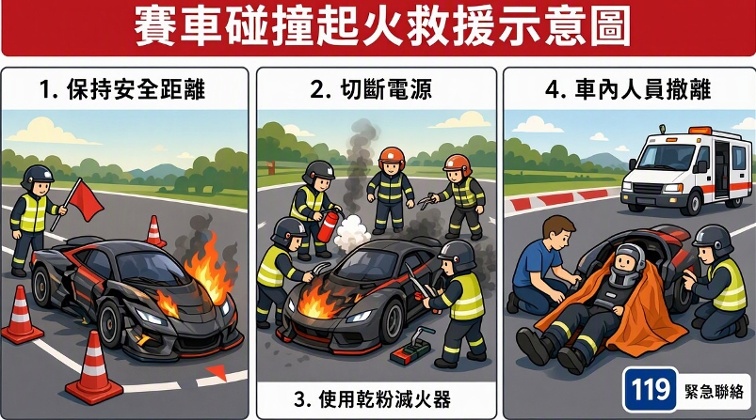
On September 5, 2026, the 'China GT' was held in Shanghai, where netizens reported that the security personnel present had not received any fire training. (People News/AI-generated image)
[People News] Terms like 'chives', 'human resources', and 'cattle and horses' have become popular on Chinese social media, serving as sharp self-deprecations by ordinary people regarding their struggles in life. In recent years, these buzzwords have not only persisted but have intensified. Following the complete suppression of last year's 'three major theories' by the authorities, a new term has recently gained traction online - 'slave labor theory', which directly addresses the current low-wage, high-pressure, and dignity-lacking labor environment.
This surge of sentiment was triggered by an absurd tragedy that occurred during the 'China GT' event in Shanghai on September 5 this year.
During the event, a supercar valued at millions collided and caught fire on the track. Shockingly, the staff on site not only failed to rush in to extinguish the flames and provide assistance, but in a panic, they dropped the fire extinguisher and fled the scene. Ultimately, it was a Dutch driver who bravely abandoned the race, ran into the flames to retrieve a fire extinguisher to control the fire, and with his bare hands pulled out a British driver who was trapped inside the car and nearly burned alive, all in under a minute. Meanwhile, the ambulance that everyone had been waiting for 15 minutes was delayed because the driver was asleep inside the vehicle, and even the loud banging on the car window from bystanders could not wake him.
The indifference and negligence displayed by on-site staff and security personnel quickly drew intense backlash from netizens. However, it was soon disclosed by insiders that most of these on-site workers were temporary employees hired through multiple layers of outsourcing. They not only lacked any professional fire safety training but also earned a mere 60 yuan per day. 'With such a meager wage, are we really expecting people to risk their lives to rush into danger?'
This incident, which seemed glamorous at first glance but was actually run like a 'shoddy troupe' at a national-level event, rapidly created a significant stir on social media and naturally led to the emergence of a new internet meme known as the 'slave labor theory.'
What exactly is the 'slave labor theory'?
The 'slave labor theory' is based on a very straightforward premise: regardless of how sophisticated and polished a system may appear on the surface, if its foundation relies on a 'slave labor' model characterized by low wages and extensive outsourcing, then, according to the barrel effect, the services and products ultimately produced by the system will inevitably degrade to a 'slave labor level' of quality. This phenomenon reflects not only the laborers' frustration with high pressure, low wages, and loss of dignity but also a backlash from the lower strata against corporate and societal structures.
In present-day China, this form of 'slave labor' existence is nearly everywhere:
In the workplace, excessively long working hours have become the norm. From tech giants to the catering, retail, and manufacturing sectors, handling work tasks on WeChat or 'DingTalk' after hours has turned into an invisible shackle without overtime pay, with the expectation of being 'always on call' encroaching on personal life at all times. Even more troubling, the workplace is filled with power dynamics and tests of obedience—whether it’s being pressured to drink with clients, participating in pointless group exercises, or enduring endless lectures from superiors, employees are not only expected to expend their physical and mental energy but are also coerced into sacrificing their dignity to please management.
Regarding rights protection, paying social insurance at the minimum level, facing salary deductions for taking sick leave, and being marginalized when pregnant at work have become all too common. When workers try to assert their rights through arbitration, they encounter a lengthy process and high costs; in an environment dominated by powerful employers and lacking real protections, individuals completely lose their negotiating power.
As people come to realize that hard work alone cannot alter their 'slave labor' fate, a collective form of passive resistance and backlash begins to quietly emerge:
In the workplace, employees opt to 'slack off' and produce low output, adopting a mindset of 'doing only as much as they are paid for' as a form of psychological compensation; in their personal lives, young individuals aware of their struggles choose not to marry or have children, rejecting the idea of providing the authorities with the next generation of 'little laborers'; mentally, the officially promoted mantra of 'enduring hardship and working hard' is completely reinterpreted as a form of brainwashing, morphing into dark humor and memes circulating online.
The more alarming issue is that this long-standing resentment is now directly impacting the companies themselves. Incidents such as kitchen staff spitting on food, which have been frequently exposed online, and intense confrontations between employees of chain coffee shops and customers, all stem from a psychological imbalance and a desire for revenge that arises from being treated as 'enslaved workers.' This serves as a wake-up call for all businesses: no matter how flawless your marketing efforts are, if you push your employees into the role of 'enslaved workers,' their mistakes and frustrations will inevitably lead to a catastrophic blow to your brand.
The emergence of the 'enslaved worker theory' reflects the profound awareness and helplessness of China's younger generation, who feel their worth has been diminished and their dignity stripped away.
Unquenchable Collective Anxiety
In recent years, a plethora of internet buzzwords has surfaced in China, accurately mirroring the collective anxiety of today's youth. For instance, last year's viral 'three theories': the 'Apple and Android theory,' which categorizes people and things into hierarchies of superiority and inferiority; the 'sexual repression theory,' which attributes societal negativity to emotional suppression; and the 'laborer all-in theory,' which criticizes lower-class men for going bankrupt in their quest for marriage.
However, these public sentiments, which carry negative and deconstructive connotations, ultimately cannot escape the heavy hand of official censorship. In late September last year, the authorities initiated the 'Clear Action' campaign under the guise of addressing 'malicious provocation of negative emotions,' leading to a comprehensive ban on the 'three theories,' with several prominent influencer accounts being shut down one after another.
Yet, while they can stifle the terminology, they cannot suppress the reality. Just as the authorities managed to silence the 'three theories,' the 'enslaved worker theory' emerged in response, even triggering deeper collective fears amid a backdrop of frequent safety incidents at various tourist attractions and amusement parks in recent years.
In light of the safety risks associated with roller coasters, Ferris wheels, and high-altitude high-pressure attractions, many netizens have openly expressed their concerns: 'I absolutely will not engage with these projects in the country that heavily depend on maintenance assurances in the future. I have no idea whether the person responsible for equipment maintenance is a professional engineer earning a monthly salary of 20,000, or a temporary outsourced worker making 3,000 who is always ready to flee.'
It is clear to everyone that when a society treats its workers as cheap and easily replaceable 'human resources' or 'slave labor,' it fundamentally loses respect for the value of life. The frequent accidents occurring in amusement parks and on racetracks are a harsh consequence of the extreme exploitation model impacting public safety—without fair compensation and dignity, true professionalism and accountability cannot be achieved; when everyone in the system is dehumanized into 'slave labor,' anyone can become a victim of this harsh system at any moment.
(First published by People News)
△






News magazine bootstrap themes!
I like this themes, fast loading and look profesional
Thank you Carlos!
You're welcome!
Please support me with give positive rating!
Yes Sure!