

Taiwan is often referred to as a blessed land. (Video screenshot)
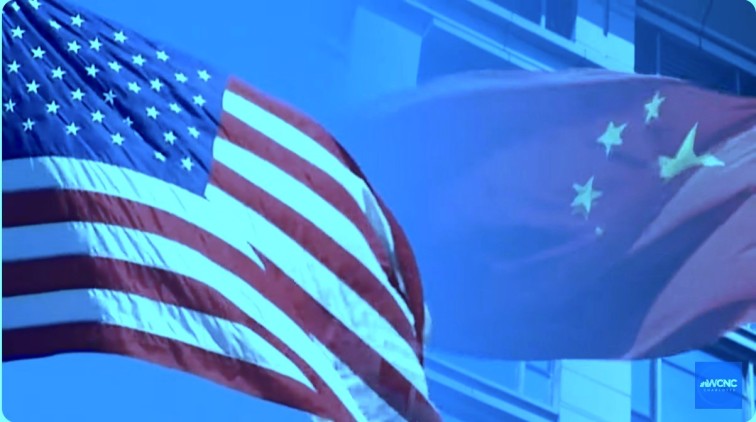
[People News] The current international landscape is quite intriguing. Just after the highly publicized Trump-Xi meeting, the United States swiftly announced the sale of two F-16 fighter jets to Taiwan.
On October 7, the European Parliament overwhelmingly approved a policy report regarding China, which not only urged EU member states and democratic allies to enhance security coordination in the Taiwan Strait, maintain naval patrols, and conduct joint exercises to stabilize the regional situation, but also explicitly stated that no party should unilaterally alter the status quo in the Taiwan Strait through force or coercion.
In addition to Europe, former Taiwanese President Tsai Ing-wen also visited the United States to deliver a speech. She candidly remarked that while international media often portray Taiwan as a crisis-laden hotspot, Taiwan's true strength lies in being an irreplaceable key partner in global security and high-tech industries. She called on democratic partners worldwide to transcend borders, forge closer alliances, and collaboratively build a more resilient supply chain defense.
Furthermore, the speech by current President Lai Ching-te during the Double Tenth National Day celebrations and banquet unexpectedly became a focal point for Western media. In his address, he openly urged Indo-Pacific democratic nations to 'join forces' to maintain regional stability and counter expansion, signaling that Taiwan is actively linking its survival to the security defense line of the international democratic coalition.
As noted by the Associated Press, while the Taiwan Strait continues to be a flashpoint for US-China tensions, President Lai is encouraged by the prospect of the US and China managing their differences through dialogue. However, he made it clear that maintaining peace requires more than just negotiations between major powers; the collective support of the Indo-Pacific democratic camp is absolutely essential.
Bloomberg has noted that as the leaders of the United States and China seek to navigate and manage their differences, President Lai (Lai Qingde) is actively engaging with democratic nations worldwide to maintain a united front, aiming to ensure that Taiwan's interests are not sidelined in negotiations between major powers.
Beyond proactive diplomatic initiatives, international media are closely monitoring Taiwan's concrete actions that reflect its commitment to defense. The Associated Press reported that while President Lai welcomed dialogue between the U.S. and China, he firmly maintained his stance, stressing that the survival rights of the Taiwanese people must be respected. He has consistently reiterated that the significant increase in the defense budget (such as the allocation of up to 1.1 trillion New Taiwan dollars in 2027, which represents over 3% of GDP) is not intended to provoke, but rather to 'effectively deter war.' This also demonstrates to allies like the United States that Taiwan is serious about self-defense and unequivocal in its resolve.
In a broader international context, President Lai's appeal during his National Day speech for democratic nations in the Indo-Pacific to 'join forces' to maintain regional stability aligns perfectly with the current strategic priorities of Western and Indo-Pacific allies.
Transitioning from a 'bilateral strategy' to a 'multilateral security network'
Historically, discussions about Taiwan Strait security have largely relied on the tacit understanding between Taiwan and the U.S. and the U.S. Taiwan Relations Act. However, it is clear to everyone that in recent years, the attitudes of the United States, Japan, Australia, South Korea, the Philippines, as well as the European Parliament and Germany, have shifted, and they are quietly assembling a larger Indo-Pacific collective security network.
President Lai has called for "democratic countries to join forces," which aligns perfectly with the United States' current initiative for "integrated deterrence." Essentially, this involves uniting the national defense, intelligence, and supply chains of each democratic node in the First Island Chain—such as Japan, Taiwan, and the Philippines—along with like-minded partners like the U.S., Australia, and the European Union. Consequently, anyone considering rash actions would face significantly heightened costs.
The Consensus of "Deterrence Before Dialogue"
Previously, there were concerns in Western political circles that bold actions might provoke Beijing excessively. However, the current mainstream Western strategy has reached a consensus: strength and a clear collective defense stance are the only effective means to prevent the outbreak of war.
President Lai emphasized that "we will not abandon freedom, but will resolutely strengthen defense and regional cooperation," which is in complete harmony with the current policy logic of the United States and its allies. Western democracies seek Taiwan to showcase its "determination for self-defense" and its value as a "regional stability asset," thereby justifying their political, military, and economic support. (The term "support" refers to covert backing, external assistance, or strong backing.)
The Elevation of Taiwan Strait Security to the "Lifeline of Global Democracy and Technology Supply Chains"
As repeatedly highlighted by the G7 (Group of Seven), peace in the Taiwan Strait is no longer solely Taiwan's concern; it is a vital lifeline for global security and economic prosperity. Taiwan serves not only as a geopolitical outpost but also as the heart of the global high-tech and semiconductor industry.
President Lai's call for unity serves as a reminder to the world: we are not merely defending Taiwan's democracy; we are also standing against the tide of authoritarian expansion on behalf of the entire free world.
This appeal from President Lai reflects a remarkable level of strategic clarity: it is not a provocation, but a prudent response to current geopolitical trends, actively tying Taiwan's survival to the security of the global democratic alliance. This strategic framing has become a crucial breakthrough for the free world in strengthening its collective deterrent capabilities.
Historically, Taiwan has often found itself in a position of 'fighting alone' or 'passive defense' on the international stage, desperately seeking diplomatic breakthroughs while facing suppression from Beijing. However, recent international developments and President Lai's statements indicate that this passive dynamic is experiencing a historic shift.
Taiwan's Shift to a 'Bilateral Value Alliance'
In his call for Indo-Pacific democratic nations to 'join forces,' President Lai does not adopt a subservient tone; instead, he speaks from an equal footing as 'key assets in global democracy and semiconductor technology supply chains.' Taiwan is no longer just a 'victim waiting to be threatened' in the geopolitical arena; it is actively positioning itself as a 'maintainer and provider of regional stability.'
The ongoing delivery of defense equipment by the United States, the significant shift in the EU and Germany's stance on the Taiwan Strait, and the increased interactions among political leaders from countries like Japan all underscore one key point: the connection between the democratic camp and Taiwan has transitioned from a previously covert understanding to a robust and tangible security network and alliance of values that is now openly acknowledged.
Attracting like-minded partners through 'strength and confidence'
International politics is fundamentally grounded in reality. As Beijing appears strong externally but is internally weakened by economic collapse and domestic crises, Taiwan's display of democratic resilience, economic vitality (particularly in high-tech sectors), and unwavering defense commitment has clarified for like-minded nations worldwide who the truly stable and reliable partner is.
In other words, Taiwan is certainly not isolated or without allies. After all, freedom and truth serve as the most powerful magnets. When Taiwan stands resolutely alongside democratic values, the global forces that cherish freedom will naturally align with this defensive stance.
Isn't this the most vivid illustration of the saying 'virtue is not solitary; it must have neighbours' in the context of modern international politics?
Xi Jinping's 'reverse gear' has backfired.
In contrast, while Lai Ching-te is viewed as someone who has embraced contemporary trends, paving the way forward and leveraging democratic values and rational confidence to secure allies for Taiwan on the international stage as a 'fair-weather friend,' Xi Jinping, who has relied on extensive internal purges to reach the peak of power, has become the target of curses from a large population struggling below the poverty line. He is increasingly isolated on the international front and is caught in a significant governance crisis. His regressive policies have led to a severe backlash, taking a nation that once had the potential to embrace openness through globalization and driving it into a dead end.
Trapped in the Dead End of Pursuing Greater Power
Through years of centralization and anti-corruption campaigns, Xi Jinping has indeed achieved an extraordinary concentration of personal power rarely seen in modern times. However, in a totalitarian regime, it is often true that 'the greater the power, the smaller the margin for error.' As the economy continues to stagnate and crises in real estate and local debts erupt one after another, Xi Jinping's solution is not to pursue genuine political and economic reforms (which would threaten the foundation of Communist Party rule), but rather to intensify the policy of 'state-owned enterprises advancing while private enterprises retreat,' reinforce security controls, and even adopt confrontational industrial policies. This strategy of 'using increased state power to mask the failures caused by power itself' ultimately stifles economic vitality to the point of suffocation.
Historically, China has been a gold rush paradise for global capital. However, due to the 'state advances while the private sector retreats', arbitrary water meter checks under the anti-espionage law, extensive big data surveillance, and political crackdowns on private enterprises, foreign investors have discovered that China's business environment has become extremely unsafe and riddled with unpredictable political risks. As a result, many have begun 'de-risking' or have withdrawn their investments altogether, transforming China into a quagmire from which capital is eager to escape.
Wolf warrior diplomacy has further narrowed the circle.
Since Xi Jinping took office, his assertive expansion and confrontational wolf warrior diplomacy were intended to demonstrate the rise of a great power and compel the world to adhere to his rules. However, the outcome has been a significant backlash: the more he exerts pressure in the Taiwan Strait and the South China Sea, the more he has awakened democratic allies such as the U.S., Europe, Japan, and Taiwan, leading to an unprecedented Indo-Pacific defense and technology alliance. His initial goal was to navigate international waters and disrupt the status quo, but instead, he has made Western nations acutely aware of the threats posed by authoritarian regimes, thereby accelerating the push for supply chain 'de-risking'. In essence, he aimed to broaden his geopolitical influence but has instead confined himself, approaching a state of strategic isolation.
The ideological 'self-binding'.
Lai Ching-te consistently reaches out to the world with the universally understood message of 'democracy, cooperation, and maintaining regional stability.'
In stark contrast, Xi Jinping consistently emphasizes 'the leadership of the Party' in his public speeches, repeatedly stressing the 'unprecedented changes in a century' and the exaggerated notion of 'national security.' This bureaucratic language increasingly bores and irritates Western politicians, further driving away foreign investment. It highlights the fact that Xi Jinping's administration is utterly incapable of implementing genuine political and economic reforms that could unleash grassroots vitality; instead, it resorts to heightened ideological control, formalism, and security checks to mask the ongoing crisis. As a result, consumer confidence has completely collapsed, leaving young people feeling helpless and opting to 'lie flat' or 'run' abroad. This situation itself represents the most silent yet deadly form of protest against the current state of affairs.
When we compare the recent actions of the leaders across the Taiwan Strait, we observe that:
Lai Ching-te has effectively seized the opportunity presented by 'democracy and collective security,' closely aligning Taiwan's fate with the global fight against totalitarianism and the pursuit of universal values of freedom, thus creating a 'wider and wider' space for Taiwan's survival.
In contrast, Xi Jinping has firmly anchored himself to the chariot of 'maintaining the absolute power of the Party-state and his personal historical positioning.' Despite wielding a vast state apparatus and an extensive surveillance network, he is gradually succumbing to the historical fate of 'the greater the power, the deeper the crisis,' as he faces the realities of objective economic laws, a collapsing demographic structure, and the fortifications of the global democratic camp.
A review of historical footprints reveals that leaders who align with the will of heaven and the sentiments of the people, who embrace civilization and kindness, and who know how to leverage their strengths, can guide their nations toward prosperity and success. In stark contrast, the Chinese Communist Party and Xi Jinping, who lead a regime rooted in dictatorial oppression marked by corruption and brutality, are ultimately fated to be crushed by the relentless march of history.
(Published first by People News)△




News magazine bootstrap themes!
I like this themes, fast loading and look profesional
Thank you Carlos!
You're welcome!
Please support me with give positive rating!
Yes Sure!