

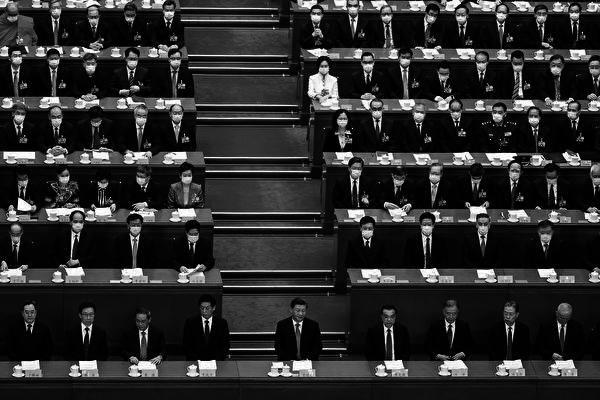
The persecution has led to a backlash, resulting in a loss of power, and those in high positions are merely playing supporting roles. (Illustration by People News)
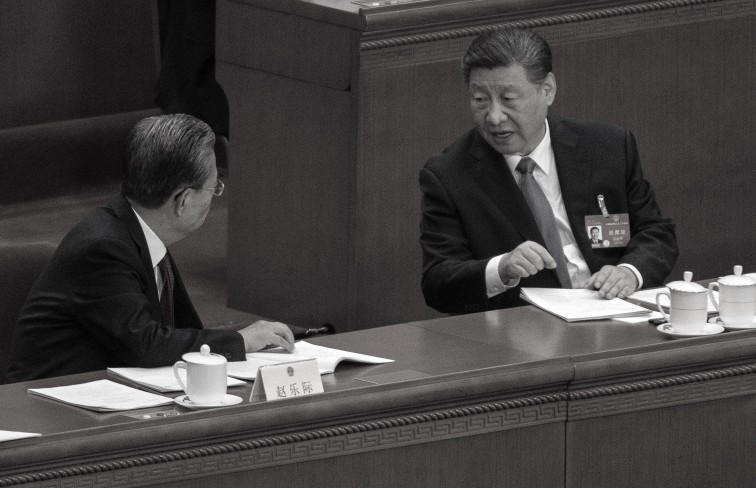
[People News] The Fifth Plenary Session of the 20th Central Committee of the Communist Party of China recently concluded in Beijing, where officials announced the expulsion of 33 senior officials from the party, government, and military in a single sweep. Logically, having removed these "hidden dangers," one would expect him to feel more secure, right? However, a closer examination of Xi Jinping's statements during the meeting shows that he not only lacks a sense of safety but has also descended into a deeper state of suspicion and crisis.
During the meeting, he reiterated the familiar slogan: "The longer we govern, the more complex the environment becomes, and the more we must enhance our awareness of potential dangers, remain vigilant in times of peace, and persistently advance the comprehensive strict governance of the party."
While this sounds impressive, in simpler terms, it translates to: "The longer I stay in power, the more anxious I feel; I can't trust anyone!"
Over a Decade of Anti-Corruption: The More We Fight, the More Corruption Grows
Since taking over at the 18th National Congress, Xi Jinping has conducted a high-pressure anti-corruption campaign for over a decade, detaining hundreds of thousands, even millions, of officials each year. If this approach were truly effective, why is he still calling for "persistence" today? Even he acknowledges that "comprehensive strict governance of the party faces many new situations and new problems."
In blunt terms, this party is incapable of governing! The Communist Party operates above the state and the law, and the entire ruling system lacks independent oversight and the rule of law. Within this bureaucratic framework, the party secretary always holds a higher position than administrative officials or technical bureaucrats. This system is fundamentally a 'breeding ground for corruption.' If a principled individual enters this system and refrains from engaging in corruption or aligning with factions, they become an outlier and face collective ostracism and suppression. In this environment of 'reverse elimination,' no matter how many corrupt officials are apprehended, it only addresses the symptoms rather than the root causes; one wave of corruption is dealt with, and another wave arises, creating an endless cycle.
Feigning to Listen to Public Opinion and Addressing Those Who Raise Issues
Xi Jinping also remarked at the meeting that governing the party must 'rely on the support of the people' and 'humbly listen to the criticisms of the masses.' To ordinary citizens, this statement is nothing short of ironic!
Everyone understands that under the Communist Party's rule, over the years, anyone who dared to voice opinions or speak the truth has been 'resolved' by the Communist Party. The issues have never been addressed; it is always the individuals who raise concerns that are dealt with. The so-called 'accepting supervision' is merely a tactic to mislead those who blindly idolise the party.
Treating the Common People as Chives and Power as Family Property
In contemporary China, the economy is in shambles, with the housing market collapsing, young people struggling to find jobs, and local governments nearly unable to pay salaries. The lives of ordinary citizens are extremely challenging. Even the most patient individuals from the past can no longer endure the situation and have begun to call for 'the Communist Party to step down' and 'Xi Jinping to step down.' This reflects a complete disconnection of public sentiment from this regime, and the legitimacy of the Communist Party's system among the populace is facing total collapse.
However, during meetings, do the leaders truly care about the lives of ordinary citizens? Absolutely not! Their sole focus is on how to maintain their grip on power.
Despite creating chaos in national governance, Xi Jinping still shamelessly demands that the public 'steadfastly support the Party's leadership.' In reality, he and his fellow Party members are not defending this dictatorial regime for any noble ideals; rather, they are solely motivated by the desire to protect their own and their families' privileges, continuing to extract maximum benefits from the populace.
The Chinese Communist Party has reached a deadlock.
The longer they stay in power, the more suspicious they become of those around them; even trusted aides like Zhang Youxia cannot be relied upon and must be swiftly dealt with. As purges become more widespread, the entire bureaucratic system grows increasingly apathetic and fearful, with officials feeling the need to shout slogans ever louder to prove their loyalty.
This Fifth Plenary Session serves as a mirror, revealing that the CCP has completely fallen into a vicious cycle of 'the more purges, the more unrest; the more anxiety, the higher the pressure.'
As a rights-protecting government remains in power longer, it becomes more wary of its surroundings; the more high-pressure crackdowns it enacts, the more the bureaucratic system succumbs to lethargy and paralysis. The signals from the Fifth Plenary Session indicate that the CCP has fully entered the 'dictator's dilemma' of 'the more purges, the more unrest; the more anxiety, the higher the pressure.'
When a regime dedicates all its efforts to internal suppression and self-inflicted turmoil, while completely disregarding the suffering of its citizens, it does not require external forces to push it; it is already teetering on the edge of collapse.
(First published by People News) △






News magazine bootstrap themes!
I like this themes, fast loading and look profesional
Thank you Carlos!
You're welcome!
Please support me with give positive rating!
Yes Sure!