
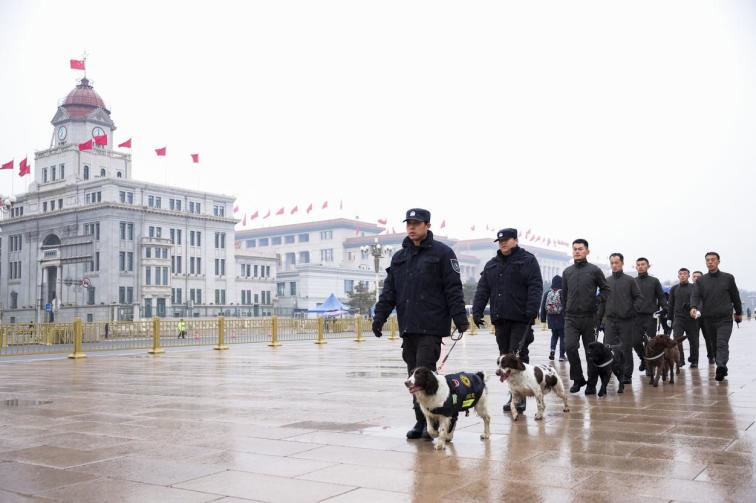
File photo: Plainclothes security personnel walk outside the Great Hall of the People during the opening ceremony of the National People's Congress in Beijing, China, on March 5, 2024. (Photo by Lintao Zhang/Getty Images)
[People News] Following the much-anticipated Fifth Plenary Session of the 20th Central Committee of the Communist Party of China, it is customary for state media to publish a series of timely articles, and for high-ranking officials throughout the Party to hold meetings to express their views on Xi Jinping's speech. This year was no exception. On October 30, the Party groups of the State Council, the National People's Congress, the National Committee of the Chinese People's Political Consultative Conference, and the Central Commission for Discipline Inspection all convened meetings simultaneously. The meetings were chaired by the four Standing Committee members of the Political Bureau: Li Qiang, Zhao Leji, Wang Huning, and Li Xi. How did state media report on this?
A key commonality among them was their affirmation of the importance of Xi's report, which they described as a "programmatic document for the new great project of Party building." However, the expressions used by the four members revealed some differences.
1. Li Qiang's Unusual Wording.
In the report of the statement meeting held by the State Council, there was an unusual phrase stating that the Fifth Plenary Session was "a historic meeting held at a critical juncture in our country's development, fully reflecting the historical initiative of the Party Central Committee with Xi Jinping at its core to strengthen the Party and the country." The terms "critical juncture," "historic meeting," and "historical initiative" indicate that this is a very significant meeting.
Does the term "critical juncture" refer to a life-and-death moment for the Communist Party? Does "historic" imply another round of "Party rectification"? Does "historical initiative" suggest that the Party Central Committee, with Xi at its core, is choosing to make painful sacrifices to preserve the Communist Party's regime? Such expressions seem to reveal more about the internal dynamics of the Fifth Plenary Session than what the Communist Party has publicly disclosed.
It is important to note that during the statement meeting following last year's Fourth Plenary Session, Li Qiang did not refer to the 'Party Central' with Xi as the core at all. The differences observed in just one year suggest that Li Qiang and other Standing Committee members alongside Xi have acquired more power than previously.
In a similar vein, while there remains a call to 'unify thoughts and actions with the spirit of Xi's important speeches and the deployments of the plenary session,' this year, the statements made by Li Qiang and his team are unprecedented. He asserted, 'We must uphold and strengthen the centralised and unified leadership of the Party Central Committee, improve the implementation mechanism for major decisions and deployments of the Party Central Committee... and resolutely act as executors, action-oriented individuals, and pragmatists in implementing the decisions and deployments of the Party Central Committee.' This statement further confirms that Xi's 'supreme' status is no longer absolute; he is simply one member of the 'Party Central.'
Furthermore, the relevant reports did not mention any of the loyalty phrases from the 'two establishes and two safeguards,' such as 'establishing' or 'safeguarding,' which is consistent with the absence of such expressions in the communiqué of the Fifth Plenary Session.
2. Zhao Leji's loyalty phrases do not mention 'centralised and unified leadership of the Party Central Committee.'
In the reports from the statement meeting held during the National People's Congress, Zhao Leji's remarks were largely formulaic and lacked originality. He attributed the so-called 'new progress and new achievements' of the Communist Party to the 'two establishes' and 'two safeguards,' whereas these loyalty phrases were only mentioned at the end of the meeting after last year's Fourth Plenary Session.
Additionally, Zhao Leji praised Xi's speeches as providing fundamental guidance for the so-called 'great project,' a sentiment that was absent from Li Qiang's reports.
Additionally, Zhao Leji urged senior officials of the National People's Congress (NPC) to "consciously align their thoughts and actions with the spirit of the plenary session," contrasting with Li Qiang's statement to "align with the spirit of Xi's important speeches and the arrangements of the plenary session," and differing from last year's directive to "align with the decisions and arrangements of the Party Central Committee."
Interestingly, throughout the report, Zhao Leji did not mention the "Party Central Committee" at all, whereas he referenced it four times during last year's meeting, including statements like "the NPC must consciously uphold the centralised and unified leadership of the Party Central Committee" and "ensure that the decisions and arrangements of the Party Central Committee are fully implemented in the work of the NPC." It is peculiar that such references were absent this year.
Does this imply that Zhao Leji has reservations about the "Party Central Committee"? Is he reluctant to assure that the "decisions and arrangements of the Party Central Committee will be fully implemented in the work of the NPC" in the future? What transpired at the Fifth Plenary Session that might have caused his discontent?
3. Wang Huning consistently emphasised the "Party Central Committee with Xi at its core" and also referred to loyalty.
In the report from the statement meeting of the National Committee of the Chinese People's Political Consultative Conference (CPPCC), Wang Huning's comments regarding the meeting's significance were more reserved than those of Li Qiang, describing it as "a very important meeting held at a critical juncture for essentially achieving socialist modernisation," without labelling it as a "historic" meeting.
Notably, in the report, Wang Huning mentioned the "Party Central Committee with Xi at its core" three times, similar to his remarks at last year's statement meeting, while Li Qiang only mentioned it once, and Zhao Leji did not mention it at all. However, last year, Wang Huning asserted that "the fundamental issue lies in the Party Central Committee steering with Xi at its core," a statement that was notably absent this year.
Additionally, Wang Huning highlighted the 'two establishments' and 'two safeguards', noting that last year there were 'two fours and four twos'. Similar to Zhao Leji, he called on senior officials of the Chinese People's Political Consultative Conference to 'align their thoughts and actions with the spirit of the plenary session'.
Wang Huning's remarks further indicate that the leadership power within the upper echelons of the Chinese Communist Party (CCP) is no longer exclusively held by Xi Jinping, although he still maintains significant authority.
4. Li Xi's expression of loyalty to Xi is noteworthy.
In contrast to the reports concerning the three Standing Committee members mentioned earlier, the first paragraph of the report from the meeting of the Central Commission for Discipline Inspection emphasised that Li Xi, the Secretary of the Central Commission for Discipline Inspection, underscored the importance of deeply studying Xi's thoughts on party building. He stated that after thoroughly grasping the 'two establishments' and achieving the 'two safeguards', it is essential to 'align thoughts and actions with the decisions and deployments of the Party Central Committee'.
Li Xi remarked that following the Fourth Plenary Session, it is the 'Party Central Committee with Xi at its core' that leads to achievements, which are 'fundamentally due to General Secretary Xi Jinping's guidance'. Recently, reports from state and military media have adopted the narrative that these achievements are 'fundamentally due to the leadership of the Party Central Committee with Xi at its core'. Li Xi's declaration of loyalty to Xi is unusual and was not present during last year's Fourth Plenary Session.
It is important to note that if it is the 'Party Central Committee steering', then it is no longer solely Xi's domain. Yet, in Li Xi's perspective, Xi remains the 'chief helmsman'!
Moreover, Li Xi's expressions of loyalty to Xi also include the call to 'unify thoughts, unify will, unify actions, and resolutely advance courageously along the path guided by Xi Jinping'. Such statements are not echoed by other Standing Committee members.
Li Xi's remarks indicate that Xi still wields considerable influence within the 'Party Central' and has the power to determine the fate of certain individuals. Could Li Xi's show of loyalty be connected to the rumours surrounding his potential investigation?
Following Ding Xuexiang's attendance at the State Council's statement meeting, reports from state media reveal that, aside from Cai Qi, the other five members of the Standing Committee voiced their opinions on Xi's speech approved at the Fifth Plenary Session. The unusual nature of these statements highlights the persistent divisions within the Communist Party of China, with Standing Committee members engaged in both overt and covert power struggles. Regarding personnel appointments, only one Politburo member was promoted, and there were no replacements for Ma Xingrui, nor for the Vice Chairman of the Central Military Commission or military committee members. This situation reflects the internal conflicts and the challenges in achieving consensus.
(First published by People News) △







News magazine bootstrap themes!
I like this themes, fast loading and look profesional
Thank you Carlos!
You're welcome!
Please support me with give positive rating!
Yes Sure!