
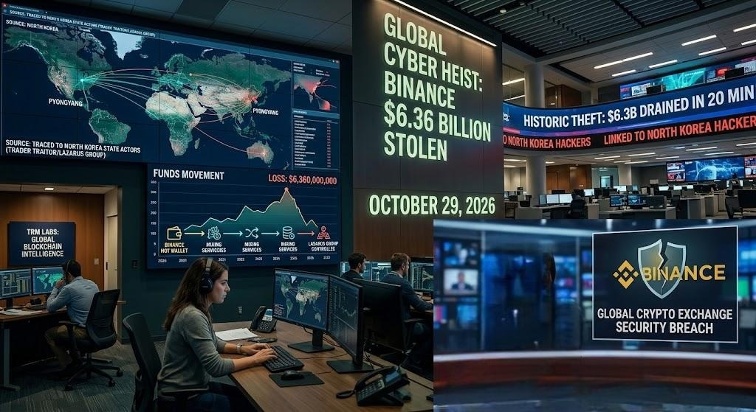
On October 29, 2026, Binance, the world's largest cryptocurrency exchange by trading volume, suffered a major hacking incident. (AI-generated image)
[People News] This incident is not just a simple case of commercial cybercrime; it reveals how totalitarian regimes like North Korea exploit state-level cyberattack capabilities as a strategic tool for illegal global financial plunder.
Investigations by blockchain security firms such as TRM Labs and Chainalysis, along with law enforcement agencies like the FBI, have pointed to TraderTraitor as the mastermind behind this attack. TraderTraitor is a core operational team of the Lazarus Group, a prominent hacking organisation linked to North Korea's military intelligence agency, the Reconnaissance General Bureau.
State-Mobilized Financial Plunder: Institutionalising Hacking Activities
Unlike traditional hacker organisations, which are often independent criminal groups seeking personal gain, North Korea's cyber forces are entirely state-driven.
Due to long-standing human rights abuses and illegal nuclear weapons development, North Korea has faced severe economic sanctions from the international community. With traditional foreign exchange channels blocked, the North Korean regime has established a state-level hacking force, using the cryptocurrency market as its primary means of acquiring foreign exchange.
The traditional banking system, such as SWIFT, implements strict anti-money laundering measures and sanctions lists, making it challenging for North Korea to transfer large amounts of money directly through conventional banking channels. As a result, decentralised, borderless, and anonymous cryptocurrencies have emerged as a strategic means for North Korea to circumvent global financial sanctions.
Funds acquired through cyber plundering are allocated for weapon development, posing a threat to global security.
Experts in national security and international strategic research institutions highlight that the funds plundered by North Korea through cyber means have significant implications for global geopolitical and military stability.
Reports from the United Nations Security Council and relevant sanctions committees indicate that billions of dollars in digital assets stolen by North Korea through hacking are laundered via mixers and decentralised finance (DeFi) platforms, with a substantial portion funnelled into its defence budget to directly support ballistic missile tests and nuclear weapon development.
North Korea operates in a state of information isolation, with very limited domestic internet infrastructure that is disconnected from the outside world. This asymmetric advantage, characterised by “almost no cyber targets available for enemy retaliation,” enables North Korea to launch devastating cyber attacks against Western and global commercial entities without fear of reprisal.
North Korean hackers are adept at targeting “human vulnerabilities.”
These hackers are intelligent and patient; they understand that blockchain security codes are nearly impossible to manipulate or breach, so they avoid direct attacks. Instead, they seek out vulnerabilities in individuals—using social engineering and phishing tactics, they successfully deceived an engineer at Binance and gained control of his computer.
The hackers then used this compromised computer as a gateway to infiltrate Binance's internal servers, successfully acquiring the keys and permissions necessary to “transfer funds on behalf of customers.”
After gaining access to the permissions, the hackers took advantage of a new feature that Ethereum had originally designed to "make operations easier for users" and repurposed it into a tool for stealing money.
They developed a program that was set to "automatically transfer money as soon as the authorisation was captured." This meant that even if they only managed to successfully invade once for a brief moment, this automated program could continuously drain funds from the Binance account like a pump.
Prior to launching their attack, the hackers had secretly conducted over 36 hours of rehearsals and tests. Late on the night of October 29, they activated the automated program, simultaneously executing withdrawals across ten mainstream blockchains, including Bitcoin and Ethereum.
Remarkably, once the money was transferred, the program would "automatically initiate self-destruction," thoroughly erasing all records and traces from the internet, making it extremely challenging for law enforcement to track down any leads.
Following the incident, stablecoin issuers such as Tether and Circle, along with major cross-chain security teams, quickly responded by freezing approximately $2.7 billion to $3 billion in stablecoin assets at the earliest opportunity. However, decentralised native assets, including around 500,000 native Ether (ETH), could not be intercepted due to the absence of a central authority, and most of these assets ended up in the hands of the hackers.
In light of this cybercrime incident, Binance promptly announced that it would utilise the Secure Asset Fund for Users (SAFU) and its own funds to fully cover the losses, ensuring that user assets remained unaffected, and began a comprehensive overhaul of its internal security structure.
North Korea's actions bring to mind the unconventional strategies employed by the Chinese Communist Party (CCP) during the Chinese Civil War and the Yan'an period, reflecting its extreme measures taken for survival and expansion without hesitation. These actions inflicted a devastating blow to the social and economic order of that time.
The 'Special Goods' Economy of the Yan'an Period: Cultivation and Sale of Opium
During the Anti-Japanese War and the confrontation between the Kuomintang and the CCP in the early 1940s, the Shaanxi-Gansu-Ningxia Border Region faced severe economic blockades and financial crises. To raise military funds and sustain its regime, the CCP promoted large-scale opium cultivation and sales in Yan'an and the border areas, referring to opium in internal documents as 'special goods' or 'local specialities.'
Historical archives and scholarly research, such as Xie Youtian's 'The Mystery of the CCP's Growth' and Gao Hua's 'How the Red Sun Rose,' reveal that the CCP sold large quantities of cultivated opium to areas controlled by the Nationalist government (the white areas) and Japanese-occupied territories, in exchange for gold, US dollars, French currency, and essential supplies like medicine, cloth, and weapon components.
While the CCP enforced strict anti-smoking policies within the border areas, prohibiting local residents from consuming opium, it simultaneously exported large amounts of opium to regions governed by the Republic of China. This practice of 'poisoning others to fund oneself' not only undermined the social economy and public health in the Nationalist government's jurisdiction but also starkly revealed its political pragmatism lacking humanitarian principles.
Manufacturing and Circulating Counterfeit Currency: Undermining the Nationalist Financial System
During the Chinese Civil War, financial warfare was one of the most brutal contests outside the battlefield. To dismantle the economic foundation of the Nationalist government, the CCP implemented a strategy of large-scale production and distribution of counterfeit currency in the liberated areas under its control and in underground networks.
The Chinese Communist Party (CCP) employed secret printing factories to produce large quantities of counterfeit currency issued by the Nationalist Government, including fiat currency, gold bonds, and later, gold yuan notes. They infiltrated major cities controlled by the Nationalist Government, such as Shanghai, Nanjing, and Tianjin, through underground channels to engage in arbitrage.
At that time, the Nationalist Government was experiencing financial difficulties due to the war, and there was already a problem of excessive currency issuance. The influx of a significant amount of counterfeit money from the CCP further intensified inflation, causing the fiat currency and gold yuan notes in the market to instantly lose their value and become worthless.
The widespread circulation of counterfeit money resulted in the assets accumulated by ordinary citizens disappearing overnight, leading to the collapse of small businesses and a paralysis of market transactions. The public completely lost faith in the financial system of the Nationalist Government. This financial devastation directly destroyed the survival baseline of the urban middle class and common people at that time.
Kidnapping, extortion, and resource plundering: grassroots control under armed separatism.
In addition to opium and counterfeit money, the CCP frequently resorted to extreme measures for resource plundering during the early period of separatism and the civil war.
During the early 'Soviet' period and as the civil war progressed, the CCP army often justified their actions with the slogan 'seizing land from the rich and distributing it to the poor,' confiscating property from local gentry, wealthy farmers, and even ordinary merchants. They resorted to kidnapping for ransom and even direct executions.
This approach of undermining private property rights and basic rule of law completely dismantled the order and moral fabric of traditional rural society in China, creating an atmosphere of extreme terror and class conflict.
From the 'opium trade' during the Yan'an period to the 'financial counterfeit currency war' during the civil war, and now to the modern practice of 'cryptocurrency transfer and money laundering' carried out by state-sponsored hacker organisations, the underlying logic has remained unchanged: prioritising survival, expansion, and external competition over laws, ethics, and international standards.
This extreme tactic, which undermines economic order and jeopardises civilian welfare for political ends, has historically inflicted deep disasters on Chinese society and continues to present significant challenges to global security and order today.
(First published in People News)△






News magazine bootstrap themes!
I like this themes, fast loading and look profesional
Thank you Carlos!
You're welcome!
Please support me with give positive rating!
Yes Sure!