
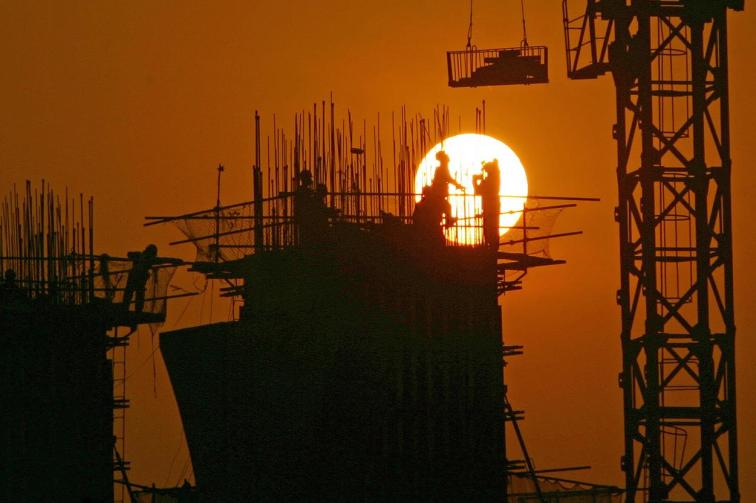
Illustration: China's economy continues to decline. (Photo by China Photos/Getty Images)
[People News] China's economy is currently ensnared in a situation leading towards structural decline. The Communist Party has concentrated its efforts on manipulating superficial data, which may still give the illusion of positive growth, but the reality is starkly different. Domestic demand is contracting, the real estate sector continues to deteriorate, and public confidence is waning, creating a vicious cycle of pressure.
Recent indicators from November 2026 suggest that this structural recession is far from reaching its lowest point. The enthusiasm for Double Eleven has plummeted, overseas tax collection is being used for emergency relief, and the ageing population has led to the unusual phenomenon of 'shared children.' Additionally, new home sales in the real estate market have hit a multi-year low, and the decline in investment is widening, all pointing to a harsh reality: the growth engine of China's economy has stalled, and the failure of the government's economic policies is now a settled matter.
Collapse of Consumer Confidence: Double Eleven Becomes a Burden
Once a vibrant and nationwide shopping festival, Double Eleven has lost its appeal to both merchants and consumers amid the current economic downturn and weak consumer spending, turning into a shared burden for both supply and demand. On November 11, 2026, platforms such as Tmall and JD.com engaged in their usual promotional battles, but the excitement was noticeably diminished. Media coverage and public discourse have significantly declined, and since 2022, these platforms have ceased to disclose total transaction volumes (GMV). According to a Citigroup research report, the overall GMV of major e-commerce platforms during the initial phase of Double Eleven saw a year-on-year increase of just over 4%, and if immediate retail is included, it reaches about 10%, barely meeting expectations. However, there is a stark disparity among different platforms, with Douyin performing exceptionally well while Pinduoduo and Kuaishou show lacklustre results.
An anonymous individual who previously ran an e-commerce business in Shanghai remarked that the normalisation of festivals has led to a sense of indifference among people. With nearly half of the year, 365 days, dedicated to 'celebrating festivals,' consumers no longer feel compelled to wait for Double Eleven to snag discounts. The promotional rules have become increasingly intricate, featuring pre-order discounts, live-stream exclusives, and member stacking, which leave people feeling 'exhausted.' More importantly, the economic downturn plays a significant role. He candidly expressed, 'In the past, when money was plentiful, I always felt the urge to buy something, and it was okay to stock up even if items expired; now, we are budgeting meticulously, and the habit of hoarding has vanished.' Additionally, the trend of physical consumption returning has intensified the competition among e-commerce platforms, forcing merchants to operate at a loss to attract traffic, with performance pressures directly impacting subsequent traffic allocation.
Consumer fatigue has become a persistent issue for the Chinese economy. The authorities, undeterred by the challenges, continue to innovate their stimulus measures year after year, yet they fail to boost the income of the public. Expectations for residents' income are declining, employment uncertainty is rising, and asset prices are shrinking; each of these trends dampens purchasing power. When household balance sheets suffer due to falling housing prices, consumption inevitably becomes the first area to be cut. Double Eleven is likely to become increasingly deserted; its decline is merely the tip of the iceberg of the broader economic situation.
Fiscal constraints: Overseas tax collection emerges as a crucial lifeline.
With sluggish consumption putting pressure on the economy, the government's financial situation is becoming increasingly worrisome. In response, authorities are intensifying their efforts to extract wealth. In November 2026, the Chinese government announced the notable success of its 'offshore trust income taxation' policy. Following the end of the transition period on October 22, the total amount of personal income tax declared from offshore trusts surpassed 160 billion yuan, with over 120 billion yuan collected in October alone, resulting in a nearly 90% increase in national personal tax revenue for that month. This has surprisingly been cited by officials as a clear demonstration of the policy's effectiveness.
The threshold for this 'wealth tax' is quite high; establishing an offshore trust typically requires a minimum investment of 1 million USD, while more complex structures may start at 5 million USD. Estimates suggest that the total assets of offshore trusts controlled by residents in China range from approximately 23 trillion to 27 trillion yuan, with around 10,000 accounts. Previously, oversight in this area was lax, but now, with advancements in AI, big data, and the implementation of the Common Reporting Standard (CRS), the opportunities for tax evasion have been significantly reduced. Reports circulating online indicate that some real estate moguls may owe back taxes amounting to billions, which, although not officially confirmed, highlights the financial authorities' determination to 'tap into' private wealth and extract as much as possible. What was once referred to as 'seizing land from the rich and distributing it' has now evolved, with big data identification, long-arm tactics, and offshore plundering becoming the new norm.
The issue at hand is that this overtly 'robbery-style governance' can only provide temporary relief. Land transfer fees used to be a crucial support for local finances, but the current slump in the real estate market has led to a significant drop in related revenues. In the first nine months of 2026, national real estate development investment fell by 20.6% compared to the previous year, marking a near-record low; the funds secured decreased by 21.6%, and domestic loans saw a dramatic decline of 33.1%. As land finance becomes increasingly unsustainable, tax collection has become a makeshift solution. However, an over-reliance on one-off tax payments is neither sustainable nor may it further diminish the investment and consumption willingness of high-net-worth individuals, resulting in a new negative feedback loop.
Absurd Ageing: The Emergence of 'Shared Children'
The worsening population structure poses an even greater long-term risk. China is rapidly entering a phase of deep ageing, and the traditional family support system for the elderly is disintegrating, leading to the rise of the 'shared children' service. In cities like Changsha, streets have introduced home care services starting at 199 yuan per month, which include cleaning, accompanying medical visits, and bathing assistance, and are dubbed 'the first street-endorsed shared children project.' Additionally, the official consumption voucher policy is fostering the silver economy, with a total of 3.328 million consumption vouchers redeemed in 2026, generating 11.5 billion yuan in elderly care service consumption.
Private platforms are stepping in to help, as children of elderly parents living abroad pay for someone to visit their parents in nursing homes on a weekly basis. The service provider is required to present themselves as a 'friend' to prevent the elderly from realising that it is a paid service. Hourly wages for these visits range from 50 to 300 yuan. Entrepreneurs acknowledge that safety is the primary concern—there is a fear that parents might be sold health products or fall victim to scams. Additionally, service providers worry about developing emotional attachments to the elderly over time, which raises questions about the commercial and ethical boundaries once feelings deepen. To mitigate potential disputes and legal issues, some providers record audio and video throughout the visits.
The emergence of this paid companionship service reflects a desperate response to the commercialisation of family functions in a society facing significant ageing. Factors such as declining birth rates, late marriages, and the immense pressures faced by young people have exacerbated the 'empty nest elderly' issue. If government subsidies are withdrawn, it remains uncertain whether the market can endure the challenges ahead. A more profound concern is that the need for a society to pay for 'shared children' to fill emotional gaps indicates that the traditional family support system is on the verge of collapse, while the new social security framework is still in its early stages. The struggling economy has not restored familial warmth, and the instability of social and family structures under the Chinese Communist Party is increasing.
Real Estate: The Bottom is Still a Long Way Off.
Real estate represents the largest grey rhino in China's economy. The latest data for 2026 remains pessimistic. In October, the transaction area of new homes in 47 cities saw a slight month-on-month increase of 0.5%, but a year-on-year decrease of 25.0%, with the decline widening compared to September; the cumulative year-on-year decline from January to October stands at 10.5%. The total sales of the top 100 real estate companies in October dropped by 16.1% year-on-year, with a cumulative decline of 14.9% from January to October. Only six companies now exceed sales of 100 billion. In the 44th week, the transaction area of new homes in 35 cities plummeted by 30% month-on-month, which is 9% lower than the average weekly figure for the year. The transaction area of commercial housing in 30 major and medium-sized cities in October reached a 17-year low for the same period, and the cumulative total from January to October is also the lowest for this timeframe.
Development investment has been particularly hard hit. In the first nine months, national real estate development investment fell by 20.6% year-on-year, with new construction area down by 24.9% and completed area down by 25.1%. Funding has tightened significantly: available funds decreased by 21.6%, with domestic loans, self-raised funds, advance payments, and personal mortgage loans all experiencing substantial declines. The land market has seen a reduction in supply, with premium rates dropping to low levels.
Regarding prices, new home prices in third- and fourth-tier cities fell by 2% year-on-year, while second-hand homes decreased by 6.5%. Although second-hand home transactions have remained relatively strong, with some cities reporting year-on-year growth exceeding 20%, they are unable to support the development sector. The de-stocking cycle in some cities still exceeds 20 months, and is even longer in third- and fourth-tier cities. Policy measures, such as mortgage interest subsidies and regulations on the sale of existing homes, have had minimal effects in first-tier cities, but are nearly ineffective in lower-tier cities. Many cities have seen prices fall by 30%-40% from their peak, resulting in a significant evaporation of wealth effects.
Real estate once represented over a quarter of China's GDP, and its influence extends even further when considering the upstream and downstream industrial chains. The drop in housing prices directly diminishes residents' wealth and curtails consumption; defaults on debts by real estate companies and the risks associated with unfinished buildings negatively impact the asset quality of banks; local governments are facing financial strain due to a significant reduction in land transfer fees. Even more alarming is the collapse of market confidence: potential homebuyers are holding onto their cash and waiting, while developers are hesitant to acquire land or commence construction, resulting in a vicious cycle of overall decline.
The prolonged winter of the Chinese economy is far from over. The current economy under the Chinese Communist Party is struggling to survive on exports alone; the existing data does not merely raise alarms but signals a dire situation.
(First published by the People News)△








News magazine bootstrap themes!
I like this themes, fast loading and look profesional
Thank you Carlos!
You're welcome!
Please support me with give positive rating!
Yes Sure!