
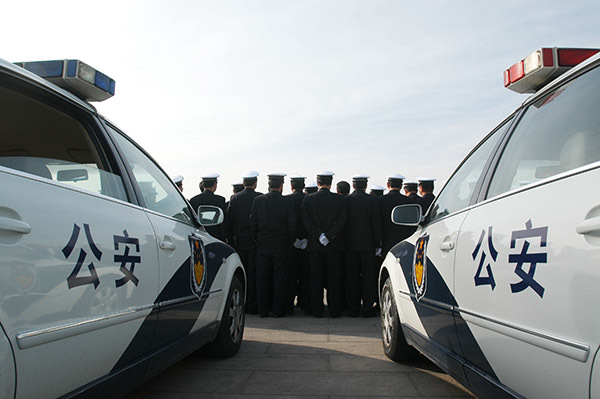
Illustration: CCP Police Vehicle (China Photos/Getty Images)
[People News] I came across a video online showing several teenagers running along the roadside in Fenyicounty, Xinyu, Jiangxi Province. They shouted repeatedly at passing motorcyclists who were not wearing helmets or had passengers without helmets, warning them that there were traffic police ahead and advising them to take a detour.
At first, this seemed quite puzzling. Isn't the traffic police's enforcement of helmet laws meant to ensure the safety of drivers? Are these children simply trying to obstruct the traffic police from doing their job?
However, after reading some comments, I learned that netizens suggested, "The children instinctively view the traffic police as adversaries, reflecting that the CCP's excessive fines have become a nightmare for the entire populace." It became clear that the children were motivated by their disdain for the traffic police's excessive fines and extortion, attempting to help the riders avoid penalties.
On the surface, it appears there is nothing wrong with the government imposing fines on violators. Laws must be adhered to, and those who do not comply should face consequences. The traffic police are acting within the law; when did it become the role of children to interfere?
Additionally, the government has established regulations and possesses the authority to enforce them. The actions of these few kids could lead to repercussions; they might face reprimands from teachers or parents, or worse, it could impact their future.
Moreover, these young kids opposing the government gain nothing from their actions; it is merely a mischievous act stemming from sympathy. Wouldn't it be better for these children to spend their free time playing games? Wouldn't it be more enjoyable to go out shopping with friends to unwind? Why engage in such a risky and unproductive endeavour?
How do these children develop thoughts that oppose the government? Why do they harbour such animosity towards traffic police? What leads them to feel sympathy for unfamiliar riders? Despite being subjected to daily brainwashing by the Chinese Communist Party (CCP) at school, where they become well-acquainted with the party's narrative and are filled with patriotic fervour, how do they cultivate such a rebellious attitude and insist on opposing the government without any apparent reason?
It is evident that children in mainland China are influenced by the injustices they witness in society. Traffic police are not the only offenders; urban management officers also oppress innocent citizens at any time and place. Elderly women selling goods are driven away, and mothers picking up their children on bicycles are violently thrown to the ground. These real-life scenarios play out daily around the children, providing a more vivid and impactful experience than the words in textbooks or the lectures from their teachers.
The local governments of the CCP are trapped in financial crises, desperately seeking ways to extract money and oppressing the populace in every conceivable manner. Public discontent is widespread and has become a common occurrence. Children living in this society cannot remain insulated from the injustices they observe. Driven by their innate kindness, they empathise with the evils of the system, which explains why these children creatively choose to stand against the traffic police.
On a deeper level, society is always characterised by a confrontation between opposing extremes, with corrupt officials and unscrupulous businessmen on one side and innocent citizens on the other. The corrupt officials and businessmen are merciless, while the common people endure immense suffering. Injustices are glaring and heart-wrenching every day. As long as there is a flicker of conscience, one cannot remain indifferent.
In society, two sets of values are in contention, and children, being innocent and naive, are easily swayed by social concepts. What enables them to resist the allure of evil and remain steadfast in their innate goodness? I believe that parental influence plays a crucial and decisive role.
Teachers can also cleverly inspire their students' inherent goodness, but when they confront the government's brainwashing, it can impact their careers, making the challenge even greater. In contrast, parents who spend time with their children daily can foster good habits of independent thinking from a young age, encouraging them to follow their inner conscience in all matters, thus laying a solid foundation for their children's values.
The brainwashing efforts of the Chinese Communist Party (CCP) are all-encompassing, and the authoritarian government's tactics are extreme. However, human nature remains a deeply entrenched reality. Concepts of good and evil, truth and falsehood, beauty and ugliness, along with a long-standing set of moral standards, continue to thrive among the people, proving to be more powerful than the CCP's hypocrisy and malevolence. As parents, resisting the CCP's malevolent ideologies is possible if one is willing to make the effort.
Children who witness the malevolent actions of the CCP's stability maintenance apparatus are also exposed to the curses and moral judgments expressed in everyday conversations, which will undoubtedly influence their young minds, leading them to question right and wrong and reflect on social injustices.
The struggle to reclaim their children from the CCP's influence is a significant concern for parents in Hong Kong today. The CCP's brainwashing initiatives have thoroughly infiltrated primary, secondary, and higher education in Hong Kong, with various nefarious ideologies gaining traction. Party loyalty suppresses human nature, personal desires overshadow conscience, and resistance has become criminalised, while disobedience is labelled as rebellion; this has become the new normal for the people of Hong Kong. In such a dire environment, it is challenging for children not to become victims.
As such, parents in Hong Kong should invest more effort in observing their children, spend more time with them, teach by example, and guide them patiently to establish a strong foundation for their children's moral conscience. Recently, during the fire at Hongfu Garden, I noticed young parents bringing their children to the site to lay flowers, which I believe represents the best form of real-life education.
We must not underestimate the insidious effects of the Chinese Communist Party's indoctrination. If parents remain indifferent for an extended period, there may come a day when your child becomes unrecognisable to you, adopting views on life, the world, and values that starkly contrast with your own. You could find yourself positioned as an ideological adversary to your child, and one day, your child might return home to oppose you.
Whenever I see children from the mainland singing revolutionary songs and pledging their loyalty to the Party, I feel a sense of pessimism about China's future. Yet, witnessing these brave and mischievous children in a small city in Jiangxi brings me some solace: China’s fate is not sealed, and there is still hope for tomorrow.
(Author's Facebook) △







News magazine bootstrap themes!
I like this themes, fast loading and look profesional
Thank you Carlos!
You're welcome!
Please support me with give positive rating!
Yes Sure!