
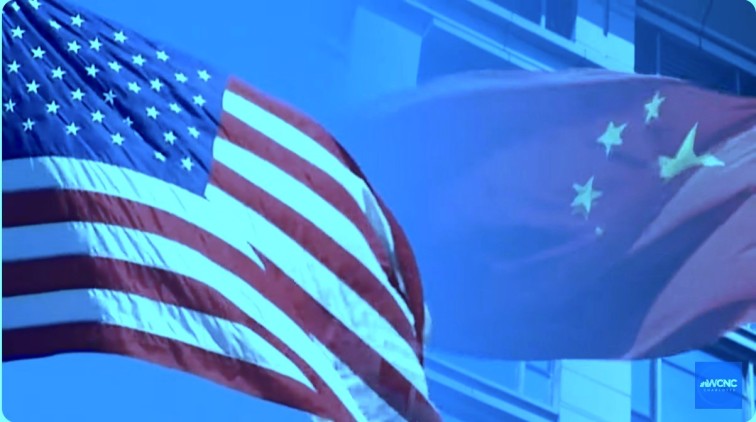
U.S.-China Confrontation. (Video screenshot)
[People News] The Chinese Communist Party's (CCP) persecution of Falun Gong has persisted for over 26 years. The sudden escalation of transnational suppression last year has inadvertently drawn the United States into the fray, posing an inevitable threat to U.S. national security and its foundational principles.
The intense competition between the U.S. and China extends beyond mere economic and military dimensions; it also encompasses a struggle between justice and evil, religion and atheism, as well as freedom and totalitarianism. The United States' prosperity is rooted in its tradition of faith in God and the safeguarding of religious freedom. Should this foundation be compromised, and should the CCP manage to infiltrate and exploit it, believers may find themselves metaphorically crucified. Even if the U.S. were to achieve economic or military superiority over the CCP, it would still risk becoming a nation of disgrace, no longer the 'city upon a hill' that enjoys divine favour.
The CCP's Drastic Escalation of Transnational Suppression
Since the CCP initiated its persecution of Falun Gong in July 1999, it has begun exporting this persecution to overseas practitioners.
Between July and September 1999, there were three incidents in which the apartment of U.S. Falun Gong spokesperson Gail Rachlin was forcibly entered by CCP agents. On September 7, 2001, five Falun Gong practitioners were assaulted outside the CCP consulate in Chicago.
Following the initial wave of intense persecution, the CCP sought to avoid drawing international attention and condemnation by refraining from directly mentioning Falun Gong. However, behind the scenes, it has been secretly formulating a broader strategy, which has come to light through the emergence of whistleblowers and the leaking of CCP documents.
In 2005, former Chinese Communist Party (CCP) Sydney Consul Chen Yonglin revealed that the CCP's campaign against Falun Gong extended overseas in 2000, necessitating that every CCP diplomatic mission have at least one official tasked with handling Falun Gong issues. Chen Jun, a CCP agent who was sentenced to 20 months in prison in 2024, recounted that at the onset of the persecution of Falun Gong, the '610 Office' provided him with $250,000 to relocate to the United States to monitor Falun Gong activities, and subsequently paid him a monthly stipend of $52,000.
In 2015, then Minister of Public Security Meng Jianzhu asserted the urgent need to designate the United States and other countries with significant Falun Gong activities as primary battlegrounds. He further stated that the CCP should leverage economic and trade relations to pressure Western nations into prohibiting or restricting Falun Gong activities.
Simultaneously, the participants in the CCP's transnational suppression have proliferated across various regions in China. A series of leaked documents from 2015 to 2018 indicate that several provincial and municipal governments referred to conducting 'in-depth investigations' on overseas Falun Gong practitioners who originated from these provinces.
For instance, an internal document from the Political and Legal Affairs Commission of Fangshan District in Beijing from 2018 reveals that a district-level unit of '610' possesses foreign affairs privileges, enabling it to directly travel abroad to engage in anti-Falun Gong 'diplomatic affairs,' with funding sourced directly from the Fangshan District Finance Department.
Following Xi Jinping's 'cleansing' of Zhou Yongkang, a key supporter of Jiang Zemin's persecution of Falun Gong, during his first term, the persecution persisted but lacked the necessary top-down pressure, resulting in a temporary decrease in its intensity. However, during Xi Jinping's second and third terms, this trend reversed: official documents and directives from the Chinese Communist Party (CCP) have now explicitly identified the crackdown on Falun Gong as a core task essential for maintaining so-called 'political security.'
Over the past two years, the CCP's transnational suppression of Falun Gong and Shen Yun has dramatically intensified in the United States. A significant event in this context was The New York Times' aggressive coverage of Falun Gong and Shen Yun, alongside lawsuits filed against the Shen Yun performing arts troupe by certain individuals.
On February 20, 2025, Shen Yun's inaugural performance at the Kennedy Centre in Washington, D.C., was met with a bomb threat, causing considerable alarm in the capital.
Nina Shea, a recognised expert on human rights and religious freedom and the director of the Centre for Religious Freedom at the Hudson Institute in Washington, highlighted to The Dajiyuan that the severity of this transnational suppression by the CCP is unprecedented since the Cold War.
In contrast to previous actions, this latest wave of transnational suppression represents a coordinated, state-level assault orchestrated from the top, with directives issued directly from the highest echelons of the CCP.
In October 2022, Xi Jinping directed the Central Political and Legal Affairs Commission to collaborate with the Ministry of State Security, the Ministry of Public Security, the Ministry of Foreign Affairs, and the United Front Work Department to develop and implement a new international strategy aimed at targeting Falun Gong.
Yuan Hongbing, a prominent legal scholar and former professor at Peking University’s Law Department, informed The Dajiyuan that Xi Jinping's new strategy can be encapsulated in the phrase 'one centre, two basic points.' 'The one centre focuses on the character assassination and moral destruction of the founder of Falun Gong; the two basic points involve launching a public opinion war (media war) and a legal war against Falun Gong.'
These media and legal battles, along with unrestricted warfare, are taking place on American soil.
The direct involvement of the highest echelons of the Chinese Communist Party (CCP) has provided new impetus for its transnational repression efforts.
Following Xi's directives, in 2023, CCP agents attempted to bribe officials at the Internal Revenue Service (IRS) in the United States in a bid to revoke the non-profit status of Shen Yun Performing Arts.
In early 2024, a so-called 'anti-cult' film from Taiwan gained popularity in mainland China, allowing the CCP to further intensify its crackdown on Falun Gong domestically. The film's imagery and commentary were subsequently amplified by the CCP's overseas operatives, reviving old insinuations that Falun Gong is an 'X cult.'
Amid this vigorous public opinion campaign orchestrated by the CCP, the opportunity window appears to have opened. Since August 2024, The New York Times has published a series of over a dozen articles attacking Shen Yun and Falun Gong.
Interestingly, this mainstream American media outlet has repeated the CCP's official rhetoric and terminology, depicting Falun Gong and Shen Yun Performing Arts as an 'evil' entity to be shunned. These reports quickly became propaganda tools for the CCP to disseminate hatred against Falun Gong and Shen Yun both domestically and internationally.
This is certainly not typical news; it only interviews a handful of dissatisfied individuals while disregarding the views of the vast majority of the group, yet it reaches conclusions that echo those of the Chinese Communist Party (CCP), which starkly contrasts with the usual reporting style of Western media. Despite the CCP amassing trillions of dollars since joining the WTO, using these funds to influence Western journalists and mainstream media to suppress coverage of the persecution of Falun Gong, these outlets typically refrain from reporting rather than openly attacking Falun Gong and Shen Yun in violation of journalistic ethics. However, the New York Times has published a series of over a dozen critical articles that remarkably coincide in timing with the plans of Xi's administration, making this situation quite unusual.
Moreover, the New York Times has failed to disclose its financial ties to the CCP. The English-language Dajiyuan reported that in 2001, the New York Times established connections with party leader Jiang Zemin, after which its coverage of Falun Gong shifted to a pro-Jiang stance.
In reality, the New York Times has not clarified the connections between several plaintiffs who filed the lawsuit against Shen Yun and the CCP; most of these individuals have documented visits to mainland China. Additionally, there are questions regarding the family background of one of the main authors of the New York Times article.
Phelim Kine, a senior China analyst at the mainstream Washington media outlet Politico, remarked on this on the X platform: 'This represents a propaganda coup in Beijing's decades-long campaign against Falun Gong.'
The misleading reports by the New York Times have set the stage for the CCP's legal offensive against Shen Yun on American soil. In November 2024, a former Shen Yun student initiated a lawsuit against the organisation, with the complaint extensively quoting the New York Times articles.
Similar to the media war, the legal battle is also a component of the Xi administration's cross-border suppression strategy.
The lawsuit against Shen Yun is fundamentally flawed in both factual and legal aspects.
According to Shen Yun's lawyers, the complaint carelessly and arbitrarily presents hearsay and news reports as facts, relying on unnamed sources without providing any justification for the court to deem these materials credible.
Even if the allegations made by the plaintiffs were true, the lawsuit lacks a legal foundation.
In reality, the Feitian Academy of the Arts is a religious boarding school established under the U.S. Internal Revenue Code (IRC), focusing on performing arts, and is recognised by the IRS as a church-affiliated organisation. As a religious institution, it is required to adhere to the school's religious beliefs (including standards of moral conduct), restrict media usage in line with the school's beliefs, and regulate interactions between the sexes, which is a common policy among most religious schools.
Shen Yun's lawyers emphasise that religious doctrine warns followers that deviating from the teachings may result in 'spiritual consequences,' and this practice is 'entirely permissible,' as 'such occurrences happen hundreds of thousands of times daily in the U.S. and are protected by the Constitution.'
They further assert, 'They disregard the facts and attempt to characterise religious activities as federal crimes.' 'The purpose of the law (the Trafficking Victims Protection Act) is to prevent human trafficking, not to obstruct religious activities.'
It is also important to note that these lawsuits strongly deny the religious status of Falun Gong in the United States.
In fact, the main text of Falun Gong, "Zhuan Falun," clearly states that "Qigong is cultivation." The term "Qigong" was adopted to evade potential persecution stemming from the extreme leftist ideology that was prevalent in mainland China at the time.
Documents from U.S. judicial, governmental, and human rights organisations affirm that Falun Gong is recognised as a religious group.
A lawyer for Shen Yun noted that under U.S. law, whether a belief system is classified as a religion depends on its functional characteristics. Court rulings involving Falun Gong practitioners have confirmed that Falun Gong is closely related to Buddhism and can be regarded as a branch of it. ... The founder of Falun Gong's non-religious assertions arises from the differing interpretations of religion in China and the United States. In China, religion is often defined by formal criteria such as state recognition, designated places of worship, and clergy. In contrast, Falun Gong is primarily practised individually and lacks the characteristics typical of religious practices in China.
Beyond media and legal conflicts, Falun Gong practitioners and associated organisations are facing direct threats, with their activities being disrupted or destroyed. The Chinese Communist Party's crackdown on Falun Gong and Shen Yun has escalated to what is termed "unrestricted warfare."
According to the latest statistics from the Falun Dafa Information Centre, from March 2024 to October 16, 2025, there have been a total of 193 anonymous death threats against overseas Falun Gong practitioners or individuals impersonating them.
Since 2024, during Shen Yun's global tour, several theatres have received threats of bombings and shootings.
In September of this year, hackers affiliated with the Chinese Communist Party impersonated The Dajiyuan multiple times, sending bomb threats to the White House and the U.S. federal government. In October, the New York headquarters of The Dajiyuan received a threatening letter that contained white powder.
Piero Tozzi, the chief of staff of the U.S. Congressional-Executive Commission on China (CECC), told The Dajiyuan that this is not just a criminal act; it represents the Chinese Communist Party's strategy of unrestricted warfare against the United States, amounting to an act of war.
The CCP's Transnational Suppression Undermines the Foundation of America's Nationhood
The Chinese Communist Party's (CCP) transnational suppression of Falun Gong and Shen Yun within the United States poses a significant threat not only to national security but also to the core principle of religious freedom that underpins the nation.
The founding fathers of the United States believed that America was established under the guidance of God.
During the American Revolutionary War, General Washington faced at least 67 moments of despair, and without divine intervention, he would have encountered 'disaster'. In his inaugural address in 1789, Washington highlighted that no one could feel the protective hand of divine providence more than the American people, as the invisible hand of God guided every step of America's journey to independence.
One of the founding fathers, James Madison, also emphasised that he witnessed the guiding hand of God while organising the Constitutional Convention, much like Washington had observed on the battlefield.
The founding fathers believed that religion is the source of morality and that human freedom ultimately derives from religious beliefs.
Without religion, can morality truly be sustained? Both reason and experience caution us: if we discard religious principles, national morality cannot possibly survive.
The founding fathers recognised that among all the traits and habits that contribute to political success, religion and virtue are indispensable supports. History demonstrates that religious belief not only provides individuals with moral self-discipline, enabling them to engage in free trade even in times of anarchy, but faith also upholds social norms and laws, with a limited government relying on an engaged citizenry.
John Adams, one of the founding fathers, remarked, "Our Constitution was made only for a moral and religious people." He emphasised, "No government can be armed with power to contend with human passions that are unrestrained by morality and religion."
Religious freedom holds immense significance in America, which is why in 1791, the U.S. Congress enacted the First Amendment to the Constitution, designating "freedom of religion" as the foremost constitutional right for American residents, even before "freedom of speech."
The U.S. Supreme Court has repeatedly affirmed that for the majority, religious freedom is the most cherished of all unalienable rights, closely resembling the right to life itself.
This foundational principle of religious freedom has propelled America towards prosperity and established it as a radiant "city upon a hill," distinguishing it from other nations. This distinctiveness stems from the fact that no other country prioritises the protection of human religious freedom as a core governance principle.
The religious freedom enshrined in the U.S. Constitution is also pivotal to Shen Yun's success in America. Shen Yun originated on American soil and represents the American narrative.
When Chinese Falun Gong practitioners came to America as refugees, they arrived with nothing but their faith and resilience, lacking support from the government or businesses. In its early days, Shen Yun was entirely dependent on the selfless contributions of individuals and the sacred mission inspired by the principles of "Truth, Compassion, Forbearance."
The artists of Shen Yun practice Falun Dafa, which serves as the wellspring of inspiration for their performances. Historically, Chinese artists engaged in meditation to seek inner tranquillity and a connection with the universe, and today’s Shen Yun artists continue this esteemed tradition.
Virtue must be continuously nurtured, hour by hour, day by day. The founding fathers of the United States envisioned families, schools, and churches as the means to ignite the moral spark that is passed down through generations.
The two art schools of Feitian are actively realising the vision of the founding fathers. Shen Yun artists, through relentless training and touring, not only acquire skills and confidence but also experience purification and elevation through divine grace. As both artists and honest citizens, they exemplify excellence in both personal and public virtues.
In stark contrast to the United States' commitment to religious freedom, all communist and socialist nations perceive religion as a genuine threat, making it the primary target for eradication and transformation.
The experiences of the 20th century have demonstrated that secular states founded on atheism inevitably attempt to present themselves as divine. The former Soviet Union and communist China serve as clear examples—religion was entirely eliminated, replaced by state theocracy and a political order that undermines the inherent dignity of humanity.
At present, the Chinese Communist Party is waging a war on faith, with no religious freedom in mainland China. All religions are required to conform to the ideology and slogans of the CCP, with images of Jesus and the Virgin Mary being replaced by photographs of Xi Jinping.
John Moolenaar, the chairman of the U.S. House of Representatives' "Special Committee on the Chinese Communist Party," remarked during an online hearing organised by the U.S. Commission on International Religious Freedom (USCIRF) on October 16, "The CCP suppresses religion, trying to replace God with state power. Its message is crystal clear: either worship the Communist Party or face the consequences. What it shows is not strength, but fear."
Sam Brownback, the former U.S. Ambassador for International Religious Freedom, told The Dajiyuan, "For us, religious freedom is the cornerstone of our nation. Without religious freedom, true freedom and an open democracy are impossible."
"Religious freedom is the most potent tool—it embodies our core values and represents a profound threat to Communist China," he stated. "This issue should not merely be regarded as a human rights concern but should be considered a matter of national security."
Kelly Shackelford, a member of the White House's "Commission on Religious Freedom," shared with The Dajiyuan, "Religious freedom is our first freedom because our founding fathers recognised that without it, we would lose all other freedoms."
He emphasised that totalitarian regimes do not permit citizens to pledge allegiance to any power above the government. They will impose these violations of religious freedom on the United States. "This is the significant difference between the U.S. and China," he noted. "We must strive to maintain the original essence of America."
The CCP has set traps in the U.S. with the intention of binding America.
It is widely recognised that the Chinese Communist Party (CCP) built its foundation on lies and deception. After seizing power, it further manipulated history in an effort to erase the genuine historical memories of the Chinese people. Following the CCP's eradication of all sincere practitioners of orthodox religions and traditional cultures, this deception has been allowed to flourish without restraint.
The Shen Yun Performing Arts, dedicated to the revival of traditional Chinese culture, aims to 'show China before communism.' Each movement, expression, and narrative, along with the accompanying music performed by the artists, radiates kindness and the beauty of tradition, captivating the audience with a remarkable power that transcends national boundaries.
For the CCP, which is used to brainwashing propaganda, this is undoubtedly a shocking revelation; it perceives that its years of efforts have been rendered futile.
The beauty and strength showcased by Shen Yun arise from the performers' belief in the principles of Falun Gong: 'Truth, Compassion, Tolerance.' Consequently, the CCP regards it as a competitive worldview that threatens its ideological monopoly. Since the initiation of the persecution of Falun Gong in 1999, the suppression of Falun Gong has remained central to the CCP's repressive strategies.
However, the persecution of Falun Gong has also become the CCP's Achilles' heel. Once the global community and the majority of the Chinese populace become aware of the truth about Falun Gong and oppose this persecution, they will denounce the CCP and resist it, ultimately leading to the CCP's downfall.
In January 2025, an insider from the Chinese Communist Party (CCP), using the alias Shen Liang, disclosed to The Dajiyuan that the CCP aims to prosecute Falun Gong in the United States, systematically tarnishing its reputation from individual cases to a broader scale. If even one case is successful, it could trigger a series of repercussions, ultimately leading to the U.S. denying the legitimacy of Falun Gong and obscuring the persecution crimes occurring in China. He remarked, 'The CCP's greatest fear is that the United States will support Falun Gong and investigate its domestic crimes; this is the CCP's Achilles' heel.'
Shen Liang noted that following Trump's election victory, the CCP's assaults on Falun Gong have noticeably intensified and become more urgent, driven by the fear that Falun Gong might collaborate with Trump. Should the U.S. government officially endorse Falun Gong and initiate investigations into the torture inflicted upon its practitioners in China, it would signify the CCP's downfall.
Consequently, the CCP's current transnational crackdown on U.S. soil not only targets Falun Gong and Shen Yun but also aims to ensnare the U.S. in a trap, turning it into an accomplice in the persecution of faith and human rights, thereby fundamentally undermining the principles upon which the United States was founded and subverting it from within.
If the CCP succeeds in its persecution of Falun Gong in the U.S., America will find itself morally compromised by the CCP, leading to a tarnished reputation and diminished international standing. The atrocities committed by the CCP will go unchallenged, and the regime will extend its persecution of the Falun Gong religious community worldwide, fulfilling its ambition to bully the global community at will.
Sam Brownback, the former U.S. Ambassador for International Religious Freedom, asserts that religious freedom poses a survival threat to the Chinese Communist Party (CCP). In China, the only group capable of resisting the authoritarian regime is the people of faith, who have endured persecution and slaughter for decades.
Brownback remarked, "Among these religious groups, the CCP is most afraid of Falun Gong.
"The reason is that Falun Gong is the most 'localised' group among all. Just like sowing wheat in Kansas soil, it will naturally thrive. They grew to ninety million practitioners in just seven years, which terrified the CCP.
"Thus, we (the U.S.) must genuinely collaborate with Falun Gong practitioners."
As the U.S.-China rivalry intensifies, the issue of Falun Gong should be integrated into U.S. policy.
With the great conflict between the U.S. and China already underway, the U.S. currently maintains an edge in both economic and military domains. However, if Xi Jinping manages to pull the U.S. into the immoral quagmire of persecuting Falun Gong, and if the U.S. fails to uphold its foundational principle of religious freedom, it risks becoming a nation of disgrace, losing the brilliance of being a 'city upon a hill.'
After over two thousand years of prayer before the cross, Western civilisation should grasp one crucial lesson—never again should religion be crucified. It is hoped that the U.S. will not have to endure a painful lesson to learn this. U.S. authorities and the American public must remain vigilant, as the CCP is infiltrating and manipulating American media and the judicial system to target the American Falun Gong community and Shen Yun Performing Arts, investigating and prosecuting Shen Yun, marking yet another historical recurrence of crucifying religious saints.
The U.S. House of Representatives passed Resolution No. 304 back in 2004, marking the first time it addressed transnational repression by the Chinese Communist Party (CCP). On May 24, 2025, Texas enacted the 'Anti-Transnational Repression Act,' officially categorising transnational repression as a criminal offence.
A recent special report from the Heritage Foundation, a think tank based in Washington, D.C., reveals that transnational repression not only poses a threat to human rights but also jeopardises the sovereignty of the United States and other nations worldwide. However, the current measures in place to address this issue in the U.S. are still lacking.
The report highlights that repressors frequently operate from a distance, employing local individuals in the victim's country to carry out harassment or intimidation. These 'locals' are often mere disposable assets; even if apprehended, they typically have little knowledge of the broader operation or command structure, making it nearly impossible to trace back to the orchestrators.
Such actions are seldom prosecuted, partly because they do not individually qualify as 'serious crimes' that would draw the attention of law enforcement, which is often focused on more immediate public safety and national security threats.
Many instances of transnational repression fall below the threshold for applicability under current U.S. criminal law, or the penalties are too lenient to serve as an effective deterrent.
The report advocates for the creation of a law specifically aimed at transnational repression, which would provide prosecutors with a clearer legal framework, leading to more consistent convictions and appropriate penalties. To ensure its effectiveness, the law should concentrate on the acts of transnational repression themselves, avoiding the inclusion of unrelated provisions.
Experts suggest that amid the ongoing U.S.-China competition, the CCP's transnational repression activities within the U.S. could be utilised by the U.S. to apply pressure on the CCP.
Sarah Cook, a Chinese issue expert and former research director at Freedom House in Washington, told The Dajiyuan that when the Chinese Communist Party's (CCP) security agencies recklessly violate the rights of American citizens, refugees, and national security on U.S. soil, it sends a clear message to Xi Jinping: the United States is unable to defend itself. This situation will undermine America's deterrent capabilities on various other issues.
She recommended that demanding that Xi Jinping halt Beijing's transnational repression within the United States should be a fundamental aspect of U.S. policy.
While this may not immediately halt Beijing's transnational repression, such actions can showcase strength, signalling that Trump has a comprehensive understanding of the Chinese Communist Party's (CCP) deceptive tactics, is aware of the regime's capabilities, and can see through propaganda claims like the CCP's assertion of 'non-interference in other countries' internal affairs.'
Cook remarked, 'This stance is not only straightforward but will also be crucial in tariff and fentanyl negotiations.'
For the CCP, the issue of Falun Gong is central to its interests; for the United States, it should integrate religious freedom into its strategic framework.
Brownback commented, 'The CCP is waging a war on faith and is also at war with us, the United States.'
He stated, 'Religious freedom is our most powerful weapon in the current struggle (the U.S.-China conflict). We must genuinely incorporate religious freedom into America's strategy. It is evident that the CCP's fear of religious freedom far surpasses their fear of American aircraft carriers or nuclear weapons.'
'Religious freedom is an urgent priority for U.S. national security. We need to shift our perspective from viewing this as a human rights issue to recognising it as a national security issue and explicitly categorise it as such.'
'We must fundamentally change our strategy regarding religious freedom.' He emphasised that religious freedom is the 'core' of U.S.-China relations.
Brownback outlined four specific recommendations:
1. Integrate the issue of religious freedom in China into the strategic considerations of U.S. national security concerning China.
2. Formulate a national security strategy that the United States and other nations can jointly support to promote religious freedom within China.
3. Implement economic sanctions similar to the Frank Wolf International Religious Freedom Act to address the actions of the Chinese Communist Party.
4. President Trump, Vice President Pence, Secretary of State Rubio, and Secretary of Defence Esper should engage with the exiled leaders of persecuted groups, including Falun Gong practitioners, Christians, Muslims, and Buddhists.
△






News magazine bootstrap themes!
I like this themes, fast loading and look profesional
Thank you Carlos!
You're welcome!
Please support me with give positive rating!
Yes Sure!