
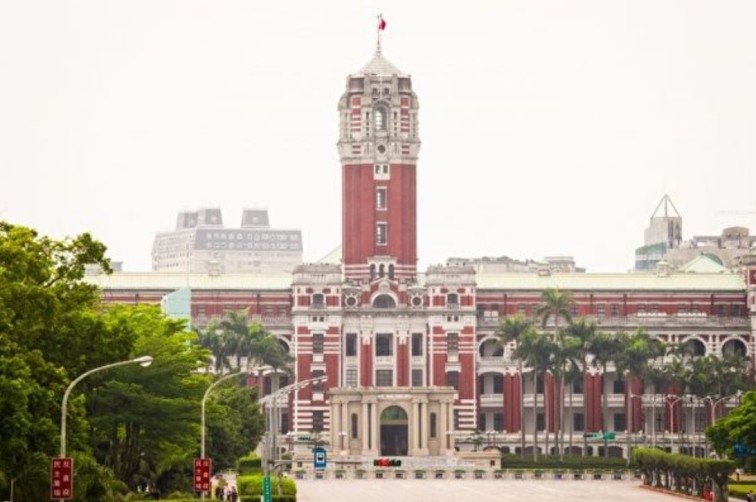
Taiwan Presidential Office. (Chen Bozhou / Dajiyuan)
[People News] Recently, the CCP has shown particular sensitivity and tension concerning the relationships between the US and Taiwan, as well as Japan and Taiwan. In various public statements from international relations and the CCP's Ministry of Foreign Affairs, it has become common to hear CCP representatives denouncing the United States and Japan. They repeatedly assert that they do not rule out the possibility of using force against "Taiwan independence," and that the US's actions to "assist independence" are accelerating military tensions in the Taiwan Strait, warning of the dangers of "setting oneself on fire" and similar threats.
On December 18, during a regular press conference at the CCP's Ministry of Foreign Affairs, the spokesperson addressed media questions regarding the US's initiation of the largest military sale to Taiwan, valued at approximately $11 billion (which includes advanced weaponry such as the M109A7 self-propelled howitzer). Displaying an unprecedented level of anger, the spokesperson condemned the "Taiwan independence forces" for their willingness to turn Taiwan into a "powder keg," stating that this will not save the inevitable demise of "Taiwan independence" but will only hasten the military crisis in the Taiwan Strait. The US's strategy of "using force to assist independence" will only backfire... Additionally, they deceitfully invoke the names of China and the Chinese nation, asserting that foreign attempts to "use Taiwan to contain China" will absolutely fail. No one should underestimate China's strong resolve and capability to defend its national sovereignty and territorial integrity... The Chinese side will take decisive and robust measures to protect its sovereignty, security, and territorial integrity.
The Chinese Communist Party (CCP) adopts a tone that suggests it is prepared to go to war with both the Republic of China and the United States, intentionally employing a range of confusing terminology. Terms such as the Chinese government, the Chinese people, China, and the Chinese side originally referred to the Republic of China, which has been in use since its establishment in 1912, but were appropriated by the CCP after 1949. This means that mainland China has always been part of the Republic of China, and it is the CCP that is promoting 'land independence' and seizing the territory of the Republic of China. This is outlined in the Constitution of the Republic of China.
During this period, the CCP has been actively engaging with ambassadors from Southeast Asian countries and other nations. Foreign Minister Wang Yi has been on a relentless tour, meeting with political leaders in France, the United Kingdom, Germany, and Middle Eastern countries such as the United Arab Emirates, Saudi Arabia, and Jordan. Despite the historical context of the Japanese Imperial Army's invasion of China, which aided the CCP in its fight against the Nationalist Army to Taiwan, the CCP harshly criticises Japan and pressures these countries to align with its stance on Taiwan-related issues, thereby broadening its support base.
Why has the CCP become increasingly tense regarding Taiwan?
What prompted the CCP's sudden anxiety over Taiwan-related issues at the end of 2025? It appears that new engagement measures planned by the United States and the Republic of China for 2026 have caused alarm within the CCP.
Recently, the U.S. Congress unveiled the National Defense Authorization Act (NDAA) for the fiscal year 2026, a comprehensive document exceeding 3,000 pages that was finalised after several months of negotiations between the Senate and the House of Representatives. The legislation identifies Beijing as the foremost strategic challenge facing Washington across military, industrial, diplomatic, and global economic spheres. It introduces new investment restrictions, prohibits a variety of technologies produced in the People's Republic of China (PRC) from entering the Pentagon's supply chain, and enhances diplomatic and intelligence efforts to monitor Beijing's global influence.
According to incomplete data from Voice of America, the bill references 'China' over 170 times, 'People's Republic of China' (PRC) more than 90 times, and 'Chinese' upwards of 80 times. The Chinese Communist Party (CCP) is mentioned frequently, with the PRC positioned as the primary strategic competitor in the Indo-Pacific region.
Additionally, the bill broadens political, economic, and military support for Taiwan, advocating for stronger U.S.-Taiwan partnerships, expanding the 'Taiwan Security Cooperation Initiative,' and increasing assistance for medical emergency services, combat casualty response capabilities, and other defence-related equipment. The legislation also mandates that the Pentagon formulate a detailed five-year strategy to enhance joint maritime operations through the Taiwan Strait and South China Sea, and directs the Pentagon to collaborate with Taiwan on a joint initiative 'to deploy unmanned systems and counter-unmanned systems capabilities,' which includes the co-development of new platforms designed for asymmetric defence.
To counter the military power projection of the Communist Army, Congress has extended the "Pacific Deterrence Initiative," which maintains investments in forward deployment, integrated air defence, pre-positioned munitions, and logistics networks. Additionally, Congress has authorised a special allocation of up to $1 billion for Taiwan's security needs in the fiscal year 2026.
The bill also mandates that Washington support Taiwan's participation in the oversight activities of the International Monetary Fund (IMF) and ensure that Taiwanese citizens have access to employment opportunities within the IMF.
What is particularly concerning for Zhongnanhai is that the bill requires the disclosure of the wealth of the Communist Party leadership, including the General Secretary of the Communist Party, members of the Standing Committee of the Political Bureau of the Central Committee, and all members of the Political Bureau. It calls for relevant intelligence agencies to provide evidence regarding facts and financial assets.
The new U.S.-Taiwan relationship plan for the New Year has left the Communist Party feeling both embarrassed and powerless.
In addition to economic measures, the National Defence Authorisation Act instructs the State Department to deploy a new group of regional China affairs officers at U.S. diplomatic missions worldwide. These officers will be responsible for monitoring China's commercial, technological, and infrastructure activities across all major geographical areas, including Beijing's Belt and Road Initiative. Other provisions of the bill address China's global port activities, cooperation with Southeast Asian networks, restrictions on entertainment collaborations related to China, and reporting requirements on China's influence operations in the U.S., Europe, and beyond.
These actions not only challenge the prestige of high-ranking officials in Zhongnanhai but also confront the Communist Party's decades-long efforts to limit Taiwan's influence in global financial institutions. But what can be done about it?
In addition, Trump has officially signed the "Taiwan Assurance Implementation Act." This Act mandates that the U.S. State Department regularly review and update its guidelines for engagement with Taiwan, including submitting a report to Congress within 90 days after completing any relevant document reviews.
Response from the Republic of China
President Lai Ching-te of the Republic of China remarked that the signing of the U.S. "National Defense Authorization Act" underscores the "importance of U.S.-Taiwan engagement." He stated, "Looking forward, we will work closely with the United States across various sectors to ensure regional peace, stability, and prosperity."
Kuo Ya-hui, spokesperson for the Presidential Office, provided further comments on the signing of the Act. She noted that the enactment of the "Taiwan Assurance Implementation Act" affirms the value of U.S.-Taiwan relations, supports a closer Taiwan-U.S. partnership, and serves as a significant symbol of the shared values of democracy, freedom, and human rights between Taiwan and the U.S.
On Wednesday (December 17), the Ministry of Foreign Affairs of the Republic of China also stated that the successful advancement of this Act through a separate review process within the limited session of the U.S. Congress reflects strong bipartisan and executive support for deepening Taiwan-U.S. relations.
Simultaneously, Lai Ching-te announced an additional $40 billion defence budget aimed at enhancing the Republic of China's asymmetric warfare capabilities, demonstrating a commitment to self-defence in response to threats from the Chinese Communist Party.
In 2026, the Taiwan Strait is expected to experience significant changes, sensing the approaching storm and the extraordinary future that lies ahead.
(First published by People News)
△






News magazine bootstrap themes!
I like this themes, fast loading and look profesional
Thank you Carlos!
You're welcome!
Please support me with give positive rating!
Yes Sure!