

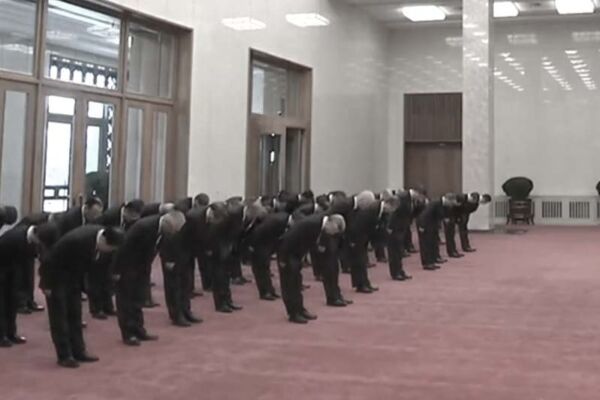
Japanese airport. (Video screenshot)
[People News] Dissatisfied with Japanese Prime Minister Sanae Takaichi’s remarks about “a Taiwan contingency,” the CCP rolled out its old playbook—inciting the public to launch an anti-Japan movement nationwide, while simultaneously imposing sanctions and economic blockades against Japan—in an attempt to force Sanae Takaichi to submit and admit fault. Japan refused, leading to heightened tensions between the two countries. Contrary to the CCP’s expectations, this anti-Japan movement has so far produced little negative impact on Japan, leaving the CCP to reap only a face full of loneliness.
With China–Japan relations tense, the CCP has no intention of resolving disputes peacefully and continues to adopt a “wolf-warrior” posture, pressing Japan further. At the same time, the CCP has also tried to gang up on others, demanding that the ambassadors to China from multiple countries choose sides.
According to a report by the Liberty Times, multiple diplomatic sources revealed that since November, China’s Ministry of Foreign Affairs has summoned ambassadors in Beijing from ASEAN member states such as Singapore and the Philippines, mainly to express China’s criticism of Takaichi’s remarks and to demand that these countries choose sides. Ambassadors from countries such as France and Germany, when meeting with senior CCP officials, were also repeatedly presented with such demands.
People familiar with Japan–China relations pointed out that this is an international propaganda war that, in reality, is forcing countries to take a stance and choose sides. However, to date, there have been no reports of any country expressing support for the CCP’s wolf-warrior approach.
Separately, according to Nikkei Asia, Xi Jinping’s close associates have been gripped by anxiety and, in trying to divine the leadership’s intentions, have expanded retaliatory actions against Japan. Sanctions against Japan are not limited to the CCP Ministry of Foreign Affairs; other central government departments, their affiliated state-owned enterprises, and local governments have also sprung into action. In order to align with the central direction led by Xi Jinping, relevant units must adopt at least one or two “visible measures” to “accumulate political performance points.”
Japan is a popular destination for Chinese outbound tourism. To “teach Japan a lesson,” Beijing authorities since November 14 have urged the public to avoid traveling to Japan, sharply reduced flights, had CCP party media intensively report on new developments in China–Japan tensions, and social media quickly saw calls such as “If you love your country, don’t go to Japan.” Soon after, party media reported that more than 540,000 tickets to Japan had been canceled. However, data showed something that failed to please the CCP: the number of Chinese tourists visiting Japan in November reached 562,600, a 3% increase year-on-year.
Statistics from the Japan National Tourism Organization show that although the number of Chinese visitors to Japan last month rose 3% compared with the same month last year, it dropped significantly compared with other months this year. However, visitor numbers from Taiwan, the United States, and South Korea all grew by more than 10%, and the total number of foreign visitors to Japan in November hit a historical high. Some businesses that cater to Chinese tourists also said that because visitors from other countries made up the shortfall, the overall impact was not significant.
These facts were like slaps across the CCP’s face—smack! smack! smack! The CCP miscalculated. And what the CCP and the “little pinks” failed to anticipate was that Chinese students studying in Japan would end up swallowing the bitter consequences of the fierce China–Japan confrontation.
According to the Liberty Times, the number of Chinese students in Japan has continued to surge in recent years, reaching 120,000 by 2024. Chinese students working part-time in Japan enjoy an “exclusive” tax-exemption privilege: as long as the necessary filings are completed through their employer, part-time income used for living expenses or tuition is not taxed. This privilege for Chinese students has long been controversial. As the CCP has recently mobilized the entire nation in a crude anti-Japan campaign, Japan has begun reviewing this special privilege for Chinese students.
Japan’s Minister of Economic Security, Kimi Onoda, has for many years questioned its fairness in the House of Councillors: why must Japanese students pay taxes on part-time work, while Chinese students do not? Japan spends large sums of taxpayer money on subsidies, yet this has failed to change China’s anti-Japan attitude. Onoda has been appointed by Prime Minister Takaichi as the minister responsible for foreigner policy and economic security, and she has taken an active stance toward abolishing the “tax-exemption privilege” for Chinese students.
In 2022, the Kishida cabinet had intended to amend the “Japan–China Tax Treaty” to revoke the tax exemptions for Chinese students. However, because the Russia–Ukraine war broke out at the time and tensions in the Taiwan Strait sharply escalated, Kishida may have considered that such a move could provoke backlash from China and that the cost of revising the treaty would be too high, and the plan was ultimately shelved.
However, after Sanae Takaichi took office as prime minister, the CCP’s targeted attacks against her have worsened relations between the two sides. If the Takaichi government were to raise treaty revision demands with China at this time, it would instead have less need to worry about the impact on bilateral relations. △






News magazine bootstrap themes!
I like this themes, fast loading and look profesional
Thank you Carlos!
You're welcome!
Please support me with give positive rating!
Yes Sure!