

Taiwan/Flag of the Republic of China. On January 11, 2023, at a military base in Kaohsiung, Taiwan‘s armed forces conducted a two-day routine exercise. (Annabelle Chih/Getty Images)
[People News] Recently, the U.S. Congress unveiled the National Defense Authorization Act (NDAA) for fiscal year 2026, which identifies the Chinese Communist Party (CCP) as a strategic challenge. This legislation enhances political, economic, and military support for Taiwan through new investment restrictions. The Trump administration announced over $11.1 billion in advanced weapon sales to Taiwan, including spare parts for AH-1W helicopters, M109A7 self-propelled howitzers, and the HIMARS long-range precision strike system, among others.
Earlier, the Japanese Prime Minister made a statement declaring that "if Taiwan faces a crisis, Japan faces a crisis." The CCP reacted vehemently to the actions of the U.S. and Japan. Initially, the Consul General in Osaka, Xue Jian, threatened to "decapitate" Japanese Prime Minister Kishi Sanae. Following this, the CCP urgently summoned several ambassadors from Southeast Asia, instructing them to align their statements regarding Taiwan with the CCP's stance. Subsequently, Foreign Minister Wang Yi swiftly criticised Japan in discussions with political leaders from Germany, France, the UK, as well as the UAE, Saudi Arabia, and Jordan, pressuring and enticing these nations to oppose "Taiwan independence" and broaden their support.
What prompted the U.S. and Japan to suddenly become sensitive to Taiwan at the end of 2025? Why is the CCP in a state of panic regarding the U.S.-Taiwan and Japan-Taiwan relationship plans for 2026? Analysts suggest that the series of actions taken by the CCP may be a precursor to cognitive and public opinion warfare aimed at attacking Taiwan, seeking to confuse historical narratives and public perception to garner international support. Meanwhile, the U.S. and Japan may have already acquired intelligence or received information prior to these developments.
So, is it possible for the Chinese Communist Party to launch an attack on Taiwan in 2026 or within the next couple of years? Analysts suggest that, given the recent internal conflicts and turmoil within the People's Liberation Army (PLA), the likelihood is low.
Following the announcement of the downfall of He Weidong and nine other generals prior to the Fourth Plenary Session, the PLA has recently and unusually issued an indefinite public solicitation for clues regarding corruption in air force procurement, which may implicate several senior officials in the air force, leading to widespread anxiety throughout the entire air force system. The announcement titled 'Notice on Soliciting Reports of Violations in Air Force Procurement Activities' stated that it primarily addresses violations related to procurement activities organised by air force units concerning materials and services (including projects organised by bidding agencies), covering areas such as demand formulation, procurement review, contract performance, supplier penalties, selection of bidding agencies, and online procurement. Whistleblowers are encouraged to provide feedback using their real names via postal mail.
What does this imply? It suggests that the internal strife within the PLA has reached a point where they no longer care about their public image, and it also indicates that there may already be individuals at the upper levels of the air force who have been removed from their positions.
Recently, there have been rampant rumours online that Air Force Commander General Chang Dingqiu mysteriously died after being questioned, and that Air Force Political Commissar Guo Pu may have been dismissed due to disloyalty. Baidu Baike has already removed the entries for both individuals. The issuance of the whistleblowing announcement seems to indirectly confirm these rumours.
Su Ziyun, director of the National Defence Strategy and Resources Institute of the Republic of China, and senior military commentator Mark both believe that the public solicitation of violation clues specifically targeting one military branch indicates that the upper echelons of the air force have already been investigated, and the CCP is now merely seeking to gather evidence of their involvement in corruption.
In July 2023, the Equipment Development Department of the Central Military Commission launched an investigation into violations related to equipment procurement bidding, indicating that the timeline for gathering evidence began after October 2017. As a result, numerous high-ranking officials from the Rocket Force, equipment procurement departments, and military enterprises were dismissed, including Li Shangfu, the then Minister of Defence, who had decades of experience in the military equipment sector.
Mark noted that if the Air Force commander and political commissar are under investigation, it could imply that the entire Air Force system might also face a series of repercussions.
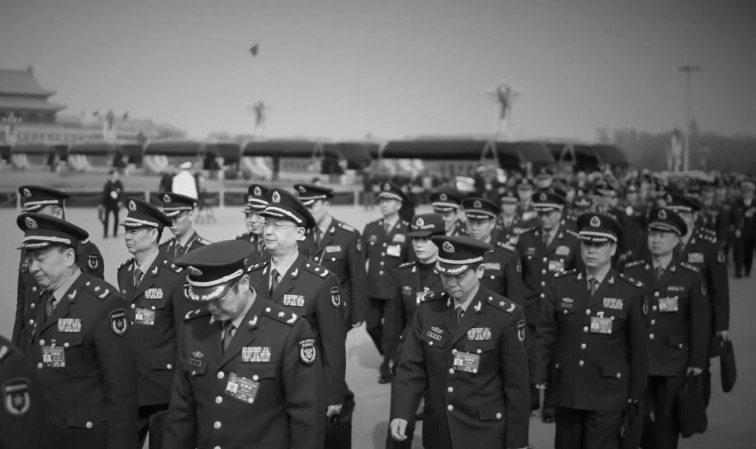
During this year's Fourth Plenary Session, reports indicate that over thirty generals were absent, with many Air Force leaders who were expected to attend not showing up. This includes Rocket Force Political Commissar General Xu Xisheng, Equipment Development Department Minister General Xu Xueqiang, and Deputy Minister of National Defence Mobilisation General Liu Faqing, among others. Notably, Xu Xueqiang not only failed to attend this month's Central Economic Work Conference as is customary but also missed the commissioning ceremony of the aircraft carrier Fujian held in Sanya in November.
Several insiders with military connections have disclosed that some individuals have already been investigated by the military disciplinary committee, while others are set to be transferred to military courts for trial, indicating that the military's rectification efforts have entered a more profound phase.
On October 18, 2025, independent commentator Cai Shenkun, who has ties within the CCP system, revealed to The Epoch Times that Equipment Development Minister Xu Xueqiang has been dismissed. On November 26, an account on the X platform named 'Zhang' reported that, in addition to Air Force Commander and Political Commissar Guo Puxiao, Military Academy President Yang Xuejun, Political Commissar Ling Huanxin, and the newly appointed Army Political Commissar Chen Hui have all been dismissed.
Earlier this year, Xu Qiliang, a former vice chairman of the Central Military Commission of the Communist Party of China and an air force general, unexpectedly passed away on June 2. Reports have suggested that his death may have been 'unnatural,' but the true cause remains unknown.
In recent years, numerous senior generals within the People's Liberation Army (PLA) have been arrested, spanning various branches including the Rocket Force, Army, and Navy. The Air Force has introduced a significant amount of new equipment in recent years, and corruption issues are just as prevalent as in other military branches. Consequently, any upheaval within the Air Force could have a considerable impact.
Analysts suggest that the PLA's strategy for attacking Taiwan primarily depends on the Navy and Air Force. However, internal conflicts within these branches have created a leadership gap, with many experienced generals being ousted and newcomers lacking the necessary experience. Furthermore, under an authoritarian regime, there is no assurance that these new leaders will be free from corruption, which significantly diminishes the chances of a successful PLA offensive.
Nonetheless, the current party leader is very keen on seizing Taiwan. The military and psychological pressure exerted in recent years indicates that capturing Taiwan would not only bolster the party's authority and prestige, showcasing the strength of the Communist Party both domestically and internationally, but also allow control over the Taiwan Strait, thereby threatening the international community. The 21st National Congress is set to convene in a year, and the party leader is eager to achieve this goal before 2027. However, the internal strife within the PLA raises concerns for the party leader about the potential for military conflict to incite a coup. In the opaque system of the Communist Party, anti-corruption measures often serve as internal power struggles, and more of Xi's key confidants could be reported by those with motives against him, similar to the cases involving Miao Hua and Zhong Shaojun, which increases the security risks in the Taiwan Strait.
(First published by the People News)
△





News magazine bootstrap themes!
I like this themes, fast loading and look profesional
Thank you Carlos!
You're welcome!
Please support me with give positive rating!
Yes Sure!