
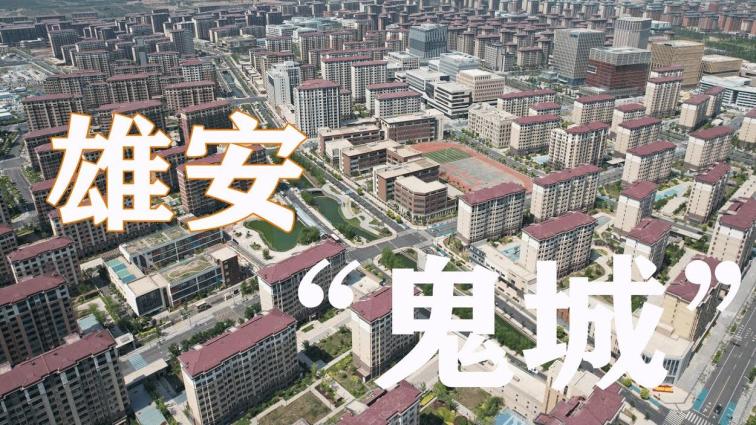
Xiong'an New Area has become China’s largest unfinished construction project. (Internet photo)
[People News] The idiom "Ye Gong Hao Long" aptly describes Xi Jinping's attitude towards the "free trade port." He vocally advocates for the establishment of a "China-style free trade port," promotes high-level openness, and aims to position it as a significant gateway for foreign engagement in the new era. However, when it comes to genuinely implementing core elements such as freedom, rule of law, and capital flow, the truth becomes apparent—his affection for dragons is merely for show, and he is deeply fearful when they actually materialise.
On December 18, 2025, the Hainan Free Trade Port will officially commence full island closure operations. The government is heavily promoting an increase in zero-tariff product categories from 21% to 74%, alongside a corporate income tax rate of 15%. The objective is to establish a high-level free trade port with global influence by 2050. This initiative was originally a "major strategy" personally devised and announced by Xi Jinping in 2018. However, due to the structural flaws inherent in the mainland system, it is fated to fall into the trap of "pseudo-openness." Not only does it significantly lag behind genuine international free ports, but it will also pose various risks to the local residents of Hainan. Reflecting on Xi Jinping's previous "grand narratives," this seems to be yet another instance of a grand launch that quietly fizzles out.
1. Background of the Hainan Free Trade Port
The idea of the Hainan Free Trade Port was first introduced by Xi Jinping during his speech at the conference marking the 30th anniversary of Hainan's establishment as a province in 2018, where he announced his support for the construction of a 'China-style free trade port.' In 2020, the 'Overall Plan for the Construction of Hainan Free Trade Port' was released, which emphasised the need for free and convenient trade and investment, as well as a low tax system. This initiative was largely a response to the China-U.S. trade war and the economic downturn, aiming to establish a frontier of 'institutional opening.' The concept of closing the port is viewed as a flagship project, encapsulated in the slogan 'open on the first line, control on the second line, and freedom within the island,' which superficially draws inspiration from Hong Kong, Singapore, and Dubai. However, the core remains a centrally-directed 'top-level design,' stressing 'the centralised and unified leadership of the Party Central Committee,' while overlooking the reality of Hainan's weak economic foundation and geographical isolation. This situation is not a natural market evolution, but rather a classic case of 'Lord Ye loves dragons': advocating for freedom while firmly maintaining control.
2. The Discrepancy with International Free Ports
The Hainan Free Trade Port can be described as a 'pseudo-free trade port' with Chinese characteristics. While it claims to offer 'zero tariffs, low tax rates, and a simplified tax system,' the differences when compared to genuine international free ports such as Hong Kong, Singapore, and Dubai are significant, particularly in terms of systems, economy, and trust.
Firstly, the system is deficient in core freedoms. International free ports depend on a high level of autonomy, rule of law, unrestricted capital movement, and open information. Singapore benefits from its neutral status and English-speaking environment, while Hong Kong enjoys protections under common law, and Dubai serves as a tax-free haven that attracts global capital. In contrast, Hainan is integrated into the mainland framework, where data security laws and anti-espionage laws limit foreign investment, there is no independent judiciary, capital accounts are not open, and internet access still requires circumvention. Secondly, the economic foundation is weak. Hainan's GDP constitutes only 1%-2% of the national total; the industrial chain is incomplete, logistics costs are high, and the 'island effect' is pronounced, preventing it from attracting multinational headquarters. Unlike Singapore's ASEAN network and Hong Kong's support from the mainland, Hainan lacks regional advantages. Thirdly, there is a deficit of international trust. In the context of the China-U.S. rivalry, foreign investors are worried about 'national security first' and the possibility of sudden policy changes. These disparities arise from 'Chinese characteristics': while the call for openness is loud, actual control is stringent, making it impossible to replicate the success of a genuine free port.
3. Xi Jinping is a 'habitual offender' when it comes to creating unfinished projects.
Xi Jinping is widely recognised as a "habitual offender" when it comes to creating unfinished projects. His decision-making, from the Xiong'an New Area to the Belt and Road Initiative, often involves impulsive choices and top-down directives that overlook market dynamics, resulting in numerous incomplete ventures. The Xiong'an New Area was touted as a "millennium plan" in 2017, with investments reaching trillions, yet it has turned into a "ghost city" characterised by empty high-speed rail lines and wasted resources. The Belt and Road Initiative, introduced in 2013 with similar trillion-dollar investments, has led to many projects falling into debt traps and incurring significant losses, earning it the label of "debt diplomacy." The ambitious chip fund, which invested hundreds of billions, has also failed due to corruption and inefficiency. Initiatives like Made in China 2025 and the Asian Infrastructure Investment Bank have gone from being seen as a "gathering of nations" to subjects of international mockery. All these projects have been launched with great publicity but have quietly faded away. The Hainan Free Trade Port is facing comparable risks: lacking judicial independence, currency freedom, and information freedom, it struggles to establish itself as a global hub. It is more likely to experience a brief surge in tourism and duty-free shopping, ultimately becoming just another "Chinese characteristic" vanity project.
4. The Harm the Hainan Free Trade Port Poses to Hainan Residents
Although the island-wide customs closure brings short-term benefits such as zero tariffs and duty-free shopping, the harm to local residents must not be overlooked. First, rising prices and living costs. While an influx of imported goods may lower the prices of some items, real estate speculation has already driven housing prices sharply upward, making it difficult for ordinary Hainan residents to buy homes and expensive even to rent. Second, an imbalanced employment structure. The Free Trade Port is positioned toward high-end services and manufacturing, yet there is a shortage of skilled talent, and the local workforce is generally low-skilled. High-end positions are unlikely to benefit locals and instead attract outside elites, further marginalising local residents. Third, environmental and resource pressures. Large-scale infrastructure construction and tourism development damage the ecosystem. Hainan already faces water shortages and frequent typhoons, and excessive development could trigger disasters. Fourth, forced land requisition and demolitions. In the course of Free Trade Port construction, to push forward infrastructure and industrial projects, the government often resorts to compulsory land seizures and forced demolitions. This leads to residents being displaced, receiving inadequate compensation, and sparks land disputes and social instability. With the advancement of the island-wide closure policy in 2025, such incidents may increase, and it will be difficult to protect the rights and interests of ordinary people. Fifth, policy uncertainty. The central authorities can tighten policies at any time, shattering residents’ expectations—much like the aftermath of previous waves of “development fever” in Hainan, which ended in bubble bursts and heavy debt burdens. Ultimately, Hainan residents may go from “witnessing history” to “paying the price,” with prosperity becoming a feast for a small minority while ordinary people suffer.
In short, Xi Jinping’s “Lord Ye’s love of dragons”–style opening-up is loud in rhetoric but conservative in practice. Without nationwide, synchronised reforms—such as opening the capital account and establishing an independent rule of law—the Hainan Free Trade Port is unlikely to escape a half-finished fate. Once again, Hainan residents are poised to pay a heavy price for Xi Jinping’s grand but reality-detached dream.
(Source: the author’s X account)






News magazine bootstrap themes!
I like this themes, fast loading and look profesional
Thank you Carlos!
You're welcome!
Please support me with give positive rating!
Yes Sure!