

"Halloween in Shanghai faced strict control by authorities, with young people turning to Zhongshan Park to celebrate, and multiple people were taken away by police."(Screenshot from the internet)dajiyuan
[People News] As the world has just celebrated Christmas, preparations are underway to welcome the New Year of 2026. In China, not only is the celebration of Christmas prohibited, but recently, numerous regions in mainland China have announced the cancellation of New Year's Eve events. Under the rule of the Chinese Communist Party, such peculiarities are not uncommon. Currently, there is significant social tension in China, with public discontent reaching a boiling point. New Year's Eve is a major event for collective gatherings; to put it plainly, the cancellation of these activities reflects the CCP's concerns about potential unrest.
With 2026 approaching, countdown events are among the popular ways for many to ring in the New Year. A post on mainland China's 'Weibo' platform reminded users: 'No New Year's activities, related events cancelled, do not gather, do not run empty.' Indeed, various official announcements have been made recently across China, stating that due to factors such as 'force majeure', celebrations like the 2026 countdown will not take place in large venues.
The government of Suzhou City in Anhui Province announced that the '2026 Suzhou New Year's Music Carnival' scheduled for December 31 has been cancelled. Following this, the Suzhou Centre Mall in Jiangsu Province declared on December 20 that it would operate normally until 10 PM on the 31st, but no related New Year's activities would be held in the public areas outside the mall.
On December 26, Taihua City in Qingzhou City, Shandong Province, announced that it had received a directive from relevant authorities indicating that there would be no outdoor countdown activities this year. The organisers of the 'Starry Sky Music Carnival' New Year's Eve event originally planned for Tangye Central Park in Jinan City, Shandong Province, also stated that due to 'force majeure', they would be unable to hold the event as scheduled.
On December 25, the Zhengdong New District in Zhengzhou, Henan Province, announced that no large-scale public events, including official New Year countdowns or New Year's Eve performances, will be permitted.
In Tianjin, authorities declared a citywide ban on fireworks this year, and the New Year's Eve fireworks display at locations such as the TEDA Aircraft Carrier Theme Park has also been cancelled.
On December 26, the Guangzhou police released a statement indicating that popular commercial areas and landmarks in the city, including Beijing Road, Dongshankou, Canton Tower, Yongqingfang, Huacheng Square, and both banks of the Pearl River, will not host any large-scale group activities for the New Year countdown. Additionally, security and temporary traffic control measures will be implemented as needed.
Moreover, the 'Beihai New Year Music Festival' in Guangxi has been cancelled. The Bund in Shanghai has also announced that there will be no themed light shows or countdown events utilising landscape lighting.
New Year's Eve has traditionally been one of the most cherished celebrations for the public, but its sudden cancellation has raised questions among netizens on the mainland. Some have asked, 'Christmas is a foreign holiday, but is New Year's Eve also a foreign holiday?' and 'What does the New Year's Day countdown have to do with foreign holidays?'
Christmas is indeed a Western holiday, allowing the Chinese Communist Party (CCP) to conduct a boycott with great fanfare. On December 24th, Christmas Eve, a little girl in Shanghai dressed as Santa Claus was handing out 'peace apples' to passersby on the street. Just as she was spreading blessings and warmth to strangers, she found herself experiencing her first ride in a police car. A police auxiliary officer took her to the police station, citing her unusual outfit as the reason. At the police station, there were other 'Santa Clauses' like her taking statements. The events happening in China under the CCP are truly surreal and unbelievable! Overflowing with love, yet it has become an unstable factor disrupting social order.
So, is New Year's Day considered a Western holiday? The concept of New Year's Day can be traced back to ancient China, with the earliest records linked to one of the Three Sovereigns and Five Emperors, Zhuanxu, who designated the first day of the lunar calendar as 'New Year's Day' or 'Yuan Zheng.' As history progressed, different dynasties established varying regulations regarding the specific date of New Year's Day. For instance, during the reign of Emperor Wu of the Han Dynasty, the first day of the first lunar month was set as New Year's Day, a tradition that continued until before the Xinhai Revolution.
In 1912, the government of the Republic of China decided to adopt the Gregorian calendar, designating January 1st of each year as 'New Year's Day,' while the first day of the lunar calendar was established as the Lunar New Year. This decision made New Year's Day a legal holiday, marking the beginning of China's alignment with international standards. After the CCP came to power in 1949, it further confirmed January 1st of the Gregorian calendar as New Year's Day and the first day of the lunar calendar as the Spring Festival, resulting in the celebration of 'two New Years.'
Thus, New Year's Day is a legal holiday in China under the CCP and is not a Western holiday.
Netizens have openly criticised the authorities, stating, 'On one hand, they want to promote consumption, but on the other hand, they prohibit events. How can consumption be stimulated this way?' 'Are they afraid of a major incident? What exactly are they afraid of?' 'Can anyone explain how the country has reached this point step by step?'
This news has also sparked significant discussion on the overseas X platform.
New Tang Dynasty Television conducted a survey on X, asking: What is the Chinese Communist Party afraid of by cancelling New Year's Eve events in various locations? The options were: first, prioritising safety to prevent stampede incidents; second, fearing that large crowds might overthrow the regime; and third, being concerned about the poor economy and the reluctance to spend money. The responses from netizens were remarkably consistent, with 100% selecting the second option: fear of large crowds overthrowing the regime.
Additionally, some comments from netizens were even bolder, suggesting, 'The main issue is that local governments are out of funds, including for stability maintenance. By cancelling New Year's Eve events, they can avoid large gatherings of 996 workers, which helps alleviate the CCP's pressure for stability maintenance.'
'What if someone shouts for Xi Jinping to resign after the countdown to three, two, one?'
The Chinese Communist Party (CCP) cites 'force majeure' as the reason for its actions. This term encompasses both natural and social phenomena. Large gatherings on New Year's Eve often result in tens of thousands, or even more, people congregating in a specific area within a short timeframe. From a public safety standpoint, such scenarios inherently carry multiple risks; high crowd density can lead to stampede incidents, and there have been tragic lessons learned both domestically and internationally over the years. For instance, a stampede occurred at the Bund in Shanghai in 2014 due to excessive crowding on New Year's Eve, resulting in 36 deaths and 49 injuries. Thus, the CCP authorities may also be motivated by safety considerations. Large-scale events necessitate significant stability maintenance costs, and the government genuinely lacks the financial resources for such measures.
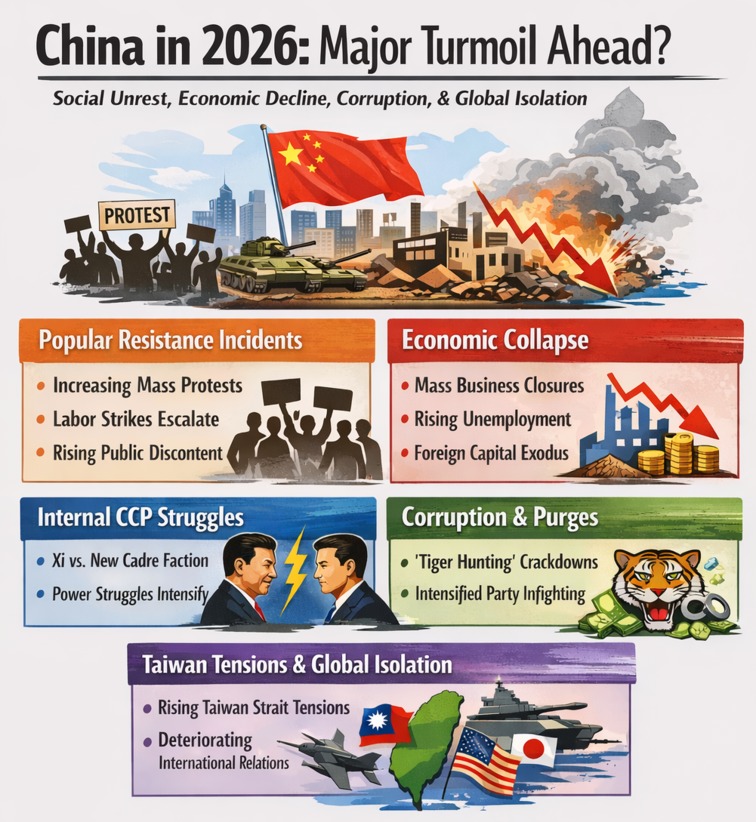
However, the CCP's greater fear now lies in the threat that large gatherings pose to its regime. China resembles a powder keg, with mass incidents capable of igniting at any moment. Statistics indicate that in 2022, there were 200,000 protests of varying sizes across the country. The 'White Paper Movement' of 2022, while primarily a protest against COVID-19 lockdowns, also challenged the policies of the authoritarian state to some extent. Recently, there have been calls online to reignite the 'White Paper Movement.' New Year's Eve events, occurring without prior coordination, fulfil the necessary conditions for public gatherings aimed at protest. Imagine if, during New Year's Eve celebrations in various locations across the mainland, people suddenly raised white papers while counting down, ultimately shouting 'Down with the Communist Party, down with Xi Jinping.' Such a striking scene would undoubtedly instil fear in the Communist Party just at the thought of it.
(First published by People News)
△






News magazine bootstrap themes!
I like this themes, fast loading and look profesional
Thank you Carlos!
You're welcome!
Please support me with give positive rating!
Yes Sure!