

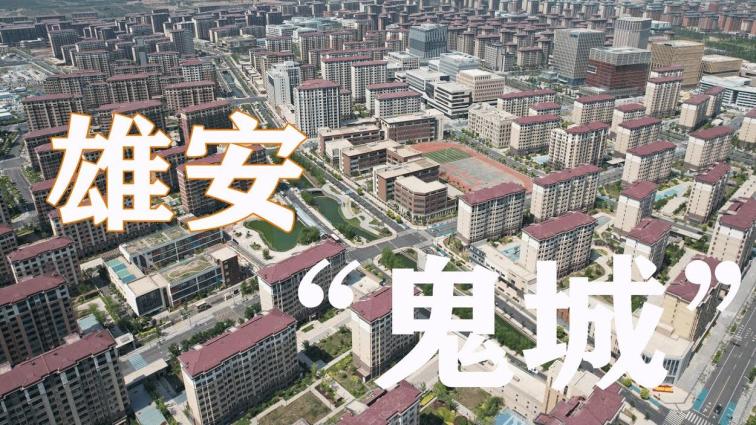
File photo: Another unfinished project added to Xi Jinping’s list of stalled developments. (Video screenshot)
[People News] The CCP has rolled out another major move: creating a Hainan Free Trade Port. The general explanation is that it is meant to offset Sino–U.S. decoupling and external blockades, to build a Chinese version of an “offshore economic zone,” and to drive the service sector and consumption. The policy of “opening the first line while controlling the second line” would be implemented, with zero tariffs on most imported goods and preferential tax rates for specific enterprises and individuals, in an attempt to challenge the “free port” status of Hong Kong and Singapore.
In my impression, Hainan was, in the 1990s, the site of a sensational nationwide wave of automobile smuggling. Later, when tourism heated up, Hainan became notorious nationwide for “ripping off tourists.” Hainan’s natural conditions are very good, but it also has the typical insular, closed mentality of island residents. Moreover, there are no economically developed regions like Hong Kong or Taiwan nearby, so it lacks the advantage of “getting the moon first by being close to the water.” As a result, Hainan lagged far behind the Pearl River Delta during the great tide of reform and opening up.
The CCP’s fanfare over the Hainan Free Trade Port is mainly because in recent years the economy has sunk and struggled to recover. This so-called “great power” has no bright spots to revive prosperity, and the whole country is lifeless and gloomy. Xi Jinping, weighed down with worries, works behind closed doors and comes up with this big idea, hoping to make a splash once again. As for whether it is feasible, that can be left aside—so long as some noise is created first.
From a macro perspective, the Hainan Free Trade Port is fundamentally just “finding something to mess with.” Under today’s circumstances, there is simply no necessity or feasibility for setting up any free trade port. It is merely that Xi Jinping “likes this sort of thing.” Anyway, if it fails, it will just become another unfinished project—he has long since become accustomed to “rotting.” Let him do it if he wants; let it rot if it rots.
It is said that the Hainan Free Trade Port is a manifestation of what the CCP calls “the door to opening up will only open wider and wider.” But when the Party’s overall line turns left, and politics, the economy, culture, law, and diplomacy all regress day by day, racing toward authoritarian dictatorship, how can you set up a free trade port that looks open in form and yet be consistent with the country’s overall policy of closure? This point has clearly not been thought through seriously. Since it is not self-consistent, how to balance the relationship between the central government and Hainan, and how to grasp the degree of policy freedom—these are inherent, congenital problems.
During Xi Jinping’s more than ten years in power, CCP politics have seen a Cultural Revolution-style regression, the economy has besieged private enterprises, the legal system has become harsh, and culture has been sealed off. All these national policies are in severe conflict with economic openness. Administratively, the Hainan Free Trade Port is still under the CCP’s bureaucratic system; legally, it still follows the CCP’s set of authoritarian and vicious laws; the government safeguards public power and makes a specialty of encroaching on private property rights; culturally, it looks back to the Cultural Revolution. How free can such a free trade port really be? This alone is worth doubting.
Secondly, the CCP’s “wolf-warrior diplomacy” has led to a comprehensive deterioration of foreign relations. Capitalist powers led by the United States have successively decoupled from the CCP; foreign capital does not come, foreign enterprises move away, and foreign trade dries up. A free trade port is originally designed for foreign investment and trade, but foreigners now feel repelled when they see the CCP and avoid it as much as possible. Who would still have the mind to get involved? Having suffered major losses, could they possibly still not have woken up?
The United States, Europe, Japan, and South Korea have all left. Southeast Asian countries are waiting for others to invest; they are competing to attract capital and enterprises relocating from China. They have neither the capacity nor the inclination to take a stake in China. Latin America is too far away and too poor; Africa is still waiting for others to save it. Calculated this way, who is left to come do business in this free trade port?
Furthermore, mainland society is sinking into a prolonged period of economic recession. The sluggish consumer market cannot be resolved in the short term. If that is the case, imports will certainly remain low for a long time, and with poor import conditions, foreign goods will not sell well either. So what business, exactly, is this Hainan Free Trade Port supposed to do?
Because of the policy of “opening the first line while controlling the second line,” before gaining favor from foreign capital, Hainan has already created divisions with provinces and cities inside the second line. In the past, the movement of goods and people between Hainan and other provinces faced no obstacles; now there are many more restrictions. This is a case of seeing harm before seeing any benefit. Only days after the free trade port was established, prices in Hainan had already risen and tourists had become scarce. It is still unknown whether things will worsen further.
The result of “controlling the second line” will inevitably be a revival of smuggling. Even if the government tries to control it, there will always be people willing to take the risk of beheading for profit—no one does a losing business. Government officials will exploit loopholes to make money on the side and open convenient channels for smuggling, with everyone cashing in together. Hainan already has a tradition of smuggling; once the free trade port is built, smuggling will come back to life. Xi Jinping will then have another headache—bringing trouble upon himself, isn’t that so?
One characteristic of Xi Jinping’s national policies is his fondness for launching grand projects—projects that must be sensational enough, ambitious enough, capable of mobilizing the enthusiasm of officials and the public and inspiring optimistic expectations for the future, appearing to have great strategic height and grand vision. This stems from a deep-seated sense of inferiority within Xi Jinping, and it has also been his shortcut to promotion after years of climbing up from the grassroots.
Grand projects can be undertaken, but the most important thing is that they must be necessary and feasible. Necessity means they promote social, economic, and livelihood development; feasibility means there is confidence they can deliver results. If neither exists, then grand projects merely waste public resources and money—they are empty cannon shots.
At present, China’s power generation already far exceeds electricity demand, yet the CCP still pours huge investments into the Yarlung Tsangpo River hydropower station. China’s high-speed rail and subway systems have long been in oversupply, yet construction continues repeatedly. China’s real estate sector is seriously detached from demand, and China’s electric vehicles also suffer from overcapacity. The Greater Bay Area was proposed ten years ago—what has it accomplished so far? The Beijing Stock Exchange is now almost invisible. As for the Tianjin Development Zone, the Shenzhen New Era Socialist Experimental Zone, and similar projects—each was launched with great fanfare and overwhelming momentum, yet all turned out hollow and dull.
Hainan dreaming of replacing Hong Kong is just that—a dream. Hong Kong prospered under British rule. Unless Hainan were outsourced to the U.S., Europe, Japan, or even Taiwan, endowed with their rule of law and free markets, and a permanently humane system, otherwise, after a few more years of tinkering in CCP hands, Hainan will only end up worse off than it is now. (Author’s Facebook)
△






News magazine bootstrap themes!
I like this themes, fast loading and look profesional
Thank you Carlos!
You're welcome!
Please support me with give positive rating!
Yes Sure!