
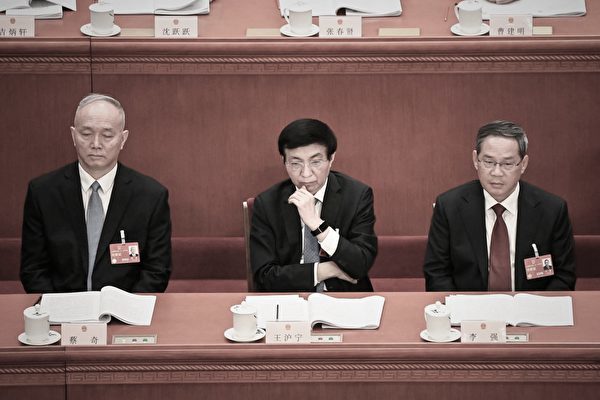
On March 7, 2023, (from left to right) Cai Qi, Wang Huning, and Li Qiang at the Chinese Communist Party&9;s National People&9;s Congress. (Greg Baker/AFP via Getty Images)
[People News] As 2026 approaches, Wang Huning—member of the CCP Politburo Standing Committee and Chairman of the National Committee of the Chinese People’s Political Consultative Conference (CPPCC)—separately met with members of the leadership teams attending the 11th National Congress of the Buddhist Association of China (held December 28–29) and the 11th National Congress of the Chinese Taoist Association (held December 29–30). From the term “leadership team members” alone, it is clear who these so-called “leaders,” operating under the banners of Buddhism and Taoism, are expected to obey.
In both meetings, Wang stated that these figures should “thoroughly study and implement Xi Thought and the spirit of the Fourth Plenum,” “study Xi’s exposition on religious work,” and, more importantly, “guide members of the Buddhist community and believers to resolutely heed the Party and follow the Party.”
Compared with reports on Wang’s meeting with the leadership of the Buddhist Association of China on October 25, 2023, and his meeting in December 2023 with leaders attending the 11th National Congress of the Protestant churches in China, a key pledge of loyalty was missing this time—namely, the phrase “deeply grasp the decisive significance of the ‘Two Establishes.’”
In the context of CCP official media, where every word follows strict rules, the absence of such loyalty language is no small matter. Even Wang Huning—long viewed as a “house servant” of the CCP’s red families—either openly refrained from mentioning it, or mentioned it only to have it deleted. Does this indirectly confirm that Xi’s power has indeed been weakened?
Consider also the CPPCC New Year Tea Reception on December 31, 2025. After Xi delivered his speech, Wang Huning, as host, said that the CPPCC should study and implement the spirit of Xi’s remarks and “unswervingly” uphold the CCP’s overall leadership. Wang said the same thing at the tea reception in late December 2024. But at the late-December 2023 reception, Wang added that Xi Thought should be used to “forge unity of mind and spirit,” and that “thought and action” should be unified with Xi’s speech and the Party Central Committee’s decisions and deployments.
Across three New Year tea receptions, with July 2024—when Xi reportedly “ran into trouble”—as a watershed, Wang’s formulations changed. Notably, at the end of 2023, Xi was placed before the “Party Central Committee,” whereas in current official media reports, the “Party Central Committee” comes before Xi—a clear difference.
Furthermore, after the CCP’s Fourth Plenum in late October, senior officials made statements pledging to study the so-called “spirit” of the meeting. At CPPCC sessions, Wang Huning not only parroted the communiqué’s language but repeatedly referred to the “Party Central Committee with Comrade Xi Jinping at its core,” saying that achievements over the past five years fundamentally lay in the “Party Central Committee with Xi at its core steering the ship,” and in the guidance of “Xi Thought.” When expounding on development during the “15th Five-Year Plan” period, Wang also mentioned the “2-4-4-2” formula, but unlike before, he did not place it in the opening section—another small change.
Yet just over two months later, all of Wang’s praise of Xi disappeared entirely from the CPPCC New Year tea reception. There must be reasons behind this.
Wang Huning is not the only one at the CPPCC showing such changes. On October 11 last year, the CPPCC Ethnic and Religious Affairs Committee held a symposium on the Sinicization of religion, attended and addressed by CPPCC Vice Chairman Bater. The report shows that the previously common “2-4-4-2” loyalty language—such as the “Two Establishes,” “Four Consciousnesses,” “Four Confidences,” and “Two Upholds”—was absent from his speech.
Most interestingly, at the closing session of the third plenary meeting of the 14th CPPCC National Committee last March, Wang Huning lavishly praised Xi. However, when Xinhua reported the event, it deleted several of Wang’s sycophantic remarks about Xi, such as references to “steering the ship” and “the guidance of Xi Thought.” Deleting content from a Politburo Standing Committee member’s speech—especially content related to Xi—is absolutely not a trivial matter; it must have come from orders by even higher-level figures.
Moreover, when Wang accompanied Xi on a trip to Xinjiang a few months ago, he reportedly stood with his hands behind his back, facing Xi while Xi was speaking—something that would have been unthinkable in the past.
Wang Huning’s various anomalies precisely corroborate rumours that Xi has lost power. But before the CCP makes any formal announcement, to avoid instability, the entire Party—from top to bottom, including Xi himself—is putting on an act. Sometimes, however, the acting is poor, and the seams show.
(First published by People News)





News magazine bootstrap themes!
I like this themes, fast loading and look profesional
Thank you Carlos!
You're welcome!
Please support me with give positive rating!
Yes Sure!