

Trump’s First Strike of the New Year Delivers the CCP Its First Defeat — Zhongnanhai “Deeply Shocked”
[People News] On the night of January 2, the U.S. military carried out a high-risk operation in Venezuela, capturing Maduro alive and withdrawing safely. At the very beginning of 2026, U.S. President Trump (Donald Trump) launched a successful first strike, which to some extent set the tone for foreign policy in the new year. America’s forceful action sent a clear signal: it will not allow CCP forces to meddle in the Americas. This also caused the CCP to suffer its first defeat of the new year very quickly.
A High-Risk Mission
Although the U.S. military had completed careful preparations in advance in Venezuela, the plan to dispatch special forces to directly capture Maduro was still fraught with risk. If intelligence were inaccurate, the assault team might come up empty-handed, alert the enemy, and make it even more difficult to capture Maduro later. If the U.S. operation were not sufficiently covert and encountered resistance, not only could the mission fail, but casualties might also occur. In addition, coordination between the assault team and support units, as well as unforeseeable contingencies, could all introduce variables.
In April 1980, the U.S. military entered Iran to carry out a hostage-rescue operation, which ended in failure: eight U.S. service members were killed, four wounded, and helicopters had to be abandoned. Iran quickly transferred and dispersed the hostages. The failure of the U.S. operation in Iran also directly led to the resignation of then–Secretary of State Cyrus Vance, and then–President Carter failed to win re-election in that year’s election.
Current President Trump, Secretary of State Rubio, and Secretary of War Hegseth should all have been aware of the potential risks, yet all supported capturing Maduro alive. To prevent leaks, Trump even refrained from promptly notifying Congress. Trump’s chosen Chairman of the Joint Chiefs of Staff, Dan Caine, once again lived up to expectations, planning and executing a flawless joint strike and nighttime raid, precisely locating Maduro and arresting him before he could reach a safe house.
Faced with high risk, the White House team still demonstrated resolve. The operation was named “Operation Absolute Resolve.” Caine revealed that it was “the final result of months of planning and rehearsals.” He also said that U.S. helicopters were attacked during the operation; one aircraft was hit but remained flyable. Fortunately, U.S. personnel brought Maduro and his wife home safely.
The White House chose to bear the risk, and the payoff was substantial. By capturing the ringleader first, the United States achieved the goal of dismantling the Maduro regime quickly and at minimal cost. Otherwise, the United States might have had to impose a prolonged blockade on Venezuela, carry out endless airstrikes, and likely deal with Maduro’s erratic bargaining. Now, the United States acted decisively with immediate effect, securing its first complete victory of 2026 in Latin America.
A Typical Case of the New National Security Strategy
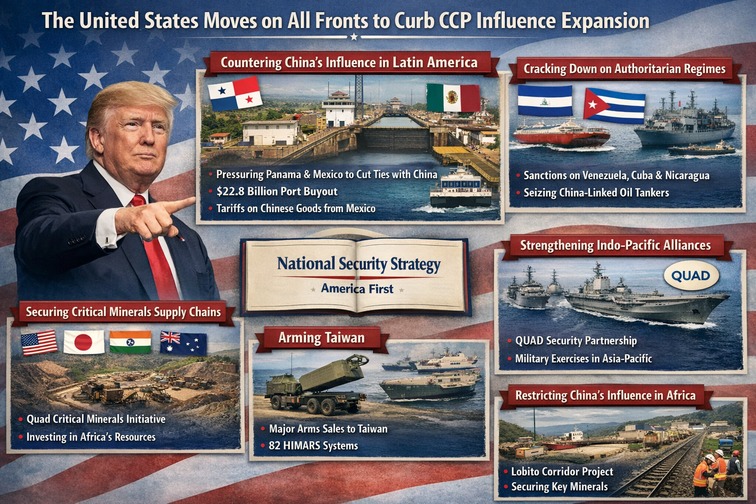
In early December 2025, the White House released the U.S. National Security Strategy 2025. The top-priority strategy is to ensure that the Western Hemisphere remains relatively stable and to prevent non–Western Hemisphere competitors from deploying military forces or other threatening capabilities in the region, or from owning or controlling assets of strategic significance.
The Trump administration does not allow the CCP’s tentacles to extend into Latin America. The Panama Canal was Trump’s first target after taking office; Venezuela was the second—both aimed at severing the CCP’s dark hand.
On December 10, 2025, the United States seized a sanctioned oil tanker off the coast of Venezuela. On December 16, Trump announced that, based on reasons such as “stealing U.S. assets” and “terrorism, drug trafficking, and human trafficking,” the United States would designate the Maduro regime as a Foreign Terrorist Organization and order a “comprehensive and total blockade” of all sanctioned oil tankers entering or leaving Venezuela.
This cleared the legal obstacles to capturing Maduro alive. At that time, the Trump administration was already preparing to shape a typical new case for the updated National Security Strategy and was determined to succeed. The U.S. military was also fully prepared for the operation.
Just after the New Year, Trump approved the U.S. military’s action plan, and his wish was fulfilled. At a press conference, Trump once again emphasized the “Monroe Doctrine.”
U.S. Secretary of War Hegseth aptly remarked, “Welcome to 2026. Under President Trump’s leadership, America is back.”
Secretary of State Rubio clarified, “The nature of this operation is not a military operation, but a law-enforcement action.” He emphasized, “When Trump says he’s serious about something, he really is serious.” When he mentioned the $50 million bounty on Maduro, Trump interjected, “Don’t let anyone touch that money. Other than us, no one deserves it.”
Reporters asked one after another how the United States would handle Venezuela’s future situation; the Venezuelan people were likely waiting eagerly as well. Trump did not lay out detailed next steps for Venezuela, but for the CCP, there were basically no next steps left. Maduro’s failure is also a major failure for the CCP in Latin America.
The CCP Is “Shocked”
The day after the United States designated the Maduro regime as a Foreign Terrorist Organization—December 17—Venezuelan Foreign Minister Yvan Gil hurriedly spoke by phone with CCP Foreign Minister Wang Yi, apparently seeking help. Although Wang Yi said that China “opposes” unilateral threats, he then merely stated that China “supports all countries in safeguarding their own sovereignty” and that it “believes the international community understands and supports” Venezuela’s position.
Forced to seek help from the CCP, the Maduro regime received from Wang Yi only ambiguous public remarks that kicked the ball to the “international community.” At a critical moment, it seemed the CCP did not intend to save Maduro.
Of course, the CCP did not give up. Before Maduro was captured alive, on January 2 he met with Qiu Xiaoqi, the CCP’s Special Representative for Latin American Affairs, and his delegation. Maduro could only treat the CCP as his last straw, claiming the two sides shared “brotherly ties.” However, neither the CCP Ministry of Foreign Affairs nor the Chinese Embassy in Venezuela issued an official statement about the meeting.
If the CCP delegation did not leave that night, they should have heard the explosions from U.S. airstrikes—effectively witnessing the collapse of the Maduro regime.
On January 3, Xinhua quoted Trump in a report titled “Trump Says the Maduro Couple Are on a U.S. Warship,” describing U.S. special forces taking Maduro from a heavily guarded “fortress.” The CCP Ministry of Foreign Affairs issued a self-question-and-answer statement saying it was “deeply shocked.” This was likely not merely diplomatic rhetoric, but rather that CCP leaders and diplomats were indeed “shocked.”
Before the New Year, the CCP had just finished a showy military exercise around Taiwan; after the New Year, the U.S. military completed a stunning real action. At a press conference, Secretary of War Hegseth said, “The United States can project our will at any time, in any place—coordination, stealth, lethality, precision, and the powerful reach of the U.S. justice system—all of which were fully displayed in the dead of night.”
Countries around the world issued statements regarding the U.S. military action, which should have further deepened the CCP’s sense of frustration. At the opening of 2026, America’s first strike was a complete victory, and it also delivered the CCP its first defeat of the new year.
In his New Year address, the CCP leader spoke of “seeking dreams across mountains and seas,” and at the CPPCC New Year tea reception he again said that “the blueprint has already been drawn.” Yet in an instant, the “delusionary dream” was “shaken awake,” the so-called “blueprint” was torn apart, and the first defeat of the new year arrived so swiftly and unexpectedly.
(Dajiyuan)
△






News magazine bootstrap themes!
I like this themes, fast loading and look profesional
Thank you Carlos!
You're welcome!
Please support me with give positive rating!
Yes Sure!