
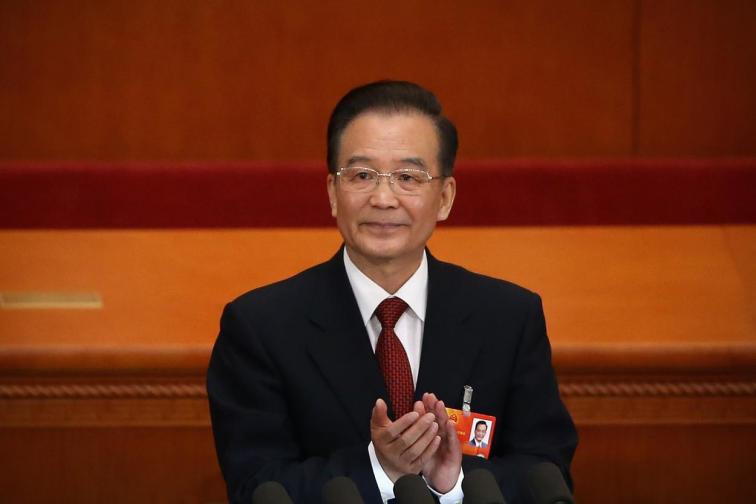
Former Chinese Premier Wen Jiabao. (Photo by Feng Li/Getty Images)
[People News] Less than a week after the New Year, on January 5, the Central Commission for Discipline Inspection announced the first major corruption case of 2026. Tian Xuebin, the former vice minister of the Ministry of Water Resources, is currently under disciplinary review and investigation for serious violations of discipline and law. His downfall has garnered attention partly because he served as the secretary to former Premier Wen Jiabao for many years. Additionally, his fall from grace occurred shortly after that of Wang Wenhua, the secretary to another retired elder, Li Ruihuan.
Just over ten days before the New Year, on December 18, 2025, the Central Commission for Discipline Inspection reported the downfall of Wang Wenhua, the former party group secretary and director of the Qingdao Municipal People's Congress in Shandong Province. Wang, who was also at the vice-ministerial level, had previously served as the confidential secretary to former National Committee of the Chinese People's Political Consultative Conference Chairman Li Ruihuan.
Wen Jiabao and Li Ruihuan were once rumoured to be part of a faction that, following perceptions of Xi Jinping's weakened power, engaged in the highest decision-making processes of the Communist Party of China alongside military figures like Zhang Youxia. They were seen as a support base for the red second generation and others aiming to correct Xi's policy deviations.
After the Third Plenary Session, rumours circulated that Xi Jinping had suffered a stroke and undergone surgery, leading to a perceived reduction in his power. Later, during the National Day reception in 2024, Wen Jiabao was seated to Xi Jinping's left, while Li Ruihuan was on his right. Other retired and current standing committee members, including Li Zhanshu and Wang Yang, were seated among them.
At that time, many overseas political observers believed that, in accordance with the conventions of the Chinese Communist Party (CCP), seating arrangements at significant events are governed by specific rules, and the order of former and current high-ranking officials is quite important. Since Li Ruihuan and Wen Jiabao have never served as the CCP leader, their sitting next to Xi Jinping suggests that Xi has made certain concessions to these elders, including being compelled to relinquish some of his powers. The presence of Wen and Li may indicate their involvement in overseeing the broader situation, potentially representing the interests of some anti-Xi factions, which implies that Xi is continuously ceding authority.
The establishment of the "Central Decision-Making and Coordination Mechanism" on July 1 last year is viewed as a covert revival of the Central Advisory Commission, effectively sidelining Xi Jinping's Standing Committee of the Politburo. There are even rumours circulating that Xi Jinping may have lost his grip on power.
However, the recent sudden downfall of the secretaries of Wen Jiabao and Li Ruihuan within a span of less than twenty days, particularly during the festive New Year period when families typically reunite, appears quite peculiar. According to the CCP's practice of 'tiger hunting', to diminish or eliminate the power of a core figure, one must first target their close associates, former subordinates, secretaries, or friends—a strategy referred to as 'cutting the hem'. Historically, this has been the approach taken against major figures who have been ousted.
Why are Wen and Li unable to protect even their own secretaries? Furthermore, Tian Xuebin has been retired for two years, and Wang Wenhua has been retired for eight years; the CCP could easily choose not to investigate them.
So, does this mean that elder factions like Wen and Li have lost their influence? Has Xi's counteroffensive been successful, leading to repercussions for Wen and Li due to their opposition to Xi? Or are Wen and Li employing a strategy of self-sacrifice to illustrate the CCP's unwavering commitment to anti-corruption, suggesting that all factions must be held accountable in the fight against corruption?
Some observers suggest that this situation reflects the escalating power struggles within Zhongnanhai, while others see it as a continuation of high-level political manoeuvring. Some interpret it as a standard procedure in the ongoing anti-corruption campaign, while others argue that the infighting within the Communist Party has descended into chaos and madness.
Tian Xuebin, who is 61 years old, served as a secretary in the General Office and the State Council from 1992 to 2008. He later became a member of the Party Group of the State Council Research Office and held positions such as Deputy Director of the State Council Research Office. After 2003, his role as the Premier's secretary was publicly acknowledged. Duofang Ru (多方如), the former chairman of the Political Consultative Conference of Fucheng County in Hebei Province, mentioned in an article titled 'Remembering Premier Wen's Inspection of Fucheng' that Tian accompanied the Premier on inspections. In July 2015, Tian was appointed Deputy Minister of Water Resources and was also a member of the 14th National Committee of the Chinese People's Political Consultative Conference and the Agricultural and Rural Committee.
His recent downfall suggests that the internal conflicts within the Communist Party will intensify in 2026. Independent commentator Cai Shenkun noted on the X platform that 2026 is the year leading up to the 21st National Congress of the Communist Party in 2027, and many personnel decisions will need to be finalised this year. The power struggles surrounding the upcoming congress will also bring to light the safety concerns of retired leaders. 'At the start of the new year, the removal of a secretary who has been with him for many years sends a clear message to those elders still active in politics: do not act impulsively.'
Since the establishment of the 'Central Decision-Making Coordination Mechanism', the Chinese Communist Party (CCP) has not publicly revealed its personnel structure, and the identities of its members remain a closely guarded secret. This arrangement may have been designed to facilitate strategic considerations in future power struggles. According to 'Party Commentary' on the X platform, there are rumours that Tian Xuebin is involved in the Liu Zhijun case. If the Central Decision-Making Coordination Mechanism is indeed under the control of Wen Jiabao, then Tian Xuebin's arrest suggests that the internal conflicts within the CCP have reached a critical 'life-or-death' stage. (To be continued)
(Originally published by People News)
△





News magazine bootstrap themes!
I like this themes, fast loading and look profesional
Thank you Carlos!
You're welcome!
Please support me with give positive rating!
Yes Sure!