

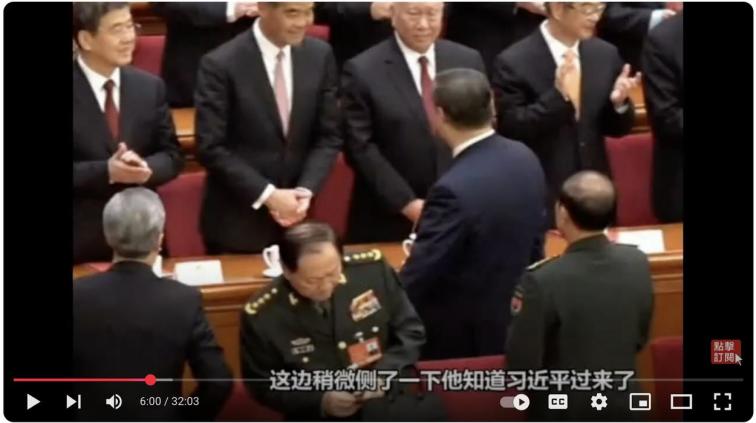
Zhang Youxia sat in the first row with the full national-level leaders. (Video screenshot)
[People News] It has been ten days since the official announcement on January 24 of the downfall of Zhang Youxia, Vice Chairman of the CCP Central Military Commission (CMC), and CMC member Liu Zhenli. China’s military and political circles have fallen into an unprecedented state of eerie calm. According to past CCP practice when Politburo-level officials fall, party and government bodies at all levels should immediately rush to declare loyalty, appear on state news broadcasts in line to support the central decision, and firmly endorse General Secretary Xi.
However, this time we have seen a silence never before witnessed. Aside from several toned-down critical articles in the military newspaper, party and government systems across provinces, autonomous regions, and municipalities have almost collectively gone mute. According to internal disclosures, official circulars regarding the Zhang Youxia case have still not been distributed to provincial- and ministerial-level units; even provincial party committees and governments have not grasped the details. Is this abnormal phenomenon a sign that Xi Jinping’s power is waning, or is Zhongnanhai brewing an even larger purge?
On February 4, the 20th session of the 14th National People’s Congress (NPC) Standing Committee convened in an emergency expanded meeting. This meeting was highly unusual, hastily inserted in a month when no meeting was scheduled. Outside observers widely speculated that Xi intended to use legal procedures to formally remove Zhang Youxia and Liu Zhenli from their state CMC posts and revoke their NPC delegate qualifications, effectively providing “procedural backing” for the major case.
But unexpectedly, the official announcement on February 5 showed that the meeting only dismissed three executives from the military-industrial sector. Not a single word mentioned Zhang Youxia or Liu Zhenli.
As a result, many observers believe the two men still possess a “protective talisman.” Under Chinese law, to protect NPC delegates in performing their duties, deputies above the county level cannot be arrested, criminally detained, or prosecuted during their term without approval from the NPC Presidium. In other words, holding an NPC delegate certificate might be useful at critical moments.
However, Du Wen, former executive director of the Legal Advisory Office of the Inner Mongolia Autonomous Region Government, received reliable intelligence suggesting a different explanation.
The NPC Standing Committee did not revoke Zhang Youxia and Liu Zhenli’s NPC delegate status, Du revealed, because the investigation has not concluded and no final verdict has been reached. But he believes this instead reflects the extreme instability of Xi’s rule.
Du disclosed that at the January Politburo meeting, Xi established a new rule: anti-corruption efforts in the party-government system and the military are to be completely separated. That is, without central approval, party and government bodies may not intervene in military affairs or comment on anti-corruption in the armed forces.
This is not institutional progress but a risk-isolation tactic aimed at sealing the mouths of officials at all levels and preventing military turmoil from spreading into society. Xi fears most that local systems might exploit the situation, causing officials to realign their loyalties.
Du said: “Ultimately it would spread the signal of instability in the military throughout society, even stimulating Zhang Youxia’s forces within the military to make a last-ditch counterattack. The CCP understands this best: the military is the regime’s final foundation. Once that foundation shakes, local officials start recalculating their positions, and the bureaucracy begins taking sides. That is the spillover risk of military contradictions. China could plunge into massive fragmentation and turmoil.”
According to Du’s internal sources, Xi’s handling strategy is “military first, political later.” The priority is to “stabilize the military,” first achieving ideological unity within the armed forces and reshuffling and reassigning key positions and generals to ensure absolute reliability in the command system. Only after the military situation is fully stabilized, Zhang Youxia’s remaining influence dismantled, and the case “nailed down,” will the party-government system receive an explanation.
Du analyzes that Xi may be deliberately creating the illusion that the party-government system does not strongly support him, thereby masking the reality that he has already achieved absolute centralization and dictatorship, lowering external vigilance toward his concentration of power.
Does Xi’s arrest of Zhang Youxia mean his position is now rock-solid? The answer is complicated: structurally, Xi has indeed reached an unprecedented level of centralized power; substantively, however, he faces extreme instability.
Du believes Xi is currently ruling by “governing the country through corruption and governing the party through anti-corruption.” He has not only taken away the people’s rights but also seized the collective interests of the CCP elite, turning power into the dictatorship of a single emperor. This trend of “personalizing the military” is transforming the PLA from a “party army” into a “Xi army.”
Yet the dispersal of public sentiment is now unstoppable. There is deep resentment toward Xi within the military. Some frontline commanders have reportedly said privately that if Xi came to inspect them, they would personally take action against him. Regarding Zhang Shengmin, seen as betraying Zhang Youxia, some officers have hinted he should be eliminated. At this sensitive moment while the Zhang Youxia affair continues to ferment, another shockwave emerged — Xi’s elder sister was exposed in an alleged 400 billion yuan oil corruption scandal. It is said this scandal is circulating among senior military ranks, severely undermining Xi’s “clean and anti-corruption” legitimacy. The current stalemate lies in the fact that anti-Xi forces harbor resentment but lack organizational initiative, while Xi’s faction is racing against time to complete a comprehensive reshuffle of the military before dissatisfaction fully erupts.
Meanwhile, signs of decay in Chinese society are rapidly emerging: bank deposits mysteriously disappearing, the economy sinking into deflation, local governments lowering GDP targets — all indicating that the CCP’s ruling foundation is shaking.
Against this backdrop of political tremors, as governance capacity declines, local officials increasingly just carry out orders mechanically, doing nothing or performing poorly. We see frequent disappearances of young people in China, horrifying rumors of organ harvesting, reflecting a complete collapse of rule of law. For ordinary Chinese people living in such an environment, especially the young, if you can leave, leave; if not, “lie flat,” protect your assets and personal safety, and do not trust any so-called get-rich opportunities.
The fates of Zhang Youxia and Liu Zhenli are a microcosm of the power struggle within Zhongnanhai. Currently, due to entanglement of various forces, Xi has had to slow down and make concessions, hoping to achieve a temporary, transitional political balance. Although variables remain, the chances for anti-Xi forces to turn the tide are diminishing. Prolonged time is unfavorable to both Xi’s faction and the anti-Xi camp. But this delay also gives Xi ample time to consolidate power and carry out the next wave of purges.
But when a regime must rely on the silence of the entire system to maintain order, how long can such stability — created through high-pressure isolation — really last? Once a single link breaks, collapse could come in an instant. The grand historical drama of the CCP’s downfall has only just entered its first act.
(First published by People News)△





News magazine bootstrap themes!
I like this themes, fast loading and look profesional
Thank you Carlos!
You're welcome!
Please support me with give positive rating!
Yes Sure!