
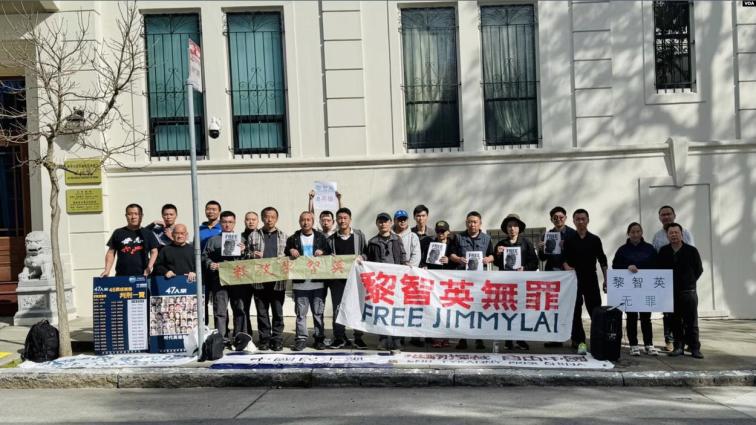
On the afternoon of February 22, 2025, democracy and human rights activists in the San Francisco Bay Area protested in front of the Chinese Consulate General in San Francisco, condemning the Chinese government's persecution of Jimmy Lai, a pro-democracy figure and media tycoon in Hong Kong. They demanded his release after nearly four years of solitary confinement and called for authorities to allow him to receive medical treatment. (Photo by VOA’s Zhou Xingchen)
[People News] This morning (January 29), during his visit to Beijing, British Prime Minister Sir Keir Starmer told the media after meeting with General Secretary Xi Jinping of the Communist Party of China that he raised human rights issues in China, including the case of Jimmy Lai, the founder of Next Media, who is imprisoned in Hong Kong.
This meeting is the first between the leaders of the UK and China in Beijing since 2018. Prior to his trip to Beijing, the opposition Conservative Party and several civil organisations urged him to address human rights issues in Hong Kong and Xinjiang with the Chinese Communist Party. Political analysts suggest that discussing these issues in a closed-door meeting does not put any pressure on the Communist Party and is, in reality, ineffective.
Sir Keir Starmer made these comments while responding to questions from British reporters at the Forbidden City in Beijing. When asked if he had raised human rights issues such as those concerning Jimmy Lai and the Uyghurs in Xinjiang with Xi Jinping, he replied, "As you would expect, we raised those issues..." He further explained that part of the reason for engaging with China (the Communist Party) is "to ensure that we can seize existing opportunities—that is exactly what we are doing—while also having mature discussions on issues where we have differing opinions." When pressed by reporters about whether he received a response from Xi Jinping, Sir Keir Starmer stated, "We had a (mutually) respectful exchange on this matter."
Li Zhiying, the founder of Hong Kong's Next Media, along with three companies of Apple Daily, was charged in the West Kowloon Court in December 2025 for violating the National Security Law. The charges include two counts of 'conspiracy to collude with foreign forces' and one count of 'conspiracy to publish seditious publications.'
The court began a two-day hearing on January 12 this year regarding a plea for a reduced sentence. After the hearing concluded on January 13, the judges designated under the National Security Law—Du Libing, Li Sulan, and Li Yunteng—indicated that they would announce the sentencing at a later date. Throughout the proceedings, Li Zhiying maintained his innocence and did not submit any plea statements or letters. His defence attorney, senior barrister Peng Yaohong, highlighted that the 78-year-old Li Zhiying suffers from multiple health issues and urged the court to consider his age, health condition, and the difficulties of solitary confinement in prison. Li Zhiying's daughter, Li Caizheng, previously wrote to The Washington Post, stating that her father's health had sharply declined while in custody. Over the past few years, during visits and while attending hearings, she observed her father's nails falling off, teeth decaying, and eyes bloodshot. When he appeared in court last June, he looked pale and trembled continuously. She warned that if the Chinese Communist Party does not release her father, he could very well become a martyr for freedom.
In 2024, Keir Starmer met Xi Jinping for the first time in Brazil, where he urged the Chinese leader to discuss human rights issues 'frankly,' which included the case of Li Zhiying. However, it became clear that closed-door discussions were ineffective, and Li Zhiying was still punished in accordance with the Chinese Communist Party's intentions as a warning to others.
Today (January 29), the Chinese Ministry of Foreign Affairs announced that during Xi Jinping's meeting with Starmer, both sides agreed on the need for China and the UK to develop a long-term, stable, comprehensive strategic partnership.
Li Zhiying's son, Li Chong'en, spoke to BBC's morning news regarding the discussions between the leaders of China and the UK about the 'normalisation' of Sino-British relations. He questioned, 'What exactly are we normalising?' He emphasised that the imprisonment of his father is something that can never be 'normalised.' The question of whether his father will be released serves as a crucial test and a clear indication of how the Chinese Communist Party perceives Sino-British relations.
On the topic of human rights, the Chinese Communist Party's violations against the rights of its citizens are extensive and well-documented. Many individuals, like Li Zhiying, have sacrificed their freedom in the pursuit of liberty, including Li Heping, Wang Quanzhang, Zhou Shifeng, and the human rights lawyer Gao Zhisheng, who has been missing for nearly nine years, with no information about his fate... This issue extends beyond Hong Kong; the Chinese Communist Party has committed unforgivable acts of massacre and repression in Tibet and Inner Mongolia. It has also faced accusations of committing crimes against humanity against the Uyghur population in Xinjiang, where concentration camps have been established to forcibly assimilate ethnic minorities. Nevertheless, Beijing vehemently denies these allegations, accusing Western governments and media of 'fabricating fantasies.'
In an interview with BBC Radio, Alicia Kearns, the shadow Home Secretary for the Conservative Party, highlighted a series of tense incidents between the Chinese Communist Party (CCP) and the UK, including cyber threats and what she referred to as the 'wrongful imprisonment' of Jimmy Lai (Li Zhiying). 'Jimmy Lai needs to return home with him (Keir Starmer), and the sanctions against the MPs should be lifted.' In 2021, while the Conservative Party was still in power, several MPs faced sanctions from the CCP due to their firm stance against Beijing. The Conservative Party has consistently questioned whether the UK and China should deepen their ties, particularly in light of the recent decision by Keir Starmer's government to approve the construction of a 'super embassy' for China in London.
Keir Starmer and Xi Jinping's discussions in Beijing today lasted for 1 hour and 20 minutes. Reports from the Chinese Ministry of Foreign Affairs and Xinhua News Agency quoted Xi Jinping as saying, in a veiled reference, that for some time, unilateralism, protectionism, and power politics have been rampant, severely impacting the international order. International law is only truly effective when all countries comply; major powers must take the lead, or else we risk reverting to a jungle world. Both China and the UK support multilateralism and free trade and should jointly advocate and practice genuine multilateralism, promoting the establishment of a more just and reasonable global governance system, achieving equal and orderly multipolarity, and inclusive globalisation.
Some commentators have noted that the CCP itself, during its reform and opening-up period, encouraged the Chinese people to abandon all moral principles, indulging human desires and primal instincts under jungle principles, while simultaneously accusing other countries of adhering to jungle principles on the international stage.
Furthermore, the report's references to 'unilateralism, protectionism, and power politics' clearly point to the actions of U.S. President Donald Trump concerning tariffs, Venezuela, and the Danish territory of Greenland. However, both the party media and the Chinese Communist Party's official news releases completely omitted Keir Starmer's remarks on human rights.
Political analysts suggest that the Chinese Communist Party (CCP) is skilled at disguise and delay. If the international community does not apply open pressure, the CCP will not honor the appealing promises it makes, whether superficially or in person. Instead, it will employ a different set of propaganda to confuse and manipulate the world. Additionally, some countries, motivated by economic and trade relations, can be easily coerced, leading to a situation where the so-called human rights and universal values are readily compromised in the face of self-interest.
△







News magazine bootstrap themes!
I like this themes, fast loading and look profesional
Thank you Carlos!
You're welcome!
Please support me with give positive rating!
Yes Sure!