
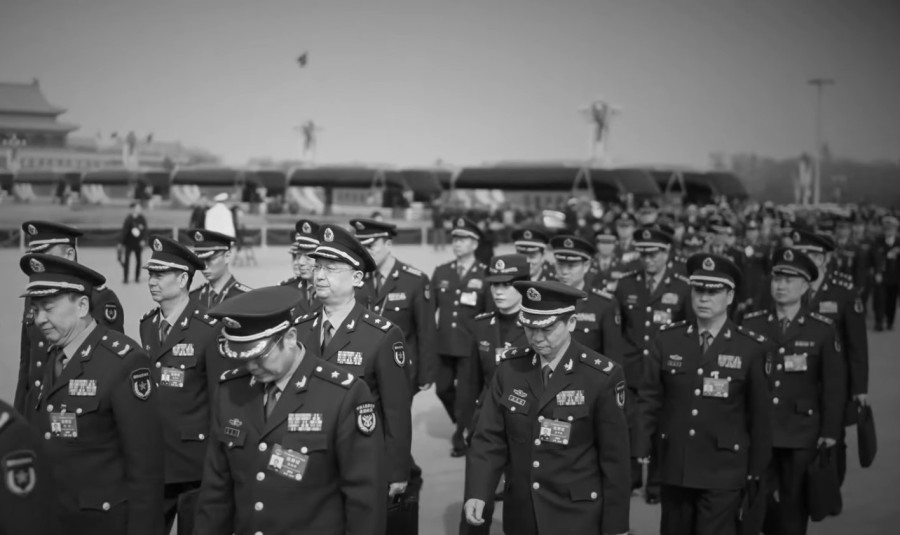
The representatives of the Chinese military attending the Two Sessions in Beijing. (Video screenshot)
[People News] Song Ping, 109 years old, witnessed throughout his life the Chinese Communist Party’s journey from Yan’an to the “New Era.” At 15:36 on March 4, 2026, one day before the opening of the Two Sessions, Xinhua News Agency released an obituary: Song Ping, former member of the Standing Committee of the Political Bureau of the CPC Central Committee and former head of the Organization Department, died in Beijing after medical treatment failed, at the age of 109. The news came suddenly, yet the precision of its timing sends a chill down the spine.
Song Ping’s résumé itself reads like a brief history of the CCP’s personnel system. Born in 1917 in Juxian County, Shandong, he graduated from the Department of Chemistry at Tsinghua University and joined the Party in 1937. While serving as Party Secretary of Gansu from 1972 to 1981, he discovered a young technician named Hu Jintao working at the Liujiaxia construction site and promoted him repeatedly in exceptional fashion: from deputy director of the provincial construction commission to secretary of the provincial Communist Youth League committee, and then to the central authorities. In 1982 he was transferred to serve as head of the Organization Department, holding enormous power over cadres, and he strongly recommended Hu Jintao to Deng Xiaoping, enabling Hu to become the youngest member of the Politburo Standing Committee at the 14th Party Congress in 1992. From then on, Hu Jintao’s political career soared until he succeeded to the post of General Secretary. It is widely acknowledged that without Song Ping, there would have been no “cross-generational designation” of Hu Jintao.
Song Ping long oversaw organizational and personnel affairs, and his influence ran through the Hu Jintao era and even affected the early years of Xi Jinping. After retirement, this elder—“the oldest in seniority and the longest retired”—still appeared as a symbolic figure: in 2015 he wrote a letter proposing “three agreements,” calling for property disclosure and warning of a “crisis within the Party”; before the 20th Party Congress in 2022, at the age of 105, he emphasized that “reform and opening up is the only path for China’s development.” He had connections with Xi Zhongxun and a deep mentor–student relationship with Hu Jintao. This cross-generational network and his identity as a “symbol of the reform faction” meant that even at the age of 109 he remained an invisible benchmark in the minds of certain forces within the Party.
In early January 2026, a letter from Song Ping to Xi Jinping circulated online (most online claims date it around January 3 or nearby). Although its contents were never officially confirmed, the rumored concerns and admonitions about the current political line immediately stirred a storm both inside and outside China. Just over two months later, on March 4—the eve of the opening of the Two Sessions—he “died of illness.” The CCP’s practice with senior elders is widely known: as long as the tubes are not removed, they are considered “alive.” When the tubes are removed and when the death is announced have always been an open secret not entirely decided by the family. This time, the timing was chosen with extraordinary “care.”
For Xi Jinping, Song Ping’s “timely departure” brings at least three immediate benefits:
First, it completely seals off the issue. The letter had already caused a stir. If the “mentor of Hu Jintao” were to remain alive, any new statement, remarks from family members, or exploitation of the issue by other retired elders could have unpredictable consequences. Removing life support and announcing the death eliminates in one move the potential risk of a “second letter.”
Second, it purifies the atmosphere of the Two Sessions. The meetings were already overshadowed by multiple pressures: high-level political turbulence, demonstrations of decapitation in Iran, strained local finances, and the pressures of maintaining stability amid public grievances. If Song Ping had continued to “live,” any commemoration or interpretation of his position might easily be amplified into implicit questioning of the current political line. Announcing the death in advance shifts the focus from the “letter controversy” to “solemn mourning,” reducing discordant notes and adding more narrative of “unity” in the meeting hall.
Third, it removes a symbolic risk. Song Ping was the last heavyweight symbol of the Hu era, a living fossil of the tradition of “cross-generational designation,” and a banner of the Party’s lingering memory of reformism. With the 21st Party Congress approaching and succession uncertainties mounting, leaving such an elderly figure—who could potentially be used by “those with ulterior motives”—would be like leaving a time bomb. Letting him “pass away naturally” before the Two Sessions fits the narrative of a life completed at an advanced age while conveniently erasing the last symbolic voice of the Hu faction.
Song Ping is gone. The life of 109 years has reached its end, which in itself is the natural order. But the timing of the obituary and the rhythm of removing life support constitute a thoroughly political calculation. What the CCP leadership excels at has never been letting history unfold naturally, but making history “happen” at the most appropriate moment.
Snow will melt, and spring will come. But when will such carefully arranged “timing” truly drift away with the wind? Perhaps only when China’s political arena no longer needs to use the life and death of an elderly man to manage narratives and eliminate discordant voices will the skies over Beijing truly clear.
(Author’s X account)
△




News magazine bootstrap themes!
I like this themes, fast loading and look profesional
Thank you Carlos!
You're welcome!
Please support me with give positive rating!
Yes Sure!