

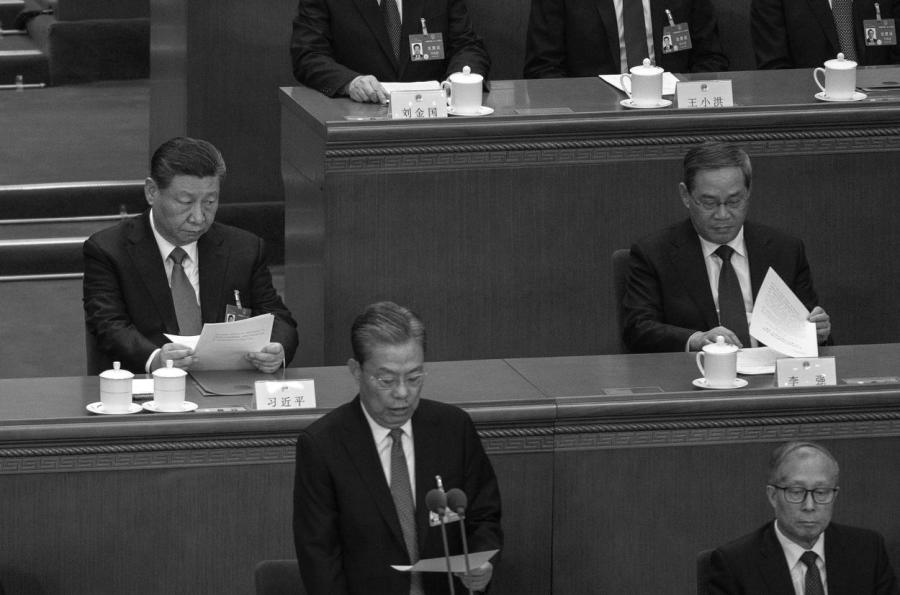
Chinese Premier Li Qiang, speaking on behalf of the CCP at the Two Sessions in 2024. (Video screenshot)
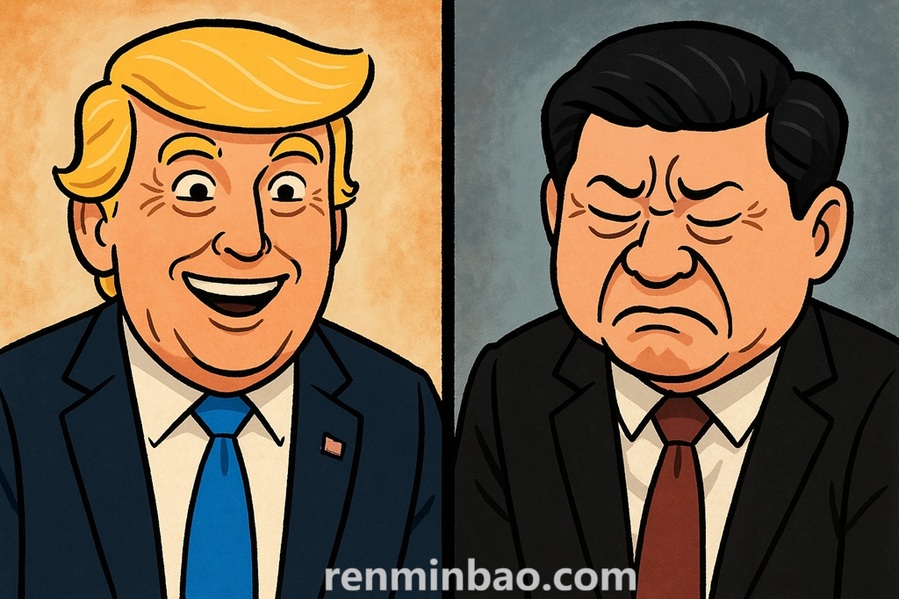
[People News] As the U.S.-Israel allied forces wiped out Iran’s top leadership, the Chinese Communist Party’s “Two Sessions” also opened one after another, but the overall feeling was completely lacking the festive air of previous years. In particular, the stiff expressions on the faces of one top Chinese Communist Party leader after another made it seem as though they were attending a funeral. That makes sense: under both internal troubles and external pressures, and not even knowing where their future lies, how could they possibly have any pleasant mood left?
Because many generals and lieutenant generals in the military were arrested or removed before the “Two Sessions,” the wording about the military in the “Two Sessions” report deserves attention. On March 5, Chinese Communist Party Premier Li Qiang delivered the government work report. The wording about the military differed from his 2024 and 2025 wording in the following ways:
1. This year marked the first mention of political army-building.
From 2024 through this year’s report, all of them mentioned implementing Xi’s strong-military thought, implementing the responsibility system of the chairman of the Central Military Commission, and continuously deepening political rectification and training, but only this year did it mention taking “political army-building as the guide.”
“Political army-building” is something Xi Jinping has frequently mentioned since coming to power. On October 30, 2014, the All-Army Political Work Conference was held in Gutian Town, Shanghang County, Fujian Province. On the 31st, Xi attended and gave a speech, clearly pointing out the importance of “political army-building.” At that time, the military was controlled by Jiang faction personnel and was not loyal to Xi. Although former Central Military Commission Vice Chairman Xu Caihou had already been taken down, the military still contained his close associates. Xi sent a signal in Gutian, indicating a further purge of Jiang faction forces within the military. Soon afterward, another former Central Military Commission Vice Chairman, Guo Boxiong, along with many Jiang faction generals, were pulled out one by one.
After the 19th National Congress of the Chinese Communist Party, as Xi’s power became highly concentrated, phrases such as “obey Chairman Xi’s command,” “implement the responsibility system of the chairman of the Central Military Commission,” and “implement Xi’s strong-military thought” became standard language in military reporting. For a time, Xi’s power within the Party and the military reached an unprecedented level.
However, Xi never fully grasped military power. Beginning in July 2023, senior military officers and executives in military-industrial enterprises were successively removed or investigated, including Central Military Commission member, State Councilor, and Defense Minister Li Shangfu, as well as three Rocket Force commanders — Li Yuchao, Zhou Yaning, and Wei Fenghe. It is said that Xi’s purge of the military was related to leaks from the Rocket Force.
On July 20 and 21 of that same year, the Chinese Communist Party’s all-military Party-building conference was held in Beijing. The meeting read out Xi’s “important instructions,” requiring the entire military to summarize the Party-building achievements “since the Gutian All-Army Political Work Conference” and to “focus on resolving prominent problems existing at various levels of Party organizations in upholding the Party’s absolute leadership over the military, strengthening combat readiness and warfighting capacity, and implementing the political responsibility of governing the Party and disciplining the Party.” Such wording indicated that Xi still had not obtained the degree of loyalty from the military that he wanted.
As Xi prepared to launch a major bloodletting, in June 2024 he led all Central Military Commission members and top military leaders, including Zhang Youxia and He Weidong, to Yan’an, where he convened yet another Central Military Commission political work conference. According to the official account, this was “personally decided and convened by Xi Jinping.” Xi once again emphasized political army-building, emphasized the military’s loyalty problem, and told senior officers to “solve the root problem in their thinking.”
Xi said that “at present, the world situation, national situation, Party situation, and military situation are all undergoing complex and profound changes, and our military is facing intertwined and complicated political tests. We must firmly grasp the requirements of the times for political army-building and push it forward without a moment’s توقف,” that “political work is forever the lifeline of our military,” and that “grasping ideological leadership is the foundation of grasping all leadership.” He also especially emphasized that “senior cadres must put themselves into it, bring out the courage to cast aside face and expose shortcomings and ugliness, and, with an attitude of digging deep to the roots and touching the soul, engage in profound reflection, serious rectification, solve the root problem in their thinking, and push political army-building deeper and more solidly.”
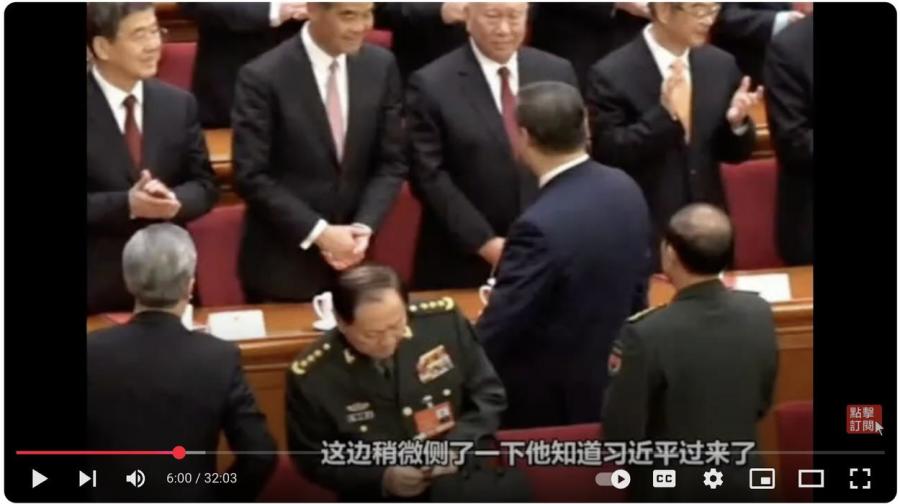
This shows that there are still “senior cadres” in the military who remain disloyal to Xi. Just as Xi was preparing to further purge the military, his sudden stroke at the Chinese Communist Party’s Third Plenary Session caused him to begin losing military power and part of his Party power, with some Party elders and Central Military Commission Vice Chairman Zhang Youxia taking control of military power. Over the past year and more, there have been many signs confirming this.
However, while lying low, Xi took advantage of the slackness of the elders and Zhang, and in January this year, regardless of violating Chinese Communist Party internal procedures and rules, quickly took down Zhang Youxia and Liu Zhenli, reclaiming part of his power. But the soft resistance from top to bottom within the military and the Party has made it even harder for Xi to obtain the military’s loyalty.
Now Li Qiang is endorsing Xi and emphasizing political army-building. On the one hand, this once again shows that after Xi took down Zhang and Liu, he still did not obtain the loyalty of the military above and below as he had wished. On the other hand, does it mean that after the “Two Sessions,” the military will be purged even further? This can only further weaken the Chinese Communist Party’s already hard-to-describe combat capability, leading more officers to comply on the surface while resisting underneath. And is this not forcing mutiny from within the military?
2. “New-quality combat power” has been changed to “advanced combat power.”
“New quality” is another Xi Jinping invention, and “new-quality combat power” was proposed by Xi in 2024 when he attended the full meeting of the military and armed police delegation at the second session of the 14th National People’s Congress. According to the official explanation, so-called “new-quality combat power” refers to “a new type of combat power generated by changes in the constituent elements of combat power such as personnel, weapons and equipment, and the way personnel and weapons and equipment are combined.” From that point on, “new-quality combat power” appeared frequently for a time in military newspapers.
This term also appeared in Li Qiang’s 2025 government work report. Strangely, in this year’s government work report, Li Qiang replaced it with “advanced combat power.” Is that because the military does not accept it? Or is it because Xi has not won an absolute victory in his struggle with other factions inside the Party, and his position is still not what it used to be?
3. Putting away arrogance: defending national sovereignty has been changed from “firmly defend” to “improve.”
This year Li Qiang said that China must “improve its strategic capability to safeguard national sovereignty, security, and development interests,” whereas in the previous two years it was “firmly safeguard national sovereignty, security, and development interests.”
Very clearly, the military strength demonstrated by the U.S. military in Venezuela and Iran, and the fact that the Chinese Communist Party’s defense-control systems in those two countries were little more than decorations, have greatly stimulated the Chinese Communist Party. It has also realized that if the same thing were to happen to itself, whether it could really “safeguard national sovereignty and security” would be another matter entirely. Therefore it has put away its previous arrogance and clearly acknowledged that it needs to improve its strategic capability in this respect.
(First published by People News) △




News magazine bootstrap themes!
I like this themes, fast loading and look profesional
Thank you Carlos!
You're welcome!
Please support me with give positive rating!
Yes Sure!