
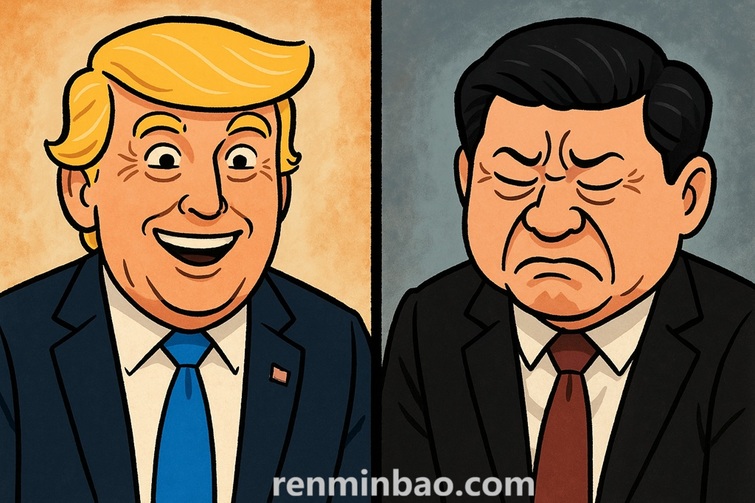
Thinking about taking action against Taiwan? Trump: You are free to think about it, but what are you actually going to do? (People News/AI-generated image)
[People News] The leader of the Chinese Communist Party, Xi Jinping, has never faced such humiliation as he does at the beginning of the Year of the Red Horse in 2026.
Under the impression that 'the East is rising while the West is declining' and that he can 'view the world from a level perspective', Xi Jinping, who believed he had the upper hand in the global chess game, has been dealt a severe blow amid the ongoing geopolitical turmoil affecting the Middle East, Latin America, and India-Taiwan. On the chessboard of US-China strategic competition, Xi Jinping is no longer a player but a pawn cornered by Trump’s relentless series of manoeuvres.
From the arrest of Maduro and the public capitulation of the Cuban leader to the decapitation of the Khamenei family in Iran, and Trump’s strategic deepening that targets Iran while launching the 301 investigation to deter Beijing, Xi Jinping’s strategic composure has completely disintegrated, leaving only strategic anxiety and embarrassment looming over Zhongnanhai.
On March 16, local time, Trump announced at the White House that he might postpone his visit to China by about a month due to the war in Iran. He was originally scheduled to visit China from March 31 to April 2, marking the first meeting between the US and Chinese heads of state during the Trump 2.0 era, following the Xi-Trump summit in Beijing in 2017.
The day prior, on March 15, Trump warned the CCP in an interview with the Financial Times that they should participate in the escorting of the Strait of Hormuz, or else his visit to China might be delayed, as 90% of China’s oil is transported through the Strait of Hormuz.
Although Trump provided different reasons for the postponement on two occasions, the decision to delay the trip to Beijing and the meeting with Xi Jinping is now final. Trump’s considerations still carry multiple implications, continuing to place the Beijing authorities and Xi Jinping under intense scrutiny.
Firstly, on the surface, Trump has conveyed a strong message to Xi Jinping that the issues surrounding Iran's nuclear facilities and the energy chokepoint in the Strait of Hormuz are his current priorities. In contrast, diplomatic relations with China and the leaders' meeting have been deprioritised. The underlying message is clear: you, Xi Jinping, are not that significant; the United States has its own strategic priorities that are not influenced by the desires of the Chinese Communist Party. Currently, whether viewed through the lens of reshaping geopolitical structures, US-China competition, or in terms of energy, tariffs, and AI strategy, the advantage lies firmly with Trump.
Secondly, Trump is particularly skilled at creating uncertainty in strategies against adversaries, which complicates their strategic assessments, increases decision-making costs, and undermines their fighting spirit and strategic stability. Regarding the postponement of his visit to China, Trump has so far thrown two smoke screens at the other side: one is due to the CCP's refusal to provide naval escorts in the Strait of Hormuz, and the other stems from the ongoing US-Iran conflict.
Reuters previously reported that Zhongnanhai expressed disappointment because Trump's team did not actively participate in the preparations for the US-China leaders' meeting, leading to a cautious stance on the potential outcomes of the Xi-Trump meeting. This suggests that Trump and his team have not prioritised diplomatic relations with China on their agenda, and Trump's strategic indifference towards Xi Jinping is sufficient to undermine the CCP's confidence as a major power and its strategic resolve.
On March 15, Trump played the Strait of Hormuz card, indicating that if the CCP does not send warships for escort, he will delay his visit to China at the end of the month. This effectively places a tight constraint on Xi Jinping, leaving the CCP with grievances it cannot voice, forcing them to swallow their anger and embarrassment. The Chinese Ministry of Foreign Affairs responded awkwardly, maintaining a low profile while stating that communication between the two sides regarding the leaders' meeting is still ongoing.
On March 16, Trump made a dramatic shift in his rhetoric, declaring, "We are at war. I think it is important for me to be here." Treasury Secretary Mnuchin took the opportunity to amplify the situation, stating to the media, "I want to clarify a false narrative: if the talks are delayed, it is not because President Trump asked China to maintain security in the Strait of Hormuz; that is completely incorrect." The Chinese Communist Party (CCP) was elated, akin to a beaten thug who suddenly hears the police admit they made a mistake, weeping with gratitude. Foreign Ministry spokesperson Lin Jian (林剑) eagerly announced, "China has noted that the U.S. has publicly clarified the false media reports, asserting that these reports are entirely wrong, and emphasised that the visit is unrelated to the navigation issue in the Strait of Hormuz."
This clearly indicates that a casual comment from Trump can dictate whether Xi Jinping can sleep peacefully at night for several weeks.
Furthermore, the issue of the Strait of Hormuz is not only a challenge in the context of the Iran conflict but also represents a critical vulnerability in the CCP's energy strategy in the Middle East. The decision to send troops for escort missions in the Strait of Hormuz hangs over Xi Jinping like a sword of Damocles. Deploying troops would signify that the CCP has capitulated, acknowledging Trump as the American leader, and engaging militarily with Iran could provoke a backlash, potentially exposing the CCP's hidden scandals and misdeeds. Conversely, failing to send troops could result in a loss of navigation rights in the Strait of Hormuz, striking at the CCP's energy vulnerabilities and effectively digging its own grave, leading to a dire era of oil shortages.
In examining the strategic landscape of the United States for 2026, it is clear that a 'hemisphere first' strategy is being pursued, characterised by distant alliances and nearby confrontations. This approach is consistent with the framework outlined in the 2025 'U.S. National Security Strategy.' Within this national strategic framework, which is fundamentally driven by the idea of making America great again, Venezuela's Maduro has already met his demise.
At the same time, the Cuban Communist regime, which shares a political symbiosis with Venezuela, is also on a rapid path to its own downfall. On March 12, the Cuban Foreign Minister held a conversation with Chinese Foreign Minister Wang Yi, but it was evident that no protective assurances were forthcoming from their larger ally. On March 13, Cuban General Secretary Díaz-Canel admitted that 'Cuban officials have engaged in talks with the U.S. government... Cuba is willing to continue dialogue based on equality and mutual respect.' Following this, on March 16, Cuba faced a widespread blackout across the island, prompting Trump to declare to the media that the Cuban Communist regime has reached its endgame. Then, on March 17, Cuban state television unexpectedly announced the largest economic opening since 1959. Under Trump's pressure, Cuba is transitioning towards a painless and casualty-free system transformation, marking yet another successful evolution of a smaller communist ally of the CCP.
The decapitation operation in Venezuela, military strikes against Iran in the Middle East, and the pressure test on Cuba are merely the opening acts. The true commencement of a new historical era is expected to be the encirclement and counteraction against the CCP regime. Meanwhile, the tariff war continues to be Trump's key weapon in subduing the CCP.
On March 10, the Office of the United States Trade Representative announced the launch of a new round of Section 301 investigations into the electric vehicles, semiconductors, and photovoltaic components of the Chinese Communist Party. Although the Chinese Communist Party raised objections during the US-China-Switzerland trade negotiations held from the 15th to the 17th, the US showed no signs of backing down. If issues are identified and tariffs are implemented, Chinese exports to the US and re-export trade will face significant new challenges, signalling the historical end of the Chinese economy's extended reach and the benefits of foreign trade.
As the Year of the Red Horse begins, Trump has clearly gained the upper hand. The Chinese Communist Party is now caught in a web of multiple crises, including the collapse of alliances, international isolation, economic deflation, and political instability. Xi Jinping's century-long transformation is unfolding as the conclusion of the Chinese Communist Party's red era.
(First published by People News) △





News magazine bootstrap themes!
I like this themes, fast loading and look profesional
Thank you Carlos!
You're welcome!
Please support me with give positive rating!
Yes Sure!