

Many elderly individuals cannot even afford pork priced at 20 yuan per jin. (Video screenshot)
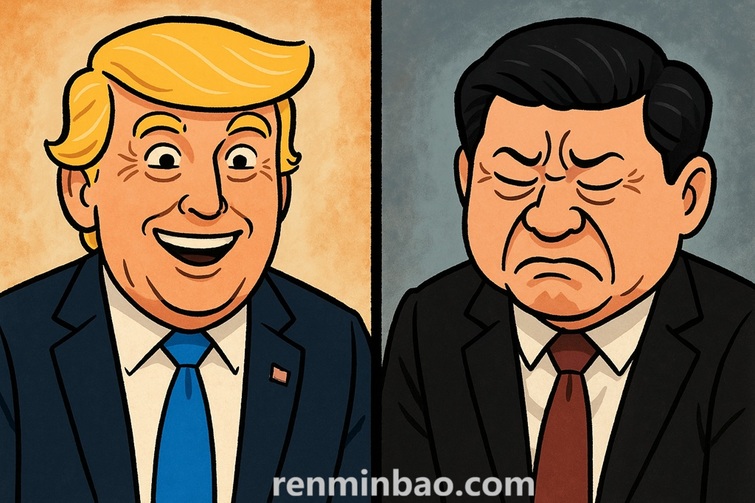
[People News] Recently, a rather humorous incident emerged on platform X. On March 28, a netizen was banned from Weibo after reposting a lecture by Professor Ai Zhi from the Central University of Finance and Economics titled 'How the National Economy is Influenced by a Pig?' which was delivered on March 24. This title, intended as a case study in agricultural economics, quickly turned into a sensitive term online.
The online community was abuzz with reactions, as many were confused and unable to grasp its significance. Netizens clarified that a university professor had previously attempted to use the term 'Winnie,' but it was repeatedly rejected during the review process, leading to widespread awareness of the term 'Winnie' throughout the entire teaching building.
Some recalled a classic joke from the former Soviet Union: A madman was running through Red Square, shouting, 'The General Secretary is a stupid pig!' Consequently, he was arrested by the KGB, and the court sentenced him to 25 years and 15 days in prison. The 15 days were for 'disturbing public order' and 'insulting the national leader,' while the 25 years were for 'leaking state secrets.'
What kind of influence does a pig really have? It should not be underestimated. Pork is not only a common ingredient in people's diets and an essential meat product, but its price fluctuations also serve as a crucial indicator for assessing the supply and demand of consumer goods, household consumption, the consumer price index, and the state of the agricultural industry chain. In essence, the price of pork can reflect the overall health of the macroeconomy; when pork prices rise, they can increase the food component of the consumer price index (CPI), potentially leading to broader inflationary pressures. Conversely, when pork prices fall, farmers face losses, leading to decreased incomes and negatively impacting rural consumption and economic growth. Additionally, pork prices are linked to feed prices, such as corn, which affects food security and related industries.
Over the past year, China's pig cycle has entered a challenging downward trend. As of March 2026, the price of live pigs has dropped below 10 yuan per kilogram, nearing the lowest levels seen in the past 15 to 20 years. Farmers are losing money on every pig they raise, and the entire industry has faced continuous losses for over 11 months, with major pig farming companies also reporting significant anticipated losses.
While the pig cycle mechanism appears to be functioning, it actually reflects a deeper picture of the mainland's macroeconomic decline and signals an accelerating recession. Xi Jinping's supply-side economic model has completely collapsed, and domestic demand stimulus policies have proven ineffective. The low benchmarks for living standards highlight a contraction in overall purchasing power and a collapse in consumer confidence. People in mainland China are struggling financially to the point where they can barely afford pork; even as pork prices continue to decline, they are still budgeting carefully and trying to eat less whenever possible.
Since the start of 2026, live pig prices have been on a downward trend. On March 26, the national average trading price for lean meat-type live pigs fell to 9.89 yuan per kilogram, reaching a near 15-year low. In some areas, prices have entered what is referred to as the '4 yuan era,' where a cup of inexpensive coffee can be exchanged for 2 jin of pork. Typically, March is a period when pork prices begin to recover, but this year has instead seen a significant drop in temperatures, leading to a freezing period for prices.
Data from the Ministry of Agriculture and Rural Affairs of the Communist Party of China indicates that in February 2026, the wholesale market price for pork was 23.73 yuan per kilogram, representing a dramatic 13.6% decline compared to the same month last year, marking eight consecutive months of decline. The price for live pigs was 12.82 yuan per kilogram, a staggering 19.9% drop year-on-year, and has been falling for 11 months in a row.
According to price data from the National Bureau of Statistics and China Animal Husbandry Network, domestic pig prices have previously fallen to around 10 yuan per kilogram in 2009, 2014, 2018, and 2021, with these lows occurring in cycles lasting approximately three to four years at the bottom of the pig price cycle. However, this situation is significantly different.
At the end of 2025, the national stock of breeding sows was reported to be 39.61 million. Some analysts estimate that the stock must decrease to 36.5 million for the domestic pig industry to reach a new supply-demand balance, which would indicate a turning point for pig prices. However, the current rate of reduction in sow capacity is noticeably slower than in 2021 and 2023. The timing of when this turning point will occur remains uncertain.
The decline in meat prices is detrimental to farmers. The aquaculture industry is currently experiencing its most challenging period in years, as rising feed costs create a severe double blow for farmers, contrasting with the falling prices of pork. Statistics indicate that the main price of soybean meal has risen by 7% this year, while corn prices have increased by over 5%. Recent data reveals that the pig-to-feed ratio has fallen below 4, hitting a low of 3.91:1, whereas the breakeven pig-to-feed ratio for the aquaculture sector should be around 6:1.
At present, farmers are incurring losses of between 280 to 350 yuan for each pig they raise. With the inverse fluctuations in pork and feed prices, these losses are expected to worsen. China has nearly 17 million pig farming entities, the majority of which are small to medium-sized farms, employing tens of millions of individuals directly involved in pig farming, transportation, slaughtering, and sales in related sectors. The slump in pork prices will have a direct impact on the income of these groups. Furthermore, even leading companies with better cost management are struggling; New Hope Liuhe is projected to report a loss of nearly 1 billion yuan, while Bright Food Group is facing its first loss in 15 years.
In sharp contrast to the supply side, the demand for pork is steadily declining. The share of pork in overall meat consumption has decreased from 62.1% in 2018 to 57.8% in 2025. The reduction in pork demand is influenced by macro factors such as an ageing population and declining birth rates, as well as the availability of substitutes like chicken, duck, and beef. Additionally, a decrease in consumers' purchasing power and willingness to spend is also a significant factor.
In essence, this situation is not merely a low cycle for pigs; it signifies a collapse in demand. People are even economising on cheap pork. Workers are experiencing salary cuts, and a high percentage are receiving no salary increases, resulting in significant employment pressure for the youth. Income expectations are continuously worsening, and consumer confidence remains low. While low pork prices should have stimulated demand, they have instead become a signal of economic transmission. Year-on-year, pork prices have dropped significantly, which has pulled down the Consumer Price Index (CPI). Given that pork prices hold substantial weight in the CPI, their fluctuations closely mirror the CPI. If the pork market is not managed properly, the CPI could spiral out of control.
The breeding industry on the mainland is losing hundreds of millions of yuan daily, with nearly 20 million farmers facing bankruptcy. This large group, suffering from low incomes, will severely impact overall consumption levels. Losses in the breeding sector lead to reduced consumption in rural areas, further contracting overall demand, which in turn drives pork prices down even more, resulting in greater industry losses and pushing the entire economy into a deadlock. Beyond the sluggish real estate market, multiple factors such as consumption, employment, and confidence are all weakening, creating a vicious cycle.
Thus, the national economy is being influenced and manipulated by 'a pig.' Some readers may have made puns or associations with this phrase. Indeed, since the Cyberspace Administration has banned it, isn't that an implicit admission of guilt?
Xi Jinping is deeply engrossed in dictatorial power and lifelong re-election, adept at political manoeuvring. He uses the guise of anti-corruption to conduct extensive purges and crackdowns, creating a pervasive atmosphere of fear among officials, leading to a chilling effect and collective inaction. To safeguard their positions, officials are hesitant to act, unwilling to take risks, and prioritise safety over ambition. In this high-pressure environment, local economic decision-making often aligns with political logic rather than market principles, and the blind expansion driven by political achievements accelerates industry involution.
Xi Jinping's crackdown on the real estate and private sectors has resulted in a dual slump in investment and consumption. The real estate sector, once a crucial engine for economic growth, has been prematurely retired. Meanwhile, massive investments in the chip and AI sectors consume vast resources but struggle to make an impact due to U.S. technological restrictions and a domestic speculative mindset.
Xi Jinping is personally overseeing and directing a return to a planned economy, discarding the principles of reform and opening up, rejecting market dominance, and obscuring property rights boundaries. His wolf warrior diplomacy, military expansion, and foreign trade dumping further worsen the external market environment, making it challenging for exports to fully counterbalance internal weaknesses while simultaneously heightening domestic economic uncertainty.
The metaphor of a single pig reflects not merely a simple cycle but a systemic decline. The political assets, economic vitality, and geopolitical resources accumulated over forty years of reform and opening up should not be repeatedly constrained and tormented by the notion of 'a single pig.'
(First published by the People News)△




News magazine bootstrap themes!
I like this themes, fast loading and look profesional
Thank you Carlos!
You're welcome!
Please support me with give positive rating!
Yes Sure!