
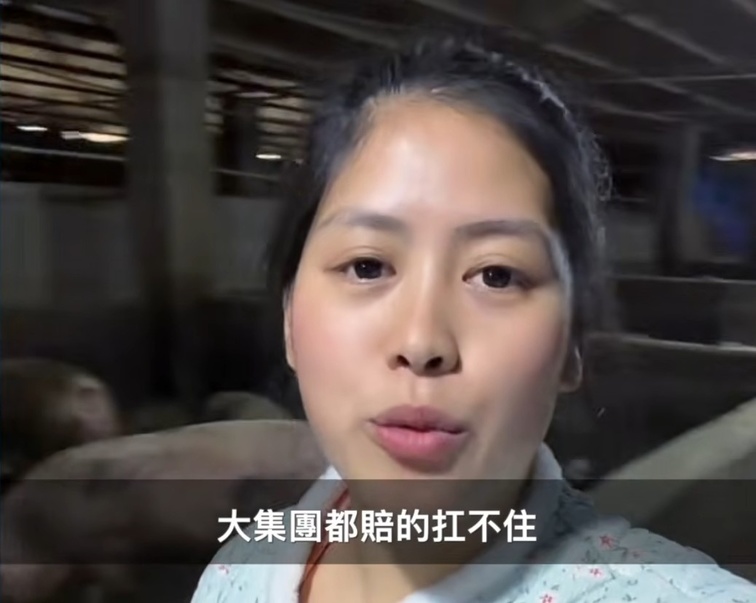
Even large pig farming enterprises are struggling to cope, while countless small and medium-sized pig farmers are on the brink of bankruptcy. (Video screenshot)
[People News] The price of live pigs in China has been declining for eight consecutive weeks, hitting a new low since 2019. Many pig farmers have taken to social media to express their frustrations, stating that in recent years, the government has aggressively 'supported' large pig enterprises through subsidies and loans. This has led to irrational expansion of production capacity, culminating in a surplus crisis that has caused significant losses across the industry, resulting in continuously plummeting pig prices and suffocating many small-scale farmers.
As reported by the Daily Economic News on April 3, data from the Ministry of Agriculture and Rural Affairs of the CCP, which monitored 500 county-level markets and collection points in China, revealed that in the fourth week of March, the national average price of live pigs was 10.68 yuan per kilogram, reflecting a month-on-month decrease of 3.3% and a year-on-year decrease of 29.8%.
Data from Hangqingbao, which provides data analysis and real-time market information in China, shows that on March 20, the average price of live pigs in China fell below 10 yuan for the first time, dropping to approximately 9.93 yuan per kilogram. By April 1, the average price of external three-breed live pigs in China was 9.38 yuan per kilogram, with Hainan province recording the lowest price at just 7.9 yuan per kilogram, making it the province with the lowest prices in the country.
Small and medium-sized farmers are heavily burdened with debt.
The price of live pigs continues to fall, pushing the pig farming industry into a state of loss. Xia Chenfeng, an analyst from Nongxin Digital Pig Industry, noted that the industry has now entered a phase of severe losses, affecting both individual farmers and large pig farming enterprises. According to calculations by Hangqingbao, as of the last week of March, under the self-breeding model, each standard weight live pig (approximately 120 kilograms) incurs a loss of over 300 yuan; under the purchased piglet model, losses exceed 200 yuan per head.
Many pig farmers in China have taken to social media, sharing tearful videos that highlight their struggles.
They express: "We feel that raising pigs has become incredibly difficult. Who is to blame? The large corporations, which use subsidies to suppress us small farmers. We genuinely care for our pigs, yet we are losing everything and drowning in debt; I truly can't bear it any longer."
"I lose my own money when raising pigs, but I wonder if capital groups lose their own money, too? After years of hard work, watching the market crash means all our efforts go to waste, and it’s truly painful."
"Fellow villagers, the price of pigs has dropped below 4 yuan, and raising pigs has become a deep loss. At 4 yuan per jin, this is the lowest price in history, with losses of 500 yuan per head becoming the norm. We feed them as if they were gold, but sell them like cabbage. We rise earlier than chickens, yet our losses are worse than anyone else's. In the past, raising pigs was a path to wealth; now, it leads to bankruptcy. The era of 4 yuan pig prices marks a doomsday for farmers. Don’t ask when prices will rise; first, ask how many more days we can survive. Is that reasonable?"
Since the influx of capital into the pig farming industry, there has been a reckless spending spree, land acquisition, and an aggressive push to increase production capacity. Even with severe overcapacity and significant losses throughout the industry, these companies have not taken steps to reduce production. This reckless expansion has resulted in many rural farmers losing their jobs, with some even facing total financial ruin. Capital in pig farming has substantial funding and requires a longer time to yield returns, as these companies aim to outlast their competitors, ultimately benefiting themselves. However, pig farming is a crucial source of income for farmers; if they stop raising pigs and farming, what alternatives do they have?
A critical warning: a significant crisis is about to hit the pig farming industry. Twenty-two major publicly listed pig companies are burdened with debts totalling 372 billion yuan. These industry giants are on the brink of a collective collapse. The amount of money burned in a single day could fund the construction of a building. Banks are constantly pressuring them to repay loans, and workers are fleeing as wages go unpaid. More alarming than African swine fever is the imminent breakdown of the capital chain. Given the current pork prices, these companies cannot survive for more than three months. At that point, it won't be a matter of mergers; rather, it will be a wave of companies collapsing under the weight of their debts. Initially, these groups aggressively acquired land at high prices and expanded production recklessly, but now they find themselves ensnared by their own actions.
The issue of overcapacity is closely tied to policy interventions.
According to market data and analyses from economists in early 2026, the drastic decline in pork prices in China, entering what is referred to as the '4 yuan era' (approximately 4-5 yuan per jin), is directly and inevitably linked to the overcapacity of large pig farming groups and the competitive pressures of scale.
In recent years, large pig farming companies such as Muyuan, Wen's, and New Hope have aggressively expanded their operations with the backing of capital and government policies. However, once overcapacity sets in, it becomes difficult to slow down production.
According to Chinese media statistics, the three major listed pig companies—Muyuan Co., New Hope, and Wen's Co.—experienced year-on-year sales growth in January this year, yet their revenues fell at the same time.
Data indicates that in the first two months of 2026, the output of 19 listed pig farming companies rose by nearly 10% compared to the same period last year. In the context of weak demand, this 'sell more despite losses' strategy is aimed at increasing market share, attempting to push out small and medium-sized farmers through economies of scale.
Media analyses suggest that large corporations, burdened with significant debt, must maintain cash flow and secure market share. As a result, even when they incur losses of 300 to 500 yuan for each pig sold, they cannot stop their production lines and continue to increase supply. This has directly caused the average price of live pigs to drop nearly 20% year-on-year, which in turn has negatively impacted national CPI data.
Some analysts have noted that government subsidies often favour large enterprises. These large groups rely on government support and low-interest bank loans to survive during periods of loss, while small and medium-sized farmers without such subsidies are going bankrupt. This scale-based subsidy logic inadvertently encourages large companies to maintain excess production capacity, leading to a breakdown in market mechanisms and delaying the recovery of pork prices.
Consumers are tightening their belts.
In addition to overcapacity, another significant factor contributing to the decline in pork prices is the shrinking demand.
The economic environment in China in 2026 remains sluggish, with unstable incomes for workers prompting them to be more budget-conscious regarding pork, a 'necessity.' The dietary habits of the younger generation are shifting towards chicken, beef, or plant-based alternatives, and the sharp decline in China's population due to the pandemic has further contracted the traditional pork market.
China's economy is in rapid decline, leading to a widespread collapse in pork prices, which are now entering a dark phase with projections indicating they will reach their lowest levels in nearly 20 years. The price of live pigs has dropped for eight consecutive weeks, and after standard pig prices fell into the 4 yuan range, they have continued to decline. With high production costs and low pork prices, pig farmers are in despair, effectively losing money on each pig they raise. The live pig market is trapped in a continuous downward trend. Analysts from pig purchasing companies identify two main reasons for the drop in pork prices: first, an oversupply due to pig farming groups recklessly expanding production capacity through loans; second, a lack of demand, as the pandemic has sharply reduced China's population, coupled with an economic downturn, decreasing per capita income, and high unemployment rates among young people. This has led to middle-aged and elderly individuals relying on their families for support, tightening their budgets, and hesitating to purchase meat. Consequently, pig farming groups are facing cash flow crises, leading to mass sell-offs that have triggered the collapse of pork prices.
There is a widespread belief that this round of pork price collapse is the result of both 'capital power' and 'policy direction'. Large pig farming enterprises, in their quest for market share, have engaged in irrational capacity expansion using their financial advantages. At the same time, the government's excessive subsidies have disrupted the natural process of market competition. However, the Chinese Communist Party will not acknowledge that its market interventions have contributed to the bankruptcy crisis facing millions of small and medium-sized pig farmers.
Some netizens have pointed out that in China, success is often credited to the Chinese Communist Party's "effective policy guidance," as seen in the case of Zhang Xue winning the championship. Conversely, failure—such as the collapse of pig prices or the real estate market—is typically blamed on "market fluctuations" or "the company's own violations." This dynamic, where "merit accumulates upwards while risks are distributed downwards," is the primary reason for the rampant mockery and criticism found in the comment sections. △







News magazine bootstrap themes!
I like this themes, fast loading and look profesional
Thank you Carlos!
You're welcome!
Please support me with give positive rating!
Yes Sure!