

The Strait of Hormuz. (Made by ChatGPT)
[People News] After the failure of U.S.–Iran negotiations, the flames of war in the Middle East have not subsided. On April 12, Israel launched airstrikes on the towns of Haniyah, Shaitiya, Bint Jbeil, and Siddiqin in the Tyre Governorate of southern Lebanon. Israeli forces also destroyed an explosives manufacturing laboratory in Tulkarm.
The U.S. Central Command issued an official announcement stating that, starting at 10:00 a.m. Eastern Time on April 13, the U.S. military would blockade maritime traffic to and from Iranian ports, including all Iranian ports located in the Arabian Gulf and the Gulf of Oman.
In an interview with Fox News, U.S. President Donald Trump explained the “all or nothing” blockade measures on the Strait of Hormuz, meaning that “if Iran sells oil… it will either sell all of it or none at all.” Trump also warned that any country—whether ally or adversary—must not circumvent the blockade.
On the same day, April 12, Trump posted a major announcement on Truth Social stating, “The U.S. Navy has begun clearing mines laid by Iran in the Strait of Hormuz. Any Iranian personnel who fire upon us or peaceful vessels will be met with overwhelming force! At the appropriate time, our military will completely destroy whatever remains of Iran!” Trump also revealed that countries such as the United Kingdom are dispatching minesweepers to the Strait.
Also on the 12th, U.S. Central Command posted images on its X platform showing U.S. Navy sailors preparing for nighttime flight operations within the Central Command’s area of responsibility.
Meanwhile, Iran’s Islamic Revolutionary Guard Corps issued a statement declaring that any warships approaching the Strait of Hormuz would be regarded as violating the ceasefire agreement.
All of this stems from the collapse of a 21-hour, all-or-nothing round of U.S.–Iran negotiations on April 11. That day, one of the key representatives in the talks, U.S. Vice President Vance, left Islamabad, Pakistan’s capital, stating, “Iran refused to accept the U.S. condition of not developing nuclear weapons,” before hastily boarding a plane and departing, leaving Pakistan’s president looking helpless.
The Iranian side blamed the breakdown of negotiations on “unreasonable demands” by the United States, stating that the U.S. “failed to earn Iran’s trust” during the talks.
Even more anxious and helpless than Pakistan is the Chinese Communist Party, whose prior efforts to mediate a ceasefire and promote negotiations have vanished like a wisp of smoke along with Vance’s departure.
Before this highly anticipated round of talks, Trump had stated that if negotiations failed, Iran would face even more severe strikes than before, “a hellish situation,” and be “bombed back to the Stone Age.” This further intensified Beijing’s anxiety and confusion.
China is Iran’s largest trading partner, and any blockade of goods entering and leaving Iranian ports would inevitably affect China. No country depends more on the Strait of Hormuz than China; nearly half of its oil imports pass through this international waterway. During wartime, Iranian authorities had granted special passage rights to vessels bound for China. However, now that control of the strait is in U.S. hands, the loss of oil supplies could become the final straw that breaks China’s already fragile economy.
China will not give up. On one hand, it seeks to continue promoting negotiations to prevent the Iran war from escalating; on the other hand, it is secretly supplying military equipment to Iran through third parties, hoping to use force to halt war, tie down the United States, and disrupt the global order.
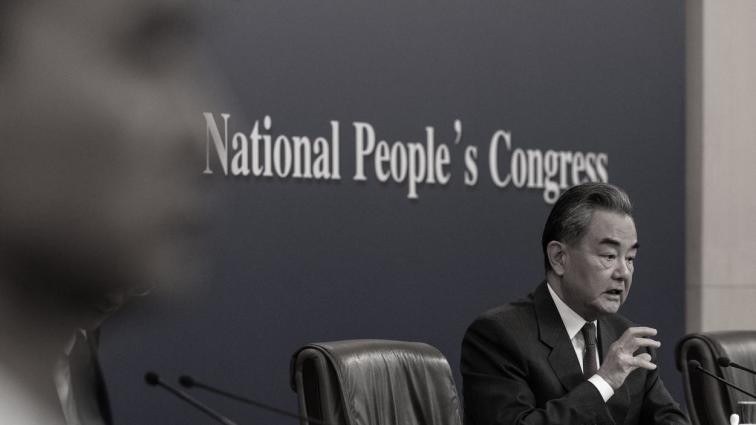
At the same time, China is preparing to abandon Iran if necessary, while moving to court North Korea, shifting the burden of dragging down the United States to this nuclear-armed, missile-launching country on the Korean Peninsula. Following the resumption of direct flights to Pyongyang last month, China acted preemptively: on the 10th, it sent Foreign Minister Wang Yi to Pyongyang to meet Kim Jong-un.
Why Is China Seeking Closer Ties with North Korea
High-level visits by Chinese leadership to North Korea have been rare in recent years. Since 2019, there has been little news of such engagement. This time, amid uncertainty over the U.S.–Iran conflict and at the sensitive moment before Trump’s planned visit to Beijing, Wang Yi’s high-profile meeting with Kim Jong-un emphasised “ironclad friendship” and strengthened strategic communication. Some scholars believe the visit aims to stabilise China’s influence over Pyongyang and secure it as a “buffer card.”
Wang Yi conveyed a message from Xi Jinping to Kim Jong-un, stating that in the face of the current “complex and turbulent international situation,” China and North Korea should strengthen communication and coordination on major international and regional issues—clearly implying this strategic intent.
Kang Jun-young, a professor at Hankuk University of Foreign Studies, believes the primary purpose of Wang’s visit was “to restore influence over Pyongyang, as China does not want to be marginalised on Korean Peninsula issues.”
Lin Chih-hao, an assistant researcher at Taiwan’s Institute for National Defence and Security Research, analysed in an interview with The Epoch Times that “after the United States successively dealt with Venezuela and Iran, China and North Korea share common security concerns regarding potential U.S. military threats.”
He pointed out that during the U.S.–Iran conflict, North Korea has taken a rare “low-profile stance,” offering no clear support or assistance to Iran. This may indicate that North Korea is leaving room for future U.S.–North Korea talks. He added, “The United States may bypass North Korea and directly target China, which would be unfavourable for Beijing. China needs a pro-China North Korea.”
Analysts believe that in late March, North Korea announced the removal of socialist terminology from its constitutional name, indicating that it recognises the global decline of communist ideology. Moving closer to the U.S. and Europe while distancing from China and Russia may be the future trend. Considering that the U.S. reportedly took one day to strike Venezuela and one month to severely damage Iran, while Russia has spent four years in a stalled war with Ukraine, the global balance of power appears obvious. Choosing to align with the strong over the weak is a natural instinct. Sensing this shift, China has rushed to reassure its ally, fearing that after losing Iran, it may also lose North Korea.
Of course, China has not yet abandoned Iran. In addition to continuing to promote negotiations, it also hopes Iran can effectively counter U.S. and Israeli actions. Iran has also learned a tactic from China—delay—thus, after the failure of negotiations, Iranian officials stated that a ceasefire cannot be achieved in a single round of talks.
Earlier, Iranian media claimed that after a pause in consultations, peace talks were expected to resume on the 12th. △



News magazine bootstrap themes!
I like this themes, fast loading and look profesional
Thank you Carlos!
You're welcome!
Please support me with give positive rating!
Yes Sure!