

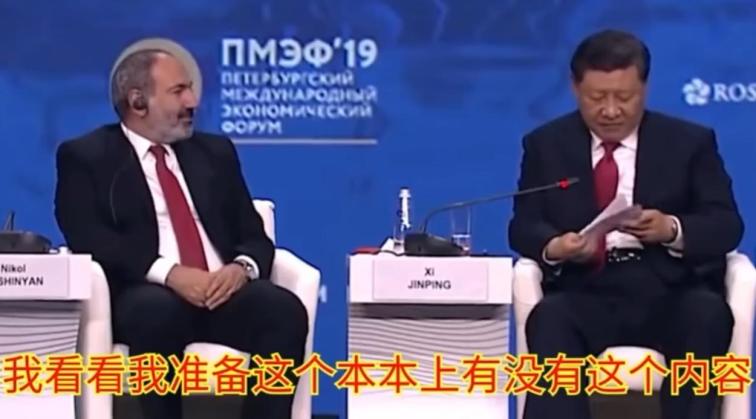
The height of Xi Jinping, the leader of the Chinese Communist Party, is considered a state secret. (Video screenshot)
[People News] After assuming office, Kuomintang Chairman Zheng Liwen has been keen to visit Beijing to meet with Chinese Communist Party leader Xi Jinping, and she finally achieved this goal on April 10. Nakazawa Katsuji, a long-time correspondent for the 'Nihon Keizai Shimbun' and a member of its commentary committee, previously wrote an article titled 'The Chaos in the Chinese Military Forces Xi Jinping to Meet Zheng Liwen in a Hurry: The Truth and Fiction of Taiwan's Military Invasion'. He pointed out that amid the turmoil within the People's Liberation Army and the international pressure from U.S. President Trump on Iran, Beijing is currently fostering an atmosphere of reconciliation with certain factions in Taiwan, emphasising that the '1992 Consensus' regarding 'One China' is of utmost importance.
According to a report by New Head Shell, Nakazawa Katsuji cited an expert familiar with cross-strait relations, who noted that 'the seemingly unrelated chaos within the (Chinese) military and the rushed arrangement of the Xi Jinping-Zheng Liwen meeting are actually two sides of the same coin. In fact, they are the same coin.'
The article mentioned that during Xi Jinping's meeting with Zheng Liwen, one could identify the faces of the senior military officers present to listen to Xi Jinping's speech. It was evident that the highest-ranking generals who had been on stage not long ago were now absent. These individuals were field commanders and political commissars from various military branches, and they have either been purged or are currently unaccounted for.
While there are some lower-ranking generals available to fill these positions, effective command requires extensive training and combat experience. Establishing a military system for invading Taiwan on short notice is a challenging task.
While a blockade strategy might be viable, the challenges of landing and invasion are exceedingly high. A sudden pivot towards what is termed military unification is neither realistic nor carries excessive risk. The recent U.S. attacks on Iran have underscored the vast disparity in military technology between China and the United States, leaving Xi Jinping and the military in a state of shock.
Katsumi Nakazawa has noted that the turmoil within the Chinese Communist Party's military coincided with Zheng Liwen's visit to China.
A review of the timeline reveals some intriguing details. Zheng Liwen, who was previously underestimated, was elected chairman of the Kuomintang on October 18, 2025. Just a day prior, on October 17, the Ministry of National Defence of the Communist Party of China announced the removal of party duties for nine officials, including He Weidong, the vice chairman of the Central Military Commission, which holds ultimate decision-making authority over military actions.
On October 19, Xi Jinping sent a congratulatory message to Zheng Liwen, who had just been elected as the Kuomintang chairman. Following this, on October 20, the Fourth Plenary Session of the Central Committee of the Communist Party of China convened in Beijing, with the purging of the military being the primary political agenda.
Coincidentally, significant changes also unfolded in Japan's political scene that same October. Sanae Takaichi was elected president of the ruling Liberal Democratic Party, making her Japan's first female prime minister. Notably, Xi Jinping did not extend a congratulatory message to Takaichi.
In summary, in October 2025, the Chinese Communist Party was embroiled in a fierce power struggle within the military, leaving it unable to launch an immediate military invasion of Taiwan. Meanwhile, in Taiwan, the pro-China faction led by Zheng Liwen emerged as the party leader. This unexpected turn of events also presents opportunities that, if not seized, would be a grave mistake.
The article highlights that leveraging Zheng Liwen to buy time is the only logical option. The aspiration for China's peaceful reunification with Taiwan remains strong, and the hope for its realisation persists. The meeting between Xi Jinping and Zheng Liwen serves as an effective means to communicate this message both domestically and internationally.
This year, the Chinese Communist Party's military has encountered significant challenges. On January 24, Xi Jinping's former ally and senior general Zhang Youxia was unexpectedly announced to be under 'investigation' and subsequently lost his position. Around the same time, the Xi Jinping administration made a crucial decision to invite Zheng Liwen to visit China. The turmoil within the Chinese Communist military and the coordination for Zheng Liwen's visit occurred concurrently.
The visit of U.S. President Trump to China, initially planned for the end of March, was postponed to mid-May due to U.S. military actions against Iran at the end of February. As a result, Zheng Liwen's visit to China was also delayed until April.
Nakahara Katsuji noted that the U.S. military actions against Iran also influenced the meeting between Xi Jinping and Zheng Liwen. This significant event appears to have been largely overshadowed on the international stage. It coincided with extensive media coverage of the U.S.-Iran ceasefire negotiations in Pakistan, which captured global attention and obscured the event.
Nevertheless, for the Xi Jinping government, fostering a reconciliatory atmosphere with certain factions in Taiwan and referencing the '1992 Consensus' on 'One China' is essential. This is because it will take time to fully address the internal turmoil within the Chinese Communist military and to rebuild its structure. The previously highlighted potential for a direct military invasion of Taiwan by the Chinese military remains difficult to verify in the short term. △





News magazine bootstrap themes!
I like this themes, fast loading and look profesional
Thank you Carlos!
You're welcome!
Please support me with give positive rating!
Yes Sure!