
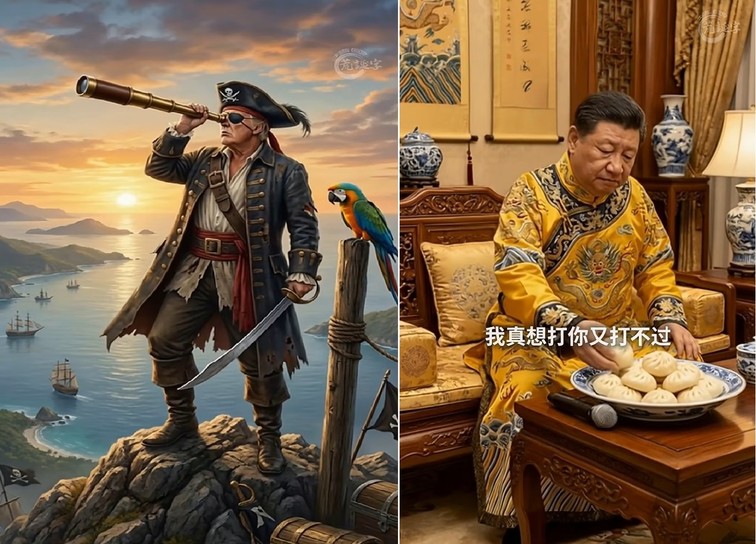
The humorous song "Trump Trump, I'm So Sad". (Video Screenshot)
[People News] On April 19, the U.S. Navy seized the Iranian-flagged cargo ship 'Tuskah' in the Gulf of Oman. The vessel had set sail from Zhuhai Gaolan Port in China and is suspected of carrying rocket propellant precursors. It attempted to evade the U.S. Navy blockade at full speed, heading directly towards Iran's Abbas Port.
However, the situation did not unfold as intended. After issuing warnings for six hours, a U.S. destroyer opened fire, and the Marine Corps boarded the ship to take control. The swift and public nature of this action sent a clear message to Beijing: you have overstepped your bounds regarding the Iran issue and crossed a U.S. red line.
Just after Xi Jinping assured Trump that China had never sent supplies to Iran, he was caught red-handed, much like a student caught cheating immediately after the proctor announced the exam rules.
In the U.S.-Iran conflict, the Chinese Communist Party has acted as a behind-the-scenes manipulator for Iran, raising the cost of war for the U.S., prolonging the conflict, and allowing Iran to continue to survive, thus increasing the risks and uncertainties of the war. Through the 'Tuskah' incident, the U.S. has firmly demonstrated to the world the disreputable role that the Chinese Communist Party plays behind the scenes, providing Trump with another card to play. Trump is set to visit China in mid-May, which is likely to cast a shadow over the upcoming Xi-Trump meeting.
What actions will Trump take next? While he won't directly overturn the table, he will work to expand America's advantages. There are four main strategies he might employ. The first is targeted sanctions, which would involve directly identifying Chinese companies, supply chain nodes, and even relevant research institutions, leading to the issuance of a negative list. Financial sanctions would follow, prompting global banks and insurance companies to avoid involvement. The second strategy is to broaden technology restrictions, focusing on Chinese chemical materials, propellant formulations, and dual-use technologies related to aerospace. This would involve strict export controls, effectively locking out any equipment and software that could be associated with these areas. The third approach is to cool diplomatic relations by postponing meetings between heads of state and high-level visits, reducing the frequency of interactions, and even publicly calling out China in multilateral settings, thereby constricting the operational space for the adversary. Lastly, he may consider imposing a 50% tariff on certain Chinese goods, further complicating the economic situation for China.
Moreover, the U.S. military's enforcement actions regarding ship detentions have significantly escalated tensions in the Strait of Hormuz. This strait is a crucial passage for over 20% of the world's oil transport, often described as the global oil choke point. According to the latest report from Fitch Ratings, if the strait remains closed, China's GDP growth rate for 2026 could drop sharply from the initial forecast of 4.3% to 3.8%.
This shift in figures represents a significant adjustment, indicating that the already weak domestic demand, fragile real estate sector, and surplus supply chains of the Chinese Communist Party (CCP) will be severely impacted by external energy shocks. Xi Jinping's (Xi Jinping) strategic partnership with Iran was intended to counterbalance the United States, but it has instead led him into a perilous situation, with the economy rapidly deteriorating and diplomatic crises escalating, leaving little room for manoeuvre.
The U.S.-Iran conflict has created uncertainty in global energy supply, trade, and demand, particularly exerting substantial external pressure on China. The free navigation of the Strait of Hormuz is crucial for the CCP's economy. If the recovery of oil transportation and regional logistics is slower than anticipated, Fitch's report includes this risk in a negative scenario: if the Strait of Hormuz remains closed until the end of the second quarter of 2026, China's economic growth rate could fall from 4.3% to 3.8%.
Fitch's predictions are not without basis; the closure of the Strait of Hormuz would lead to increased prices for crude oil, naphtha, and liquefied petroleum gas. As the world's largest crude oil importer, China depends on Middle Eastern shipping routes for over 70% of its oil. Should the strait be blocked, import costs would surge, with the chemical industry being the most affected. Fitch specifically notes that 'the chemical industry warrants close attention,' as rising raw material costs and constrained capacity utilisation will particularly impact producers that rely on imports and lack vertical integration. The downstream oil and gas sectors are also facing pressure on profit margins.
The situation is even more dire, as this is not merely a short-term fluctuation but a condition that further ensnares the Chinese Communist Party's (CCP) economy in systemic issues. Fitch Ratings has indicated that the Chinese government's policy mix 'may continue to favour the supply side over the demand side,' which compresses the recovery potential for household spending. Measures aimed at boosting consumption 'may only have a minimal impact,' while policies for industrial upgrading and manufacturing support could result in capacity expansion outpacing improvements in demand, thereby increasing debt pressure and undermining corporate pricing power.
The real estate sector continues to be the largest burden on the CCP's economy. Fitch forecasts that sales of commercial residential properties will drop by 7% to 8% in 2026, with loose policies 'producing only weak and uneven outcomes.' Domestic demand is already sluggish, and the impact of external oil price shocks will collectively pressure household spending, corporate investment, and export competitiveness. A growth rate of 3.8% signifies a substantial reduction in the annual economic increment, leading to a collective surge in unemployment pressure, debt risks, and local fiscal crises.
Why has Xi Jinping found himself in this predicament? The fundamental issue lies in strategic misjudgment and the dangerous amplification of economic vulnerabilities.
The first issue is a strategic miscalculation. Beijing believes that supplying dual-use military and civilian materials to Iran through grey zones is a common tactic that can sustain Iran's role as a Middle Eastern proxy, and that the United States is powerless to intervene. Similar to the Russia-Ukraine conflict, where the Chinese Communist Party (CCP) has secretly supported Russia for a long time, what can the world do? However, Xi Jinping has misjudged the situation this time; the United States is not NATO Europe, and Trump is a leader who takes action. Xi underestimated the U.S. resolve to confront Iran and failed to recognise that this move is a carefully calculated strategy aimed directly at the CCP. The risk in the Strait of Hormuz has sharply increased; if Beijing continues to back Iran, it is essentially wagering its own economic lifeline. Conversely, if it backs down, it would publicly admit to a failure in its Middle Eastern policy, leaving Xi Jinping in a difficult and frustrating position.
The second issue is the structural weakness of the CCP's economy. China's economy has long been trapped in a cycle of insufficient demand, excess supply, severe deflation, and high debt. Fitch has repeatedly highlighted the CCP's 'weak domestic demand,' which is rooted in sluggish income growth, lack of consumer confidence, a collapsing real estate market, and an inequitable distribution system. This situation reveals the systemic flaws in the CCP's economic model, which heavily relies on external energy and key technologies while navigating grey areas, lacking strategic buffers. Previously, it benefited from being the 'world's factory + low cost,' but now, with a tightening external environment and internal instability, any geopolitical friction could trigger an economic black swan event. Any external disturbance is akin to pouring gasoline on a fire and adding snow to the frost.
The third issue is the geopolitical crisis. The Chinese Communist Party has raised the Iran and Middle East issues to the level of core interests in its rivalry with the United States, and the crisis in the Strait has now become a tangible threat. Abandoning Iran would signify a strategic retreat and a decrease in international influence; conversely, maintaining a hardline stance risks failing to meet the 5% economic growth target, thereby accelerating Xi Jinping's governance crisis.
The true danger of this situation extends far beyond a single ship or a strait.
In the international spotlight, Xi Jinping has found himself in a precarious position, pushing the Chinese Communist Party's economy to the edge of catastrophe. If the Strait of Hormuz were to remain closed, a GDP growth rate of 3.8% would not merely be a figure, but a source of hardship for the populace and a societal tragedy. The real threat has never been the United States seizing a ship, but rather the critical disconnect between Beijing's global strategy and its economic support system. Confronted with this self-created trap, Xi Jinping is likely to face an even deeper quagmire.
(First published by the People News) △





News magazine bootstrap themes!
I like this themes, fast loading and look profesional
Thank you Carlos!
You're welcome!
Please support me with give positive rating!
Yes Sure!