
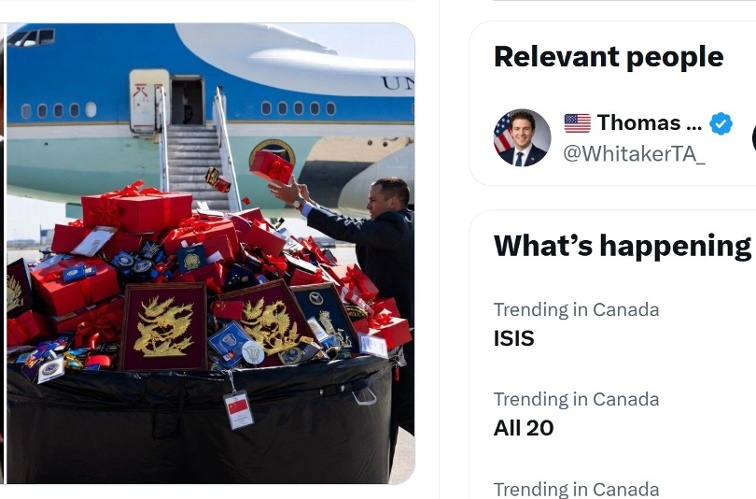
Before departing from China, American staff discarded all gifts received from China into the trash. (Reproduced from X platform)
[People News] U.S. President Trump has wrapped up his whirlwind visit to China. While Trump publicly referred to Xi Jinping as a 'great leader' and a 'friend', asserting that U.S.-China relations would be 'better than ever', the actions of the American staff revealed their true sentiments: White House personnel disposed of all gifts from the Chinese Communist Party in the trash before boarding Air Force One. This manoeuvre by Trump has humiliated the Chinese Communist officials who enjoy special provisions, leaving them embarrassed and unable to voice their feelings, forced to suppress their frustration.
The Chinese Communist Party's 'special provision' system is an exclusive supply network that provides high-ranking officials and select groups with high-quality living materials and services that are typically not made public. Given the numerous food safety crises in China, including incidents of counterfeit goods and excessive additives, the food served in official canteens and through the special provision system is subject to rigorous inspections and exclusive logistics channels to ensure the utmost safety and quality of the ingredients. During Trump's visit to Beijing, he remained highly vigilant in the face of a dictatorial regime where 'party and state cadres' consume special provision food, the state apparatus closely monitors public opinion, and citizens are encouraged to 'catch spies'.
A U.S. journalist who accompanied Trump on his visit to China reported that White House staff collected all items distributed by Chinese Communist Party officials before boarding Air Force One and disposed of them in the trash, citing a policy that "no items from China are allowed on the plane." This action underscores the U.S.'s complete distrust of the Chinese Communist Party. It’s striking to think that before even leaving the 'friend's' home, all gifts from the 'friend' are discarded right in front of them. What does this attitude convey—friendship or enmity? The answer is obvious.
On Friday (May 15) at 2:30 PM, Emily Goodin, a reporter for the New York Post, posted on X that prior to boarding Air Force One, U.S. staff confiscated all items distributed by Chinese Communist Party officials, including identification documents, delegation badges, and the 'burner phones' provided by the White House.
Goodin noted on X that they "threw these items into the trash" before takeoff, emphasising that "no items from China are allowed on the plane."
Following the post on X, it quickly received thousands of likes, retweets, and interactions.
Fox News previously reported that during President Trump's visit to China, most of his entourage would leave behind their regular electronic devices, such as smartphones, opting instead for simplified 'clean' devices, temporary laptops, and tightly controlled communication systems. This approach aimed to significantly reduce the risk of U.S. officials being monitored, hacked, or having their data compromised while in China.
According to The Epoch Times, Bill Gage, a former Secret Service agent and the current head of the protection department at Safehaven Security Group, remarked, 'China is a massive surveillance state.' He noted that briefings provided to U.S. officials clearly indicate that 'everything is being monitored' in China.
Earlier, The New York Post reported that during Trump's visit to China, he and all accompanying personnel were advised against using personal devices to safeguard their data from potential hacking.
Cybersecurity experts have analysed that these precautions reflect the U.S. assessment of the high risks associated with China's cyber environment, suggesting that any electronic device and connection could be vulnerable to monitoring or infiltration.
Moreover, at the banquet organised by the Chinese Communist Party for Trump's team, while the public interaction between the two sides appeared cordial, security measures remained stringent. Footage from the event revealed that Xi Jinping's wine glass was served by Chinese staff, whereas Trump's wine glass was delivered by American staff.
Speculation from observers suggests that both sides may be attempting to prevent each other from poisoning and are avoiding contact with each other's wine glasses to prevent leaving fingerprints or DNA.
Historically, there is a saying, 'When two countries are at war, do not harm the envoy,' which is a traditional military and diplomatic principle indicating that warring parties should not harm or kill the messengers conveying information. However, the open display of mutual suspicion regarding poisoning or sabotage between the leaders of the U.S. and China highlights a complete lack of trust between the two nations.
The openly antagonistic demeanour of the staff from both sides was also accurately captured by cameras.
On May 14, when Trump arrived at the Temple of Heaven in Beijing for a visit, Chinese security personnel forcibly confined the White House press corps in a small room. A Fox News reporter accompanying Trump’s trip to China disclosed that in the backdoor area of the Temple of Heaven event, Chinese officials prevented a U.S. Secret Service agent from bringing a weapon into the venue, which escalated tensions immediately. This led to a fierce physical confrontation between the U.S. Secret Service and Chinese police, all of which was captured on camera. The rude treatment of U.S. personnel by Chinese security clearly indicates that they do not view the U.S. personnel as 'friends' at all. So, does Trump genuinely consider Xi Jinping a 'friend'?
Chinese affairs expert Chen Pokong told The Epoch Times that the level of security from the U.S. side during Trump’s visit to Beijing was unprecedented, highlighting the extreme distrust between the U.S. and China, with significant potential hostility on both sides. The meeting was merely intended to ease relations and prevent any accidental conflicts.
Bill Gage, president of Safehaven Security Group and a security expert, remarked that these measures reflect how the U.S. government perceives the Chinese cyber environment as 'highly guarded,' where any equipment could potentially be monitored or infiltrated.
Many netizens have passionately discussed that discarding items gifted by the Chinese Communist Party is 'the right thing to do,' insisting, 'It definitely should be thrown away because they are likely equipped with listening devices; gifts exchanged between each other always contain listening devices, this is common sense.'
'No matter how friendly the surface may seem, it does not change the fact that the U.S. views China as the highest cyber threat environment, concerned that any Chinese items may contain listening devices, tracking chips, or malicious software.'
It is preferable to err on the side of caution rather than risk allowing Air Force One to carry potential threats.
Such hidden geopolitical concerns are not visible to the public eye. In contemporary diplomacy, even a commemorative badge may be considered a potential cybersecurity asset.
(First published by People News)





News magazine bootstrap themes!
I like this themes, fast loading and look profesional
Thank you Carlos!
You're welcome!
Please support me with give positive rating!
Yes Sure!